Wondering how does Fiverr Pro verification actually works? This in-depth guide breaks down every step of the process, from invitation to approval, plus tips to boost your chances.
If you have spent any real time browsing Fiverr, you have probably noticed a small badge next to certain sellers’ names that simply says “Pro.” It looks unassuming, but that little label carries a lot of weight. It tells a buyer, at a glance, that the person behind the gig has already been screened, checked, and approved by Fiverr’s internal team before they were ever allowed to use it.
That badge doesn’t come easily. Unlike a Level 1 or Level 2 seller badge, which you earn automatically by hitting order counts and rating thresholds, Fiverr Pro status is handed out through a completely different system: manual, human-led verification. There is no algorithm quietly upgrading your account overnight. A real person on Fiverr’s vetting team looks at your work, your history, and sometimes even talks to you directly before a decision is made.
In this guide, we are going to walk through exactly how that verification process works from the very first invitation to the moment the badge appears on your profile. We will also cover what Fiverr’s reviewers are actually looking for, how long the process tends to take, why applications get rejected, and what you can do to put your best foot forward if you are hoping to join the Pro roster yourself.
Table of Contents
What Is Fiverr Pro, Exactly?
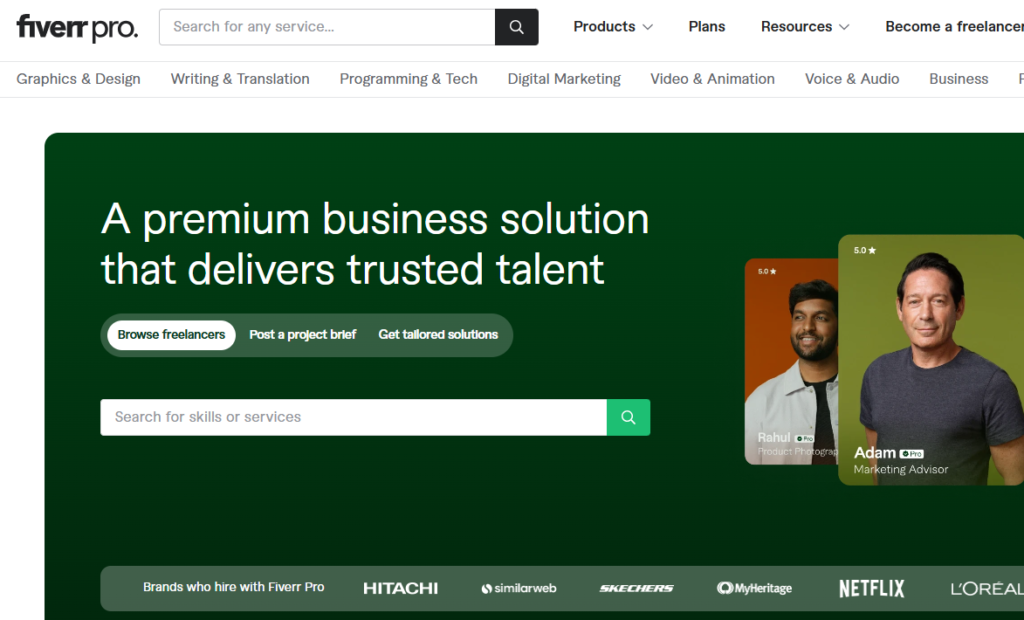
Before diving into the verification steps, it helps to understand what Fiverr Pro is actually for. Fiverr Pro is a curated tier of the marketplace built specifically for business clients who need dependable, agency-quality work and are willing to pay accordingly. Instead of scrolling through thousands of gigs with wildly different price points and quality levels, Pro buyers see a smaller, pre-screened pool of freelancers who have already proven their professional credentials.
For freelancers, this means two things. First, competition inside the Pro catalog is far lighter than in the standard marketplace, since only a small percentage of applicants ever make it in. Second, the buyers who shop in the Pro section tend to have real budgets and are not there to negotiate a $10,000 branding project down to $50. That combination is exactly why so many experienced freelancers want the badge, and why Fiverr keeps the entrance so tightly controlled.
Why Fiverr Bothers Verifying Pro Sellers at All
It would be far easier for Fiverr to let anyone slap a “Pro” label on their profile and call it a day. So why go through the trouble of building an entire vetting pipeline?
The short answer is trust. Fiverr’s biggest challenge as a marketplace is convincing large companies and serious buyers that the freelancer they are about to pay thousands of dollars actually has the skills to deliver. Standard reviews and star ratings only go so far, especially since anyone can accumulate five-star reviews on small, low-stakes gigs. Verification exists to filter out sellers who are good at gaming the review system but lack the professional-grade experience that enterprise buyers expect.
By manually reviewing portfolios, work history, and sometimes conducting live conversations with applicants, Fiverr is essentially acting as a talent agency rather than a simple listings site. That extra layer of human judgment is what allows the platform to charge premium prices and attract corporate clients who would otherwise never consider hiring a freelancer off the open internet.
How Fiverr Pro Verification Works: The Full Step-by-Step Process
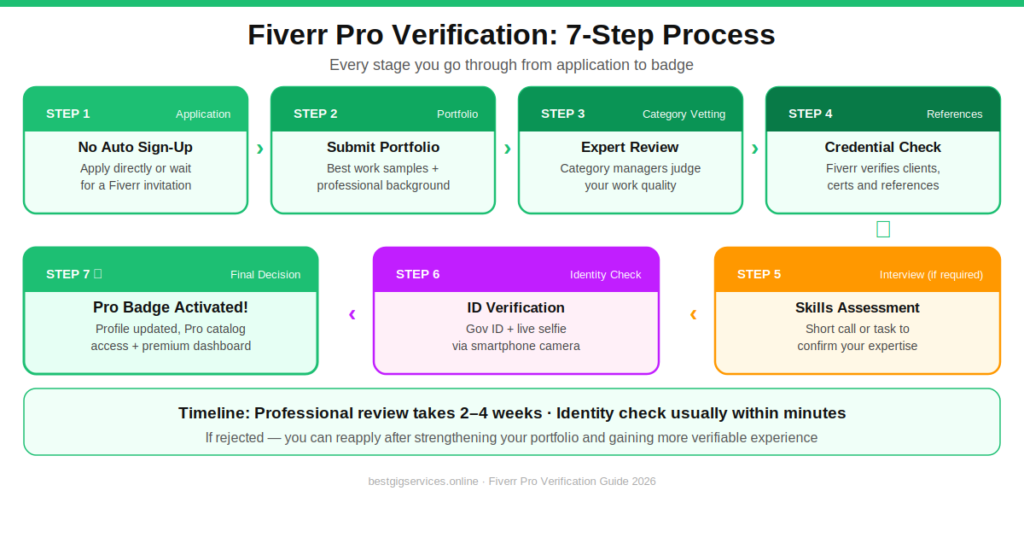
Here is the process broken down into the stages that most applicants go through, based on how Fiverr’s Pro program is currently structured.
Step 1: You Cannot Simply Sign Up for Pro Status
The very first thing to understand is that Fiverr Pro is not a subscription you purchase or a checkbox you tick in your account settings. There are two main paths into the program:
- Direct application: Fiverr allows freelancers to apply for Pro status through a dedicated application page, where you submit your details for review.
- Fiverr-initiated invitation: In some cases, Fiverr’s team identifies promising sellers based on their marketplace performance, professional background, or industry reputation, and reaches out proactively.
Either way, nobody is automatically enrolled. Even sellers with thousands of five-star reviews on the regular marketplace still have to go through the same application and review pipeline as everyone else.
Step 2: Submitting Your Application and Portfolio
Once you start the application, you will be asked to fill out a detailed form covering your professional background. Expect to provide information such as:
- Years of hands-on experience in your specific field (design, writing, development, marketing, video, and so on)
- Formal education, certifications, or specialized training relevant to your niche
- A curated portfolio showcasing your strongest, most representative work
- Notable clients, agencies, or companies you have worked with
- Links to external work samples, case studies, or a personal website, if available
This is the stage where quality matters far more than quantity. Fiverr’s reviewers are not counting how many projects you have completed; they are judging whether your best work would hold up next to an agency’s portfolio. A handful of outstanding, well-documented projects will always beat a long list of average ones.
Step 3: Category-Specific Vetting by Fiverr’s Internal Team
After your application is submitted, it lands in the queue for the category you applied under, whether that is graphic design, copywriting, web development, SEO, video editing, or one of the dozens of other Pro categories. This matters because the standards are not one-size-fits-all. A copywriter’s application is judged by different benchmarks than a web developer’s.
Category managers, who understand the specific craft and industry standards, review your submission. They are essentially asking one core question: would this person’s work meet the expectations of a paying business client, not just a budget-conscious individual buyer?
For creative fields like design, reviewers typically look for agency-level polish and work for recognizable or credible clients. For writing, they look for publication credits, enterprise content experience, or a portfolio that demonstrates strong command of tone, structure, and research. For development, they look at the complexity of past projects and whether the outcomes can be verified.
Step 4: Reference and Credential Checks
Depending on your category and the strength of your initial submission, Fiverr may look into the references, testimonials, or client relationships you listed. This does not necessarily mean they will call every client you mention, but verifiable, well-known relationships carry noticeably more weight than vague claims of “worked with several Fortune 500 companies” without any way to confirm it.
If you list certifications, formal education, or professional memberships, these should be genuine and, where possible, easy to verify. Reviewers are experienced at spotting embellished resumes, and inconsistencies here can quickly sink an otherwise strong application.
Step 5: Possible Interview or Skills Assessment
For some categories, the process includes a short conversation with a member of Fiverr’s Pro team, or a brief skills-based assessment. This is not universal for every applicant, but when it happens, it usually serves as a final gut check to confirm that the person behind the application is who they claim to be and can speak knowledgeably about their own work and process.
Think of it the same way you would think about a job interview. You are not just proving that your portfolio pieces exist; you are demonstrating that you can talk through your decisions, your workflow, and how you handle client relationships.
Step 6: Identity and Account Verification
Running parallel to the professional vetting, Fiverr also requires standard identity verification for anyone joining a premium program like Pro. This typically involves:
- Uploading a clear photo of a valid, unexpired government-issued ID (a passport, driver’s license, or national ID card)
- Taking a live selfie through your smartphone camera so Fiverr’s verification software can match your face to the ID photo
- Confirming personal or business details such as your legal name, address, and, in some regions, a registered business number
This identity check exists for security and regulatory reasons rather than as a measure of your skill. It helps Fiverr maintain a trustworthy marketplace, comply with financial regulations, and, in certain regions, meet legal requirements such as the EU’s Digital Services Act. It is worth noting that screenshots or digital copies of your ID are not accepted; the system requires a live photo taken directly through your device’s camera.
Step 7: Final Decision and Badge Activation
Once the professional review, any reference checks, and identity verification are all complete, Fiverr’s team makes a final call. If approved, your profile is updated with the Pro badge, and you gain access to the Pro seller dashboard, the curated Pro catalog, and onboarding resources designed to help you set up your first Pro gig correctly.
If you are not approved, that is not necessarily the end of the road. Many freelancers apply more than once after strengthening their portfolio, gaining more verifiable experience, or addressing whatever gap held them back the first time.
How Long Does the Verification Process Take?
Timelines vary depending on your category, how complete your application is, and current application volume, but most applicants can expect the professional review stage to take somewhere in the range of two to four weeks. Identity verification, on the other hand, is usually much faster and can often be completed within minutes once you have your ID and a working camera ready, assuming there are no technical hiccups.
If your application requires an interview, additional documentation, or reference follow-ups, the timeline can stretch out further. Patience matters here. Chasing up support repeatedly rarely speeds up a manual review process that depends on a real person’s schedule.
What Fiverr’s Reviewers Are Really Looking For
It helps to think about this from the reviewer’s perspective. They are not trying to catch you out; they are trying to protect the credibility of the Pro badge for buyers who are about to spend real money based on it. With that in mind, here is what tends to move the needle:
- Verifiable professional experience, ideally from agency work, enterprise clients, or a well-documented independent career, not just Fiverr order history
- A portfolio that could pass a real job interview in your field, showing range, technical skill, and consistent quality
- Clear, professional communication throughout the application and any interview stage
- Honest, accurate information, since inflated claims or unverifiable credentials are one of the fastest ways to get rejected
- A track record that fits the specific category you are applying under, rather than a generic “I do a bit of everything” application
Common Reasons Applications Get Rejected
Understanding why applications fail is often more useful than knowing what success looks like. Some of the most frequent stumbling blocks include:
- Relying only on Fiverr performance metrics. A seller with hundreds of five-star reviews but no professional background outside the platform is often less competitive than someone with a smaller Fiverr history but a strong agency or corporate résumé. Reviewers are vetting professional credentials, not marketplace popularity.
- A weak or inconsistent portfolio. Submitting a mix of strong and mediocre work dilutes the overall impression. Curate ruthlessly and only include your best pieces.
- Unverifiable claims. Naming clients or companies that cannot be confirmed, or listing credentials that do not check out, damages trust immediately.
- Applying in the wrong category. If your strongest work is in brand identity design but you apply under UI/UX design, the mismatch can hurt your chances even if you are talented.
- Incomplete applications. Skipping optional fields like education, certifications, or client references removes opportunities to strengthen your case.
- Failed identity verification. Technical issues, blurry photos, expired documents, or using a screenshot instead of a live photo can stall or derail the process entirely.
The Benefits of Becoming a Verified Fiverr Pro
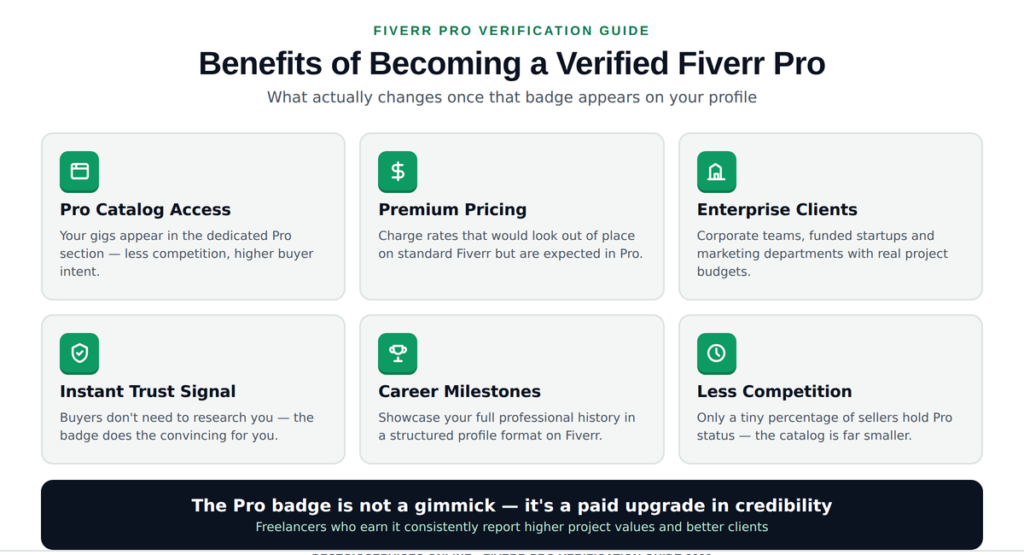
Going through this process is not a small commitment, so it is worth understanding what you actually gain once you are approved.
- Access to a dedicated Pro catalog that puts your gigs in front of buyers who have specifically filtered for vetted, professional-grade talent
- The ability to charge premium rates that would look out of place in the standard marketplace but are expected and accepted in the Pro space
- Exposure to higher-budget clients, including enterprise teams, funded startups, and marketing departments with real project budgets
- A visible trust signal on your profile that shortcuts the usual process of convincing a stranger online that you are worth hiring
- Career-milestone features on your profile that let you showcase your professional history in a more structured way than a standard bio
Practical Tips to Strengthen Your Fiverr Pro Application
If you are planning to apply, a little preparation goes a long way. Here are some practical steps worth taking before you submit anything:
- Audit your portfolio like a stranger would. Remove anything that is not genuinely one of your five or six best projects. Quality over quantity, every time.
- Document your client work properly. Case studies that explain the brief, your process, and the measurable outcome are far more persuasive than a plain image gallery.
- List real, verifiable experience. If you have worked with agencies, in-house teams, or notable clients, make that visible. If you are earlier in your career, lean on formal education, certifications, or standout independent projects instead.
- Match your application to the right category. Apply where your strongest, most consistent body of work actually lives.
- Prepare for identity verification in advance. Have a valid, unexpired government ID ready, disable any VPN, and make sure your device camera works properly before you start.
- Be completely honest. Reviewers compare notes across applications regularly, and exaggerated claims are one of the most common reasons for rejection.
- Don’t take rejection as final. If you are turned down, treat it as feedback. Build more verifiable experience, tighten your portfolio, and consider reapplying later.
Fiverr Pro vs. Regular Fiverr: A Quick Comparison
| Feature | Regular Fiverr Seller | Verified Fiverr Pro |
|---|---|---|
| How status is earned | Automatic, based on order count and ratings | Manual application and human review |
| Vetting process | None beyond basic account verification | Portfolio, experience, and sometimes interview review |
| Pricing expectations | Wide range, often lower-budget | Premium, agency-comparable rates |
| Buyer type | General public and small businesses | Enterprise teams, funded startups, larger budgets |
| Marketplace visibility | Standard search and category listings | Dedicated Pro catalog and Pro-only filters |
| Acceptance rate | Open to virtually anyone | Highly selective, with most applicants not approved |
Who Should (and Shouldn’t) Bother Applying
Not every freelancer benefits from chasing the Pro badge, and being honest with yourself here can save you time and disappointment.
Applying makes sense if you already have professional experience that exists outside of Fiverr itself, such as an agency background, a history of enterprise clients, formal training in your craft, or a portfolio strong enough to hold up in a competitive job interview. If that description fits you, Pro status is likely to open doors that the standard marketplace simply cannot.
On the other hand, if your entire track record lives inside Fiverr and consists mainly of small, low-budget gigs, it may be worth building more verifiable outside experience before applying. The vetting team is specifically trained to look past order counts and star ratings, so a seller with a modest number of Fiverr reviews but a genuinely strong professional history will often be more competitive than a seller with hundreds of reviews and no outside credentials to point to.
There is no penalty for trying, aside from the time it takes to prepare a solid application, so even borderline candidates often find it worthwhile to apply once they feel their portfolio genuinely represents their best work.
Frequently Asked Questions
Can I apply for Fiverr Pro directly, or do I need an invitation?
Both paths exist. You can submit an application yourself through Fiverr’s Pro application page, or Fiverr may invite you based on your marketplace activity or professional reputation. An invitation is not a guarantee of approval; you still go through the same review process.
Does having a lot of five-star reviews on regular Fiverr guarantee Pro approval?
No. Reviewers are primarily assessing verifiable professional experience and portfolio quality, not your Fiverr order history. A large number of reviews on small gigs does not carry the same weight as agency work or enterprise client experience.
How long does the whole verification process usually take?
The professional review stage generally takes a few weeks, while identity verification is typically much quicker once you have the required documents ready. Total time can vary depending on your category and application completeness.
What happens if my Fiverr Pro application is rejected?
You are not permanently barred from reapplying. Many sellers strengthen their portfolios, gain more verifiable client experience, or address specific weaknesses before submitting a new application later.
Can Fiverr Pro status be taken away after approval?
Yes. Pro status is tied to maintaining certain quality and performance standards. If your ratings or delivery quality drop significantly below expectations, your Pro status can be reviewed or revoked.
Is the identity verification step the same as the professional vetting?
No, these are two separate processes. Identity verification confirms who you are for security and regulatory reasons, using a government ID and a live selfie. Professional vetting evaluates the quality and credibility of your work and experience.
Do I need formal certifications to get approved?
Not necessarily, but they help. What matters most is being able to demonstrate real, verifiable professional-level skill, whether that comes from formal education, agency experience, or an exceptionally strong independent portfolio.
Final Thoughts
Fiverr Pro verification is intentionally rigorous, and that is precisely what makes the badge valuable. It is not a marketing gimmick or a paid upgrade; it is the result of a genuine human review process designed to separate proven professionals from the much larger pool of general freelancers on the platform.
If you are considering applying, focus on what actually moves the needle: a tightly curated portfolio, verifiable professional experience, honest representation of your background, and a smooth identity verification process. Getting approved is difficult by design, but for freelancers who put in the preparation, the payoff in credibility, pricing power, and access to serious clients can be well worth the effort.