Most bad Fiverr experiences don’t come out of nowhere. Almost every buyer who’s been burned can look back and point to a small warning sign they noticed before ordering and talked themselves out of worrying about. A portfolio that looked a little too polished for the price. A gig description that didn’t quite answer the question. A seller who was suspiciously quick to agree to everything.
The good news is that these signals are learnable. Fiverr’s marketplace is enormous, but the sellers worth avoiding tend to repeat the same handful of patterns, and once you know what to look for, screening a profile takes a few extra minutes rather than a leap of faith. This guide walks through how to find a good Fiverr seller- what actually separates a reliable seller from a risky one, the seven red flags that matter most, and a short pre-order checklist you can run through every time you hire.
Table of Contents
Why Vetting a Seller Actually Matters
Fiverr’s open marketplace is part of what makes it useful — practically anyone with a skill can list a gig, which keeps prices competitive and choice wide. But that same openness means quality varies enormously between two gigs that look nearly identical on the surface. Star ratings help, but they’re easy to inflate with a handful of early reviews from friends or low-stakes orders, and they don’t tell you anything about how a seller handles a complicated brief, a tight deadline, or a request for revisions.
Spending five or ten minutes vetting a seller before you order isn’t about being paranoid. It’s the same due diligence you’d apply to any hire — you’re just doing it faster and with different tools than you would for a full-time employee.
What a Genuinely Good Fiverr Seller Looks Like
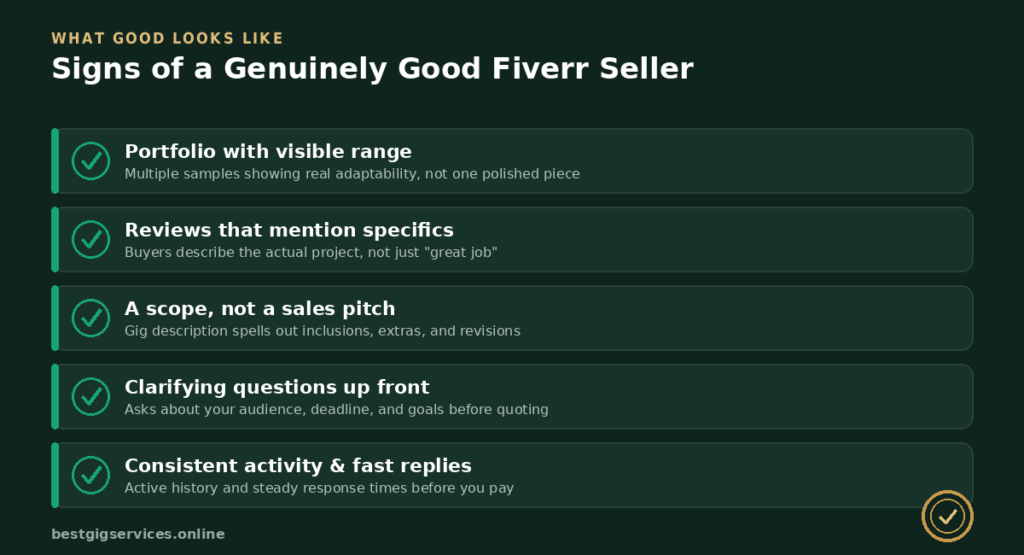
Before getting into what to avoid, it helps to know what you’re actually hoping to find, since the red flags below are really just the inverse of these traits.
- A portfolio with visible range. Not just one polished hero piece, but several samples that show the seller adapting their style to different briefs.
- Reviews that mention specifics. Buyers who write “delivered our onboarding email sequence two days early and explained the reasoning behind each subject line” are describing a real experience, not leaving a courtesy rating.
- A gig description that reads like a scope, not a sales pitch. Good sellers tell you exactly what’s included, what’s extra, and how many revisions come standard.
- Clarifying questions before the sale. A seller who asks about your audience, your deadline, or your brand before quoting a price is thinking about the actual job, not just closing an order.
- Consistent activity and response times. An active, responsive seller is far less likely to disappear mid-project than one with sparse, irregular history.
Keep these in mind as a mental baseline. Now here’s what tends to signal the opposite.
The 7 Red Flags to Watch For
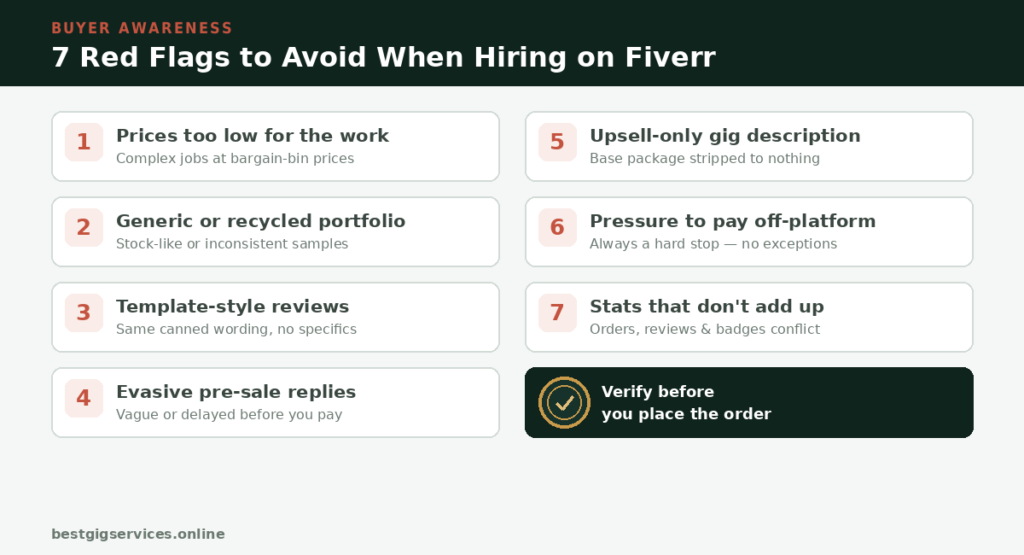
1. Prices That Don’t Match the Complexity of the Work
A logo package for five dollars, a full website build for twenty, a “500-word SEO article” that also promises keyword research, meta descriptions, and image sourcing — all for a price that wouldn’t cover an hour of anyone’s time. Extremely low pricing on complex deliverables is one of the most reliable predictors of a disappointing order.
This doesn’t mean every budget-friendly gig is a scam. Some sellers genuinely price low to build reviews early on. The distinction is whether the price is low relative to a simple, well-scoped task, or low relative to a deliverable that obviously requires hours of skilled work. When the math doesn’t add up, assume corners will get cut somewhere — usually in research, originality, or revision support.
2. A Portfolio That Feels Generic, Recycled, or Unverifiable
Look closely at portfolio samples, not just their existence. Warning signs include: images that appear to be stock photography rather than original work, design samples with inconsistent style from one piece to the next (suggesting they may not all be the seller’s own work), or a portfolio that hasn’t been updated in years despite an active gig.
A quick reverse image search on a suspicious portfolio piece takes under a minute and can save you from hiring someone who’s presenting someone else’s work as their own.
3. Reviews That Read Like Templates
Genuine reviews vary in length, tone, and detail because real clients have different projects and different things worth mentioning. A wall of reviews that all say some version of “great seller, fast delivery, highly recommend” with no project-specific detail is worth a second look, especially if they’re clustered in a short time window. That pattern is consistent with either purchased reviews or a seller who nudges every buyer toward the same canned wording before releasing the final file.
Genuine, detailed criticism buried among positive reviews is actually a good sign — it suggests the review base hasn’t been curated or filtered.
4. Vague, Slow, or Evasive Pre-Sale Communication
How a seller responds before you’ve paid them anything tells you a great deal about how they’ll behave once you have. Watch for:
- Copy-paste answers that don’t actually address your specific question
- Long delays responding to a simple, direct message
- Reluctance to confirm what’s included in the price
- Pressure to “just place the order and we’ll sort out details after”
A seller who won’t commit to scope before you pay is unlikely to suddenly become more transparent afterward.
5. A Gig Description Built for Upselling, Not Clarity
Some gigs are written so the advertised price looks appealing, while the actual deliverable is stripped down to almost nothing — a single revision, a tiny word count, or “commercial use” locked behind a paid add-on. This isn’t automatically dishonest; upselling itself is a normal business model. The red flag is when the base package is so minimal it’s clearly designed to force an upsell rather than to represent a genuinely useful starting offer. If you have to read the fine print three times to figure out what you’re actually getting for the listed price, that’s a sign the description was written to obscure rather than inform.
6. Any Attempt to Move Payment Off Fiverr
This is the clearest and most serious red flag on this list, and it deserves zero tolerance. A seller asking you to pay through PayPal, bank transfer, or any method outside Fiverr’s system — often framed as “avoiding fees” — removes every protection the platform offers you: buyer resolution support, dispute handling, and a documented record of what was promised. Legitimate Fiverr sellers have no real reason to ask for this, since Fiverr’s own payment system already handles their payout. Treat any request to pay outside the platform as an immediate reason to walk away, regardless of how reasonable the excuse sounds.
7. Stats That Don’t Add Up
Fiverr surfaces a handful of trust signals on every profile: completion rate, response time, order count, and rating. Occasionally these numbers tell an inconsistent story — a seller with thousands of completed orders but only a handful of visible reviews, or a “Top Rated” badge alongside a portfolio that looks brand new. This can sometimes be explained innocently (reviews can be left privately, or a seller may have pivoted categories), but when several numbers conflict at once, it’s worth messaging the seller directly and asking a specific question about their experience in exactly the type of project you need done. A confident, detailed answer resolves the concern quickly; a vague one confirms it.
A Quick Pre-Order Verification Checklist
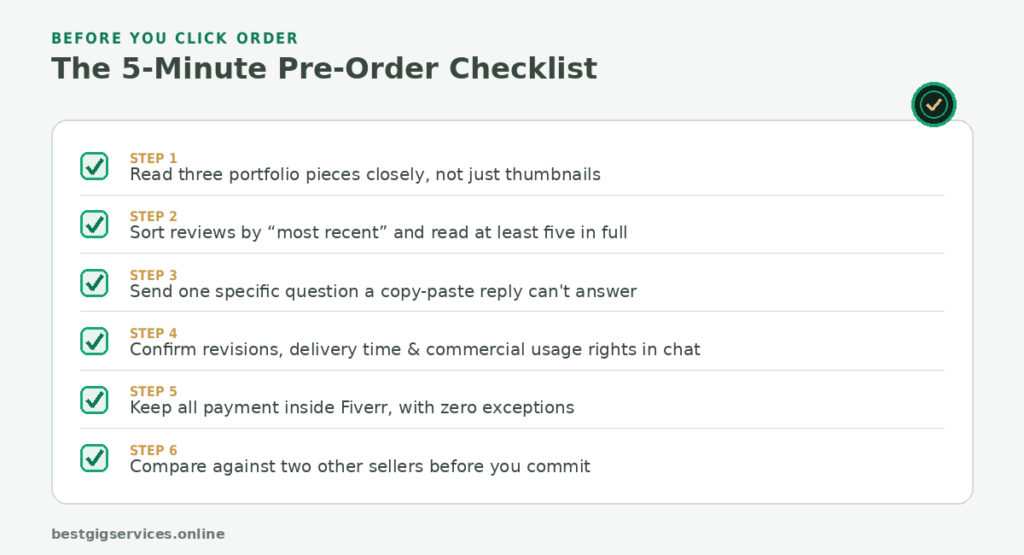
Before you place an order, run through this in under five minutes:
- Read three portfolio pieces closely, not just glance at thumbnails.
- Sort reviews by “most recent” and read at least five in full, not just the star average.
- Send one specific question the seller couldn’t answer with a copy-paste response.
- Confirm revisions, delivery time, and commercial usage rights directly in the chat before ordering.
- Check that all payment stays inside Fiverr, with no exceptions.
- Compare against two other sellers in the same category before committing, even if you already like the first one.
This short routine won’t catch every possible problem, but it eliminates most avoidable bad hires and takes less time than writing the brief itself.
What to Do If You Spot a Red Flag After Ordering
Sometimes a warning sign only becomes clear after work has started — a first draft that ignores half your brief, or a sudden request to communicate outside the platform. If that happens, document everything inside Fiverr’s messaging system, request a revision with specific, written feedback tied to your original order requirements, and involve Fiverr’s resolution support if the seller becomes unresponsive or refuses reasonable fixes. Because your order requirements and messages are preserved on the platform, you’re in a strong position as long as the conversation and payment stayed where they belong.
How Red Flags Show Up Differently Across Categories
A warning sign doesn’t always look the same from one type of gig to another, so it helps to know what it looks like in the categories buyers hire for most often.
Graphic design and branding. Watch for sellers whose “custom logo” samples all share suspiciously similar templates with only the text swapped out. A genuinely custom design process usually shows some variation in concept and layout across a portfolio, not the same shape recolored five times.
Writing and content. Be cautious of writers who guarantee “100% original, plagiarism-free content” as the headline of their gig rather than as a normal baseline expectation. It’s not wrong to mention it, but when it’s the main selling point rather than a quality standard, it can suggest the seller is used to buyers who’ve been burned before — worth asking a direct question about their research and drafting process.
Web and app development. Red flags here often hide in scope: a rock-bottom price for a “full website” that turns out to only cover a single template installation, with hosting setup, custom features, and testing all sold separately after the fact. Ask for an itemized breakdown before ordering, not after.
Video and animation. Watch for portfolios that only show finished, heavily-edited final cuts with no raw footage or process shots. It’s reasonable to ask to see a short behind-the-scenes clip or a project breakdown, since editing quality alone doesn’t tell you how the seller handles direction, feedback, or reshoots.
Digital marketing and SEO. Be skeptical of guaranteed rankings or follower counts delivered on a fixed timeline. Search algorithms and social platforms don’t work on guarantees, and a seller promising a specific rank position “in 30 days” is either overpromising or using tactics that can get your site penalized later.
Why Trusting Your First Instinct Still Matters
Checklists help, but they’re not a replacement for basic judgment. If something about a gig description, a portfolio, or a seller’s tone feels off, it’s worth pausing even if you can’t immediately name which specific red flag applies. Most experienced buyers develop this instinct after a handful of orders, but you don’t have to learn it the expensive way — treating a vague sense of doubt as a reason to ask one more clarifying question, rather than talking yourself out of it, is often enough to avoid a bad hire before it starts.
Frequently Asked Questions
Is a low order count always a bad sign?
Not necessarily. Newer sellers can still be highly skilled, especially if they bring outside experience from another platform or industry. Weigh a low order count alongside communication quality and portfolio strength rather than dismissing it outright.
Should I avoid every gig with extremely low prices?
Not automatically, but treat unusually low pricing on complex deliverables as a prompt to look closer, not as a green light. Simple, well-scoped tasks can genuinely be priced low without any red flag involved.
What’s the single most important red flag on this list?
Any attempt to move payment off Fiverr. It removes your protection entirely and has essentially no legitimate justification, which makes it the clearest and least ambiguous warning sign of the seven.
Can I trust the “Top Rated” or “Level 2” badges by themselves?
They’re a useful starting filter, but they reflect platform-wide performance rather than fit for your specific project. Pair badge status with a direct look at reviews and portfolio work relevant to your niche.
How many reviews should I read before deciding?
Aim for at least five to ten recent reviews, sorted by most recent rather than “most helpful,” since recent reviews reflect the seller’s current standard of work rather than a possibly outdated peak.
Final Thoughts
Finding a good Fiverr seller isn’t about finding someone with a flawless profile — very few exist, and a stray average review or a modest order count usually isn’t disqualifying on its own. It’s about noticing when several small signals point the same direction at once: a price that’s too good to be true, a portfolio that doesn’t hold up under a second look, and communication that avoids specifics. Spend the few extra minutes it takes to check, and you’ll spend a lot less time cleaning up after a hire that never should have happened.