Website development service pricing explained for 2026. Compare website costs by type, features, platform, and developer to set a smart budget.
Website development service pricing can range from less than $100 for a simple landing page to several thousand dollars for a custom website or web application. That wide range can make it hard to know what you should actually pay — but the good news is you don’t need to guess.
The cost of a website usually depends on its size, platform, design, features, content, technical requirements, and who builds it. A five-page business website is a very different project from an online store with hundreds of products or a custom customer portal.
This guide breaks down website development service pricing in simple terms: realistic budget ranges for different website types, what affects the final quote, which features increase costs, and how to compare freelancers without choosing a developer based only on the cheapest price.
If you want to compare freelancers after deciding your budget, you can also browse Fiverr website development services and compare sellers based on their services, portfolios, reviews, delivery times, and package details.
Table of Contents
Pricing at a Glance
These are general planning ranges, not fixed industry prices — a real quote can be lower or higher depending on the project.
| Website Type | Typical Development Budget | Best For |
|---|---|---|
| Simple landing page | $50–$200 | Campaigns and lead generation |
| Personal website | $100–$400 | Individuals and portfolios |
| Small business website | $150–$600 | Local and service businesses |
| WordPress website | $150–$800+ | Blogs and business websites |
| Wix website | $100–$500+ | Simple business sites |
| Shopify store | $200–$1,000+ | Online stores |
| WooCommerce store | $250–$1,500+ | WordPress eCommerce |
| Webflow website | $200–$1,500+ | Design-focused websites |
| Custom website | $500–$3,000+ | Unique business needs |
| Web application | $1,000–$10,000+ | Custom software |
| Large eCommerce website | $1,000–$5,000+ | Growing online stores |
The important point: a website’s price should be based on what it needs to do, not simply how many pages it has. A five-page website with a complex booking system may cost more than a 15-page informational website.
What Is Website Development Service Pricing?
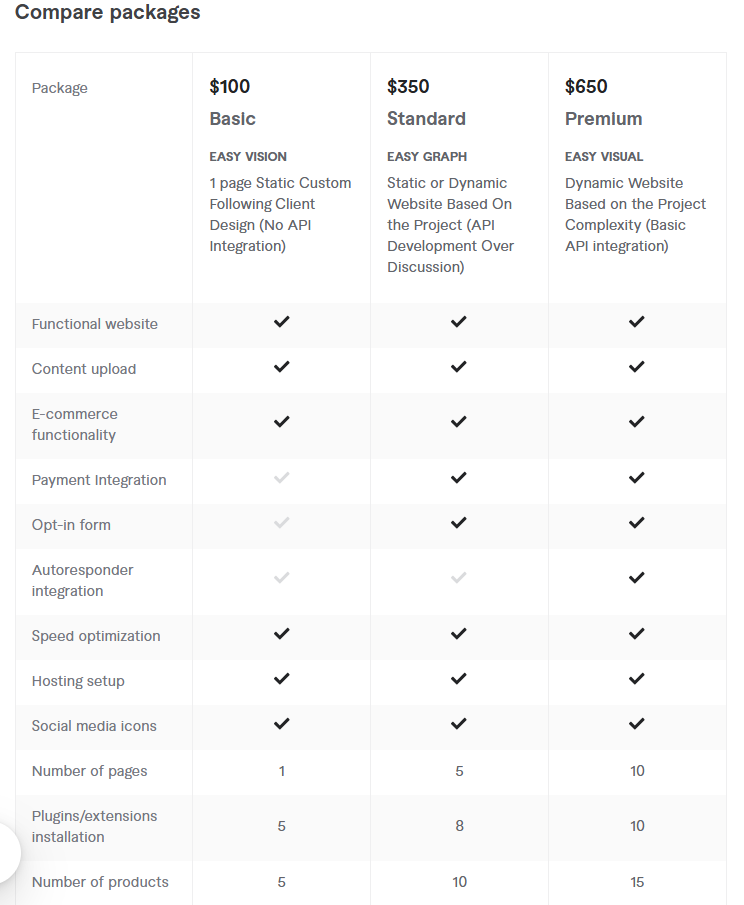
It’s the amount you pay a developer, freelancer, agency, or development team to build, customize, or improve a website. The service may include website planning, design, front-end and back-end development, CMS setup, database work, mobile optimization, forms, payment systems, eCommerce, third-party integrations, testing, migration, basic technical SEO, and launch support.
Not every developer includes all of these services — that’s why two websites with similar prices can have very different deliverables. One $300 package may include design, development, mobile optimization, and five pages. Another $300 package may include only development, because the client already has a finished design. Always compare the scope of work.
What Does a Website Developer Actually Do?

Before discussing price, it helps to understand what you’re paying for. Website development is more than putting text and images on a page — a developer may need to set up the website platform, install or configure a theme, create page layouts, build navigation, add forms, configure plugins or apps, connect third-party services, make the site responsive, test different browsers, fix errors, improve performance, configure security settings, connect the domain, and publish the site.
More technical projects require even more: a custom web application may need database architecture, user authentication, admin dashboards, APIs, server configuration, payment processing, user permissions, data validation, automated emails, testing, and ongoing maintenance. This is why it’s dangerous to compare every website project using a simple “price per page” formula.
How Much Does Website Development Cost?
There’s no universal price, but most projects fall into broad budget groups.
Under $100: Very Basic Website Work
At this level you may find landing page development, small website edits, WordPress setup, theme customization, basic one-page websites, and simple fixes. This budget can work if you already have most of your content and only need technical implementation — it’s usually not enough for a sophisticated business website.
Best for: individuals, bloggers, small campaigns, simple portfolios, temporary websites.
What to watch for: cheap packages often have strict limits — check the number of pages, revisions, design quality, content upload, mobile responsiveness, support, and plugin limits. A $75 package may sound attractive until you discover every additional page costs $40.
$100–$300: Basic Professional Website
A common range for smaller projects. You may get three to five pages, responsive design, WordPress setup, a contact form, basic customization, social media links, basic SEO structure, and simple animations. This works well for a small service business — for example, a local cleaning company needing Home, About, Services, Reviews, and Contact pages. There’s no reason to spend thousands if the site only needs to provide basic business information and generate leads. That said, quality still matters — a cheap website that looks outdated can hurt trust.
$300–$600: Professional Small Business Website
This range gives you more room: a custom homepage, multiple service pages, blog, contact forms, responsive design, better visual design, basic performance optimization, analytics setup, SEO-friendly structure, and more revisions. Often a sensible range for a small business wanting a professional online presence. You can also spend part of the budget on better design while keeping the technical setup relatively simple — a WordPress website doesn’t need custom coding for every feature; the right theme, plugins, and page builder can reduce development time.
$600–$1,000: Advanced Business Website
At this level you can consider custom WordPress design, larger websites, WooCommerce, advanced forms, booking systems, membership features, CRM integrations, email marketing integrations, advanced animations, custom functionality, website migration, and performance optimization. Expect more planning here — don’t just send a developer “I need a professional website.” Provide a detailed project brief; a good developer should understand what the website needs to accomplish before giving a final quote.
$1,000–$3,000: Custom Website Development
More appropriate for projects with significant customization — custom UI design, custom-coded features, advanced eCommerce, user accounts, dashboards, API integrations, advanced search, custom calculators, booking systems, membership systems, and multiple integrations. The process may involve several stages: planning, wireframes, design, development, testing, revisions, and launch. This is no longer just basic website setup — you’re paying for technical problem-solving.
$3,000+ Website Development Projects
Larger projects easily move beyond $3,000 — SaaS products, large marketplaces, custom eCommerce systems, customer portals, internal business platforms, advanced booking platforms, subscription systems, and complex web applications. Some businesses spend $10,000, $20,000, or more on complex web software. The final cost depends heavily on technology, number of users, integrations, security requirements, testing, and ongoing support. At this level, getting multiple proposals is important.
Pricing by Website Type
1. Landing Page Development
A basic landing page may cost $50–$200; a more polished or conversion-focused one can run $200–$500+. A landing page normally focuses on one goal — getting leads, selling a product, collecting email addresses, booking a consultation, or promoting a service. A good landing page doesn’t need dozens of features, just a clear message and an easy next step.
Features that may affect price: custom design, animations, lead form, email integration, payment processing, A/B testing setup, copywriting, custom graphics, and advanced tracking. If you only need a simple page, avoid paying for features you’ll never use.
2. Small Business Website
Typically $150–$600, with a larger or more customized site reaching $1,000+. A typical site includes Homepage, About, Services, Testimonials, FAQ, Contact, and Blog. The biggest cost factors are design and functionality — a simple information-based site can be inexpensive, while one with online booking, customer accounts, payments, and integrations costs more.
3. WordPress Website
A basic setup may cost $100–$300; a professional business website $300–$800+; a custom WordPress website $1,000–$3,000+. The WordPress software itself isn’t usually the main cost — you’re paying for development, design, hosting, premium themes, premium plugins, custom functionality, and maintenance.
If you’re comparing WordPress developers, our guide to Fiverr website development services under $200 compares different developers, starting prices, project types, and seller strengths.
4. Wix Website
Wix projects can start around $100–$300, with more customized sites reaching $300–$800+. Wix is a good choice for people who want a website that’s relatively easy to manage without much technical maintenance — typical projects include business websites, portfolios, blogs, booking websites, and basic online stores. The developer’s job may include design, layout, responsive optimization, and configuration of Wix features.
5. Shopify Website
Shopify development often costs $200–$1,000+, with large or heavily customized stores running considerably more. Work may involve theme customization, product setup, collections, navigation, payment configuration, shipping, apps, product filters, custom sections, and conversion improvements. The number of products also affects price — uploading 10 products isn’t the same task as uploading 500. Always ask how many are included.
6. WooCommerce Website
WooCommerce websites often cost $250–$1,500+. A basic store may be relatively affordable, while a larger one can become much more expensive. Possible requirements include product variations, payment gateways, shipping rules, coupons, customer accounts, inventory, tax settings, subscription products, product filters, and custom checkout. Write down the exact store features you need before hiring someone.
7. Webflow Website
Webflow development can range from $200–$1,500+. A simple marketing website sits on the lower end, while a sophisticated project with animations and CMS functionality costs considerably more. Webflow is often chosen by companies that care heavily about design and visual presentation — if you need a simple five-page business site, it may not always be the most cost-effective option.
8. Custom Web Application
Much harder to price. A basic custom application might start around $1,000–$3,000; more complex applications can reach $5,000–$10,000+. Examples include customer portals, SaaS products, marketplaces, booking systems, dashboards, CRM systems, inventory platforms, and membership platforms.
A custom application should be priced based on functionality. Don’t ask “How much does a custom website cost?” — ask “How much will it cost to build these specific features?” That produces a much more useful estimate.
What Factors Affect Pricing?
Number of pages. More pages usually mean more development and testing, but page count is only one factor — a simple 20-page website can sometimes cost less than a complex five-page site.
Design complexity. A template-based website is usually faster to build than a custom design. You may pay more for custom graphics, animations, interactive sections, unique layouts, and custom UI components.
Platform. WordPress, Shopify, Wix, Webflow, and custom development have different workflows — choose based on what your business needs, not because a technology is popular.
Functionality. Features are one of the biggest price drivers: a simple contact form is low complexity, online booking is medium complexity, a customer dashboard is higher complexity, and a custom marketplace is high complexity.
Content. If you provide all text and images, development can be faster. If the developer also needs to write content, edit images, create graphics, upload products, or format hundreds of pages, the cost increases.
Integrations. Connecting a website to another system — CRM, email marketing, payment processors, booking software, inventory systems, accounting software, APIs — can require additional development.
Developer experience. Experienced developers may charge more, which can be worthwhile for complex projects. You’re not simply paying for coding time — you’re also paying for problem-solving, experience, communication, planning, debugging, and project judgment.
Website Design vs. Website Development
These terms are often confused. Website design focuses on how the website looks and how users move through it — layouts, colors, typography, buttons, user interface, and visual hierarchy. Website development focuses on making the website work — turning those designs into HTML, CSS, JavaScript, WordPress templates, Shopify sections, Webflow pages, or custom software.
Some freelancers do both. If you want both design and development, confirm that both are included — our Fiverr website design services guide is useful for comparing design-focused sellers separately from developers. This distinction prevents a common mistake: hiring someone for development when you actually expected them to create the entire visual design too.
Does Website Development Include SEO?
Not always. Some developers include basic technical SEO — SEO-friendly URLs, heading structure, image alt text, mobile responsiveness, basic metadata, sitemap configuration — but that’s different from a complete SEO campaign. Ongoing SEO may involve keyword research, content planning, link building, technical audits, internal linking, content optimization, Search Console analysis, and competitor research.
If SEO is important to your business, ask the developer exactly what’s included. Don’t rely on a vague statement like “SEO optimized” — ask for deliverables.
Website Speed Should Be Part of Your Budget
Website speed isn’t just a technical detail — it affects how visitors experience your website. Google’s current guidance recommends paying attention to overall page experience, including Core Web Vitals, mobile usability, HTTPS, and other user-focused factors. Core Web Vitals cover three main measurements:
- LCP (loading performance)
- INP (responsiveness)
- CLS (visual stability)
Google recommends aiming for an LCP of 2.5 seconds or less, an INP below 200 milliseconds, and a CLS below 0.1 for a good user experience. You shouldn’t hire a developer solely because they promise a “100/100” PageSpeed score — instead, ask whether they’ll build a website that’s fast, responsive, stable, secure, and easy to use. Google also makes clear that good page experience doesn’t guarantee top search rankings — relevant, helpful content remains important.
Hosting, Domain, and Other Costs Beyond Development
Your development budget isn’t necessarily your total website budget. You may also need to pay for:
- Domain — your website address (e.g., yourbusiness.com)
- Hosting — stores your website files and makes them available online
- Premium theme — some WordPress sites use paid themes
- Plugins — some have paid versions or subscriptions
- Apps — Shopify and other platforms may have paid apps
- Email — professional business email may cost extra
- SSL — HTTPS security is essential; many hosts include it, but check before purchasing
- Maintenance — ongoing help after launch
When comparing development quotes, separate the one-time development cost from recurring website costs.
How Much Should You Budget for Maintenance?
Website development doesn’t always end when the site goes live. You may need ongoing maintenance for software updates, plugin updates, security checks, backups, broken links, content updates, bug fixes, and performance monitoring. A simple website may need little paid maintenance if you manage it yourself; a complex business website may benefit from regular professional support.
Ask your developer: “What support do you provide after launch, and for how long?” Some freelancers provide a short free support period; others charge hourly or offer monthly maintenance plans.
How to Get an Accurate Website Development Quote
The best way is to create a project brief covering:
- Website goal — e.g., “I need a website that generates leads for my local plumbing business.”
- Number of pages — list them all (Home, About, Services, Service 1, Service 2, Reviews, Contact).
- Platform — e.g., “WordPress with Elementor.”
- Features — e.g., contact form, booking calendar, WhatsApp button, Google Maps, testimonials.
- Content — who supplies text, images, logo, videos, product information.
- Examples — send two or three websites you like, and explain what you like about them.
- Deadline — give a realistic one; don’t demand a two-day delivery for a project that normally needs two weeks.
- Budget — provide a range, e.g., “My budget is $300–$500 depending on the final scope.” This helps the developer determine whether the project is realistic.
How to Compare Website Development Quotes
Imagine three developers send these quotes:
| Developer | Price | Pages | Features | Support |
|---|---|---|---|---|
| A | $150 | 5 | Basic | 7 days |
| B | $350 | 7 | Advanced forms + SEO setup | 30 days |
| C | $700 | 10 | Custom design + integrations | 60 days |
Which is best? There’s no automatic answer. If you need five basic pages, Developer A may be enough. If you need integrations, Developer B may offer better value. If your website is central to your business, Developer C may make more sense. The cheapest quote is not always the best deal.
Freelancer vs. Web Development Agency
A freelancer may be ideal for small websites, landing pages, WordPress, Shopify, redesigns, and small eCommerce projects. Advantages: lower overhead, direct communication, flexible packages, often lower prices.
An agency may be better for large websites, complex applications, projects needing multiple specialists, large eCommerce stores, and long-term development. You may get access to designers, developers, SEO specialists, project managers, copywriters, and QA testers — but agency pricing is often higher.
Is Fiverr a Good Place to Find a Website Developer?
It can be — the advantage is choice. You can compare many sellers offering different platforms, budgets, and specialties, and Fiverr makes it easy to see package details before contacting a seller. Still, you need to research the freelancer: recent reviews, portfolio, seller level, relevant experience, response time, delivery time, package details, revision policy, and support. Don’t choose someone simply because their Basic package is $50.
To compare actual Fiverr website developers, see these Fiverr website development services before making your shortlist. When you’re ready to contact a developer, find a website development freelancer on Fiverr and compare several sellers before ordering.
How to Avoid Overpaying
You don’t need to spend the most money to get a good website. A few strategies:
- Define the scope. A clear scope prevents unnecessary work.
- Avoid unnecessary features. Don’t add a feature just because another website has it — ask “will this help my visitors or business?” If not, skip it.
- Provide your content. Logo, text, images, brand colors, product information — this reduces the developer’s workload.
- Compare multiple sellers. Get at least three quotes for a medium or large project.
- Look at relevant portfolios. A developer who builds eCommerce stores may not be the best choice for a SaaS dashboard — find someone with relevant work.
- Ask about extra costs. Extra pages, extra revisions, plugins, apps, hosting, content, maintenance, integrations.
How to Avoid Choosing the Wrong Developer
Price is only one part of the decision — pay attention to communication. A developer who asks useful questions before starting may be safer than someone who immediately says “Yes, I can do everything.” Good questions are a positive sign: What is the website’s main goal? How many pages do you need? Do you already have hosting? Do you have the content? Do you have a design? Which features are essential? Do you have examples? This shows the developer is actually thinking about your project.
Warning signs to watch for: a seller who promises impossible results, gives an extremely low quote without reviewing the project, has no relevant portfolio, avoids explaining what’s included, pushes unnecessary services, doesn’t clarify ownership, refuses to discuss revisions, gives vague answers about support, or can’t explain the technology being used. You don’t need a developer who uses complicated technical language — you need someone who can clearly explain what they’re going to build.
What Should You Own After the Website Is Finished?
You should know who controls the domain, hosting, website administrator account, website files, database, design files, source code, premium licenses, analytics account, and Search Console account. Don’t let your entire online business depend on an account that only your developer controls — clarify ownership before the project starts.
A Simple Budget Formula
If you want a simple way to estimate your project:
Base website + design complexity + features + content + integrations + support
For example, a small business site:
| Component | Cost |
|---|---|
| Base development | $200 |
| Custom design | +$100 |
| Extra pages | +$75 |
| Forms and integrations | +$50 |
| Total estimated budget | ~$425 |
This is only a planning example — actual prices depend on the developer and project. The formula is useful because it helps explain why quotes differ.
Best Budget for a Small Business
For many small businesses, a reasonable starting budget is $200–$600 — enough for a professional website when requirements are simple. You may need more for eCommerce, booking, membership, custom integrations, advanced animations, or custom software.
Don’t spend $2,000 on features your business doesn’t need — but don’t spend $100 on a website that needs to handle a complex business process, either. Match the budget to the job.
What Is the Cheapest Way to Build a Website?
The cheapest option is often building it yourself using a website builder or CMS — using a ready-made theme, writing your own content, using free plugins, choosing simple layouts, and avoiding custom functionality. But your time also has value. If you spend 30 hours trying to build a website that a freelancer could complete properly for $200, the “free” option may not actually be cheaper. Think about the total cost of your time.
When Should You Spend More?
Spend more when the website directly affects revenue:
- Online store — a broken checkout can cost real sales.
- Booking website — a broken booking system can lose customers.
- Membership site — security and account management matter.
- SaaS product — performance and architecture matter.
- Lead-generation website — design and conversion affect how many leads you receive.
In these cases, saving a few hundred dollars during development may not be worth the risk.
FAQ
How much does website development cost in 2026?
Anywhere from under $100 for a simple page to several thousand dollars for advanced websites and web applications. The final price depends on the platform, number of pages, design, features, integrations, and developer.
What is a reasonable price for a small business website?
Around $150–$600 when the project is relatively simple. More customized websites can cost $1,000 or more.
How much does a five-page website cost?
A basic five-page website may cost around $150–$500. Custom designs, eCommerce features, booking systems, advanced integrations, and professional content can increase the price.
Is $100 enough to build a website?
It can be, for a simple landing page, basic WordPress site, or small website setup — usually not enough for a complex custom website.
Is WordPress cheaper than custom website development?
Often, yes. WordPress provides an existing content management system and a large ecosystem of themes and plugins. Custom development can require more design, programming, testing, and maintenance.
How much does an eCommerce website cost?
A basic one may start around $250–$1,000. Larger stores with many products, custom checkout processes, advanced shipping, integrations, or subscriptions can cost considerably more.
Should I hire a freelancer or agency?
A freelancer is often suitable for smaller websites and clearly defined projects. An agency can make more sense for large projects needing several specialists or long-term development.
Can I negotiate website development prices?
Sometimes — but instead of simply asking for a lower price, ask whether the developer can reduce the scope. Removing unnecessary features is often better than asking someone to do the same amount of work for less money.
Final Thoughts
Website development service pricing can look confusing because there’s no single standard price. A simple landing page may cost less than $100. A professional small business website may cost a few hundred dollars. An advanced eCommerce website may cost $1,000 or more. A custom web application can require several thousand dollars.
The right budget depends on what you actually need. Start with the website’s purpose, then list your pages, features, platform, content, integrations, and support needs. Once you know the scope, compare developers based on the complete package, not just the advertised starting price.
It’s also worth remembering that good website development is about more than appearance. Your site should work well on mobile devices, load efficiently, remain secure, and provide a useful experience. Google’s current guidance emphasizes people-first content and a good overall page experience rather than optimizing for one ranking signal alone.
If your project fits a freelance model, compare website development freelancers on Fiverr and shortlist developers whose portfolio and package match your needs. For more freelancer buying guides, explore BestGigServices.online, including its guides on website development, website design, and other freelance services.
The smartest website budget is not the cheapest one — it’s the budget that gives you the right website for your actual business needs without paying for work you don’t need.
This post contains affiliate links. If you sign up or make a purchase through them, I may earn a commission at no extra cost to you.