Getting the little “Pro” badge next to your Fiverr profile name changes how buyers see you before they read a single word of your gig description. It signals that Fiverr itself has already checked your work, your communication, and your track record — so the client doesn’t have to gamble on a stranger.
That badge is also one of the hardest things to earn on the platform. Fiverr doesn’t hand it out for hitting a sales number or logging enough hours online. It’s a manual, human-reviewed approval, and most applicants get rejected on their first try because they don’t understand what the reviewers are actually looking for.
This guide breaks down exactly how Fiverr Pro works in 2026, who qualifies, how the application is scored behind the scenes, and what separates an approved profile from a rejected one. If you’re a freelancer who’s serious about turning Fiverr into a full-time income source, this is the roadmap.
Table of Contents
What Fiverr Pro Actually Means
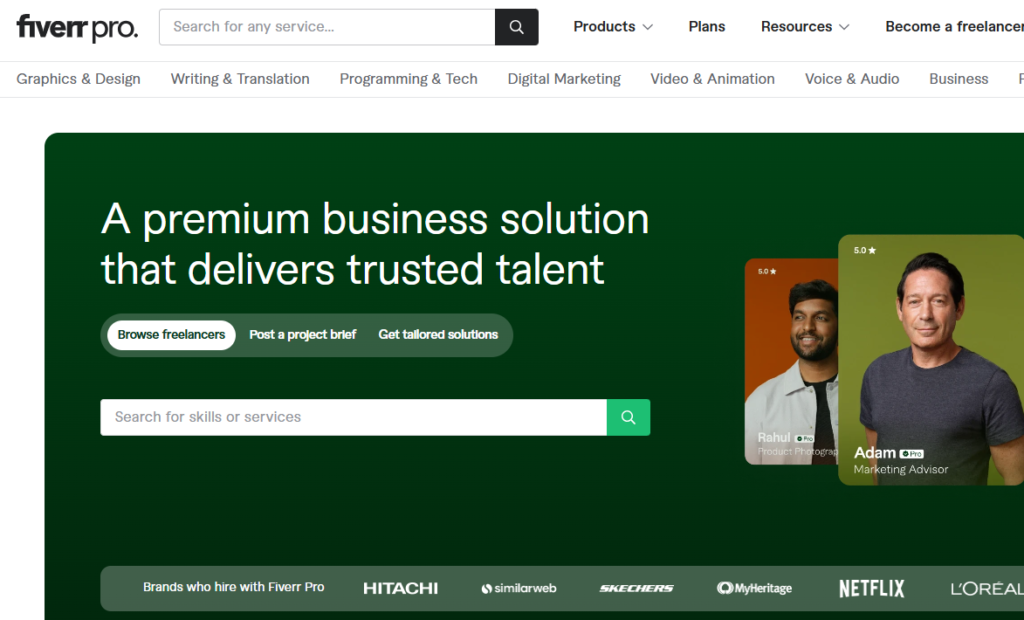
Fiverr Pro is a separate, invite-and-application-based tier of the marketplace reserved for freelancers who can prove a professional-level track record. Unlike a regular Fiverr seller account, which anyone can open in minutes, a Pro account requires a formal vetting process that looks at your portfolio, your work history outside Fiverr, and sometimes a live interview or sample task.
Once approved, your profile carries a small “Pro” badge, and your gigs are placed in a separate, less crowded results pool that’s shown to buyers who specifically filter for vetted talent — typically businesses, agencies, and enterprise clients with bigger budgets and less patience for trial and error.
Think of it less as a Fiverr feature and more as a certification. It doesn’t guarantee sales, but it changes who’s willing to hire you and how much they’re willing to pay.
Fiverr Pro vs. Regular Fiverr Sellers
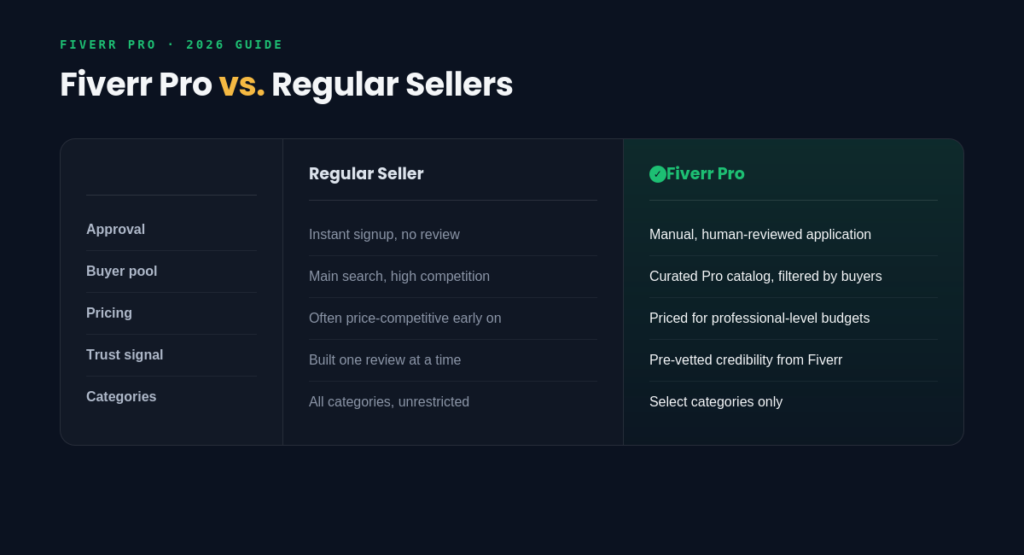
The gap between a standard seller account and a Pro one is bigger than most people expect. Here’s how they actually differ in practice.
Approval process. A regular seller account is instant. You sign up, verify your email, and you’re live. A Pro account requires an application, a portfolio review, and often a follow-up request for more samples or references before Fiverr’s team makes a decision.
Buyer pool. Standard gigs compete in Fiverr’s main search results against millions of other freelancers. Pro gigs sit in a curated, smaller catalog that buyers reach by deliberately choosing the “Pro” filter, which mostly attracts corporate and agency clients.
Pricing expectations. Regular sellers often compete on price, especially early on when they have no reviews. Pro sellers are expected to price like established professionals, and buyers browsing that tier already expect higher rates, so undercutting yourself isn’t necessary or advisable.
Perceived trust. New sellers have to build trust one review at a time. Pro sellers start with an implicit stamp of credibility because Fiverr has already done a layer of vetting most buyers can’t do themselves.
Category availability. Not every Fiverr category has a Pro version. Pro is concentrated in categories where quality is harder to judge from a distance — like branding, video production, software development, and marketing strategy — rather than simple one-off tasks.
Understanding this distinction matters because Pro isn’t a “better version” of the same game. It’s a different game with different rules, different buyers, and different expectations for how you present yourself.
Who Is Eligible for Fiverr Pro
Fiverr doesn’t publish an exact scorecard, but based on the application requirements and what gets approved, eligibility tends to cluster around a few consistent factors.
- Verifiable professional experience. Reviewers want to see that you’ve done this work for real clients, not just personal projects. Agency experience, corporate roles, or a long freelance history all count.
- A polished, focused portfolio. Scattered, unrelated samples hurt you. A tight portfolio in one clear specialty beats a wide one that tries to cover everything.
- Strong communication skills. Since Pro sellers often work with agencies and enterprise clients, Fiverr weighs how clearly and professionally you present yourself in writing.
- A track record on or off Fiverr. Existing sellers with strong ratings have an advantage, but Fiverr Pro also accepts applicants who’ve never sold on Fiverr before, as long as their outside portfolio is strong enough.
- A specific, sellable skill. Broad titles like “I do marketing” perform worse than specific ones like “B2B SaaS email marketing strategist,” because reviewers are trying to picture exactly what kind of buyer would hire you.
If you’re missing one of these — say, you have great skills but a thin portfolio — it’s usually smarter to spend a few weeks strengthening that gap before applying, rather than submitting a weak application and risking a rejection that delays your next attempt.
Which Categories Typically Offer Fiverr Pro
Fiverr Pro is concentrated in categories where buyers have the most trouble judging quality from a portfolio alone, and where a bad hire is expensive to recover from. Categories that commonly include a Pro tier are:
- Graphic design and branding, including logo design and full brand identity packages
- Video and animation, including explainer videos, motion graphics, and editing
- Programming and tech, including web development, app development, and DevOps
- Digital marketing, including SEO strategy, paid ads management, and marketing consulting
- Writing and translation, particularly long-form content strategy and copywriting
- Business consulting, including market research and financial consulting
- Music and audio production, including mixing, mastering, and composition
Fiverr adjusts which categories carry a Pro option over time based on buyer demand, so it’s worth checking the current Pro catalog for your specific niche before assuming it exists. If your category isn’t listed, that doesn’t mean you can’t eventually apply — it may simply mean Fiverr hasn’t opened that vertical yet, and it’s worth checking back periodically.
A Realistic Timeline: From Application to First Pro Client
It helps to know what the weeks around an application actually look like, since a lot of freelancers assume it’s faster or slower than it really is.
In the first week after you submit, you’ll typically get an automated confirmation and then silence while the review happens in the background. Between week two and week four, most applicants either hear back with a decision or get a follow-up request for more information. If approved, your profile is upgraded almost immediately, and your existing gigs become eligible to appear in Pro search results within a day or two.
Landing your first Pro client isn’t usually instant. Buyers browsing the Pro catalog tend to take longer to make a decision because they’re often comparing a shortlist of vetted freelancers rather than picking the first result. It’s common for the first inquiry to take anywhere from a few days to a few weeks after approval, especially if your gig descriptions and portfolio haven’t yet been updated to speak directly to that higher-budget audience.
The freelancers who convert fastest after approval are usually the ones who treat the upgrade as a relaunch. They rewrite their gig titles, refresh their portfolio images, and adjust their pricing before the badge even goes live, so they’re ready the moment buyers start seeing them in the Pro results.
Step-by-Step: How to Apply for Fiverr Pro
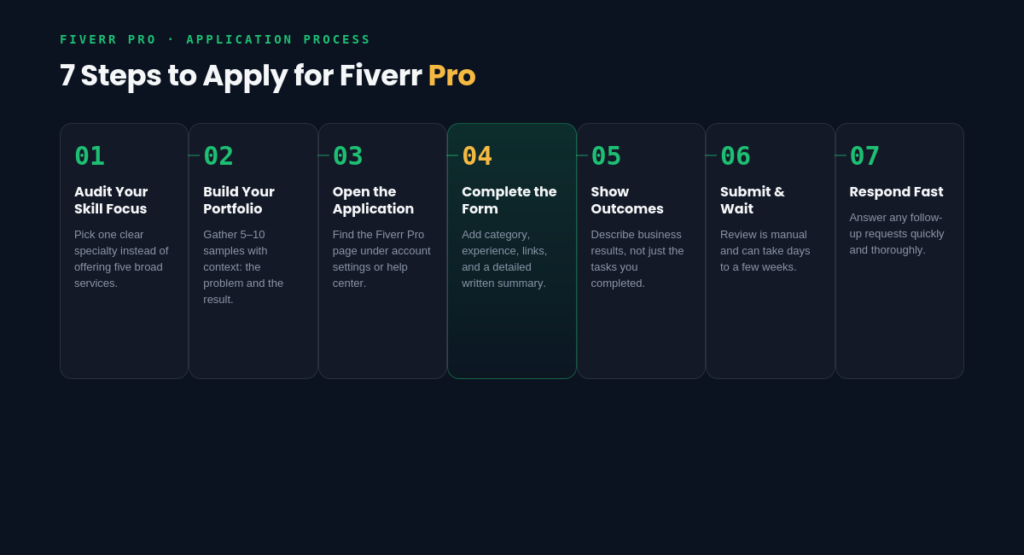
Here’s the actual sequence you’ll go through, from first click to (hopefully) approval.
Step 1: Audit Your Current Skill Focus
Before touching the application, pick one lane. Fiverr Pro rewards specialists, not generalists. If you currently offer five different services, choose the one you’re strongest in and most consistently get paid well for. This becomes your Pro application focus.
Step 2: Build or Refresh Your Portfolio
You’ll need to submit real samples of your work, ideally 5 to 10 pieces that show range within your specialty — not outside it. If you’re a designer, show different industries and formats. If you’re a developer, show different types of projects and problems solved, not just a single stack repeated five times.
Make sure every sample includes context: what the client needed, what you delivered, and what the result was. A screenshot with no explanation tells reviewers very little.
Step 3: Go to the Fiverr Pro Application Page
From your Fiverr account, navigate to the Fiverr Pro section (usually found under your account settings or by searching “Become a Pro” in the help center, since Fiverr occasionally moves the exact menu location). Click to start the application.
Step 4: Fill Out the Application Form Completely
The form typically asks for:
- Your primary category and sub-specialty
- Years of professional experience
- Links to your portfolio, LinkedIn, or personal website
- A written summary of your background and expertise
- Sample work uploads or links
Don’t rush this part. Vague, one-line answers are one of the most common reasons applications get rejected. Treat it like a job application for a role you actually want, because that’s essentially what it is.
Step 5: Highlight Outcomes, Not Just Tasks
Instead of writing “I designed logos for small businesses,” write something closer to “I designed brand identities for 40+ small businesses, several of which went on to raise funding or expand into new markets.” Reviewers are trying to assess business impact, not just technical ability.
Step 6: Submit and Wait for Review
Fiverr’s team manually reviews every application. Response times vary, but it commonly takes anywhere from a few days to a few weeks. There’s no way to expedite this, so plan your income around your existing gigs in the meantime rather than pausing everything to wait.
Step 7: Respond Quickly If Fiverr Follows Up
Sometimes Fiverr’s team asks for additional samples, clarification, or even a short call. Treat this stage as seriously as the original application. A slow or careless response here can hurt an otherwise strong application.
What to Do If You Get Rejected
Rejection isn’t permanent, and it’s more common than most people assume, especially on a first attempt. If it happens, resist the urge to reapply immediately with the same materials. Instead:
- Ask yourself honestly whether your portfolio is specific enough for one clear niche
- Add two or three stronger, more recent samples with better documented outcomes
- Tighten your written summary so it reads like an expert positioning statement, not a generic bio
- Wait for the recommended reapplication window before trying again
Most successful Pro sellers didn’t get approved on their first attempt. What separates them is that they treated the rejection as feedback instead of a final verdict.
What Changes Once You’re Approved
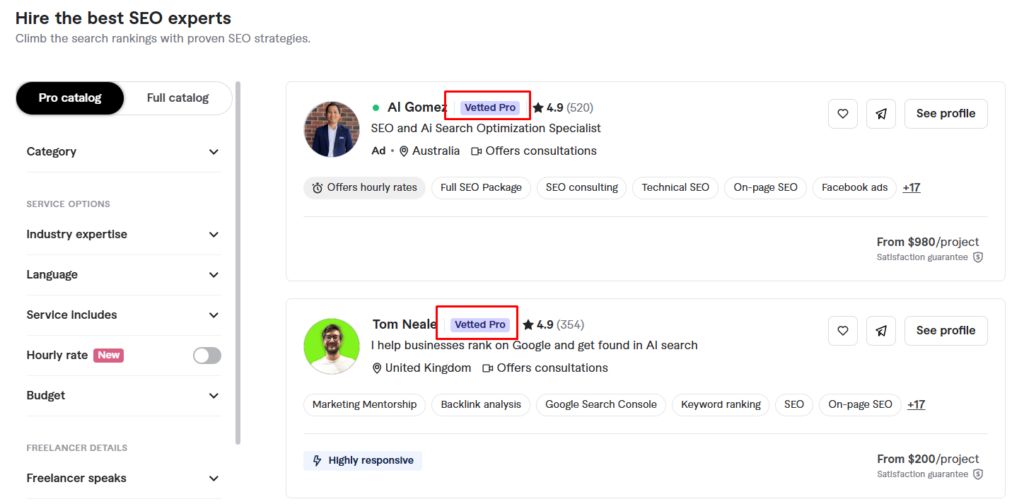
The moment your account is upgraded, a few things shift right away.
Your profile gets the Pro badge, visible in search results and on your profile page. Your gigs become eligible to appear in the dedicated Pro catalog that buyers filter into deliberately. You’ll likely get access to a dedicated account manager or support contact in some regions, which regular sellers don’t have. And your pricing conversations change — buyers browsing Pro talent expect to pay professional rates, so this is the moment to stop pricing like a beginner.
It’s also worth noting that Pro status doesn’t remove the need for good gig SEO, strong gig images, and clear descriptions. It opens a door; it doesn’t replace the fundamentals of running a good Fiverr business.
Common Mistakes That Get Applications Rejected
A few patterns show up again and again in rejected applications, and almost all of them are avoidable.
Applying with a scattered portfolio. Trying to prove you’re good at everything usually reads as not being truly excellent at anything specific.
Submitting work without context. A file or link with no explanation of the client’s problem and your solution doesn’t tell reviewers what they need to know.
Writing a generic bio. Copy-pasted, vague descriptions (“passionate and hardworking freelancer”) don’t demonstrate real expertise.
Choosing the wrong category. Applying under a broad, oversaturated category instead of the specific niche where your strongest samples live weakens your case.
Ignoring outside credibility. If you have client testimonials, LinkedIn recommendations, or press mentions, leaving them out is a missed opportunity to strengthen trust.
Rushing the application. Filling it out in ten minutes usually shows, and reviewers can tell the difference between a considered application and a hasty one.
How to Succeed as a Fiverr Pro Seller After Approval
Getting the badge is only the starting line. Here’s how experienced Pro sellers actually make the most of it.
Reposition your gig descriptions for bigger clients. Pro buyers are often agencies or companies with internal processes, so your gig copy should speak to their concerns: reliability, communication, scalability, and clear deliverables, not just price.
Price for the audience you’re now in front of. Since Pro buyers already expect higher rates, pricing too low can actually make you look less credible in that pool, not more attractive.
Keep response times fast. Enterprise buyers are used to working with agencies that respond quickly. Slow replies stand out more in the Pro tier, where expectations are higher across the board.
Ask for detailed reviews. A short “great work!” review helps less than a review that mentions the specific problem you solved. When possible, encourage clients to be descriptive.
Keep your portfolio current. Refresh your samples every few months with your best recent work, since your profile is now being seen by a more discerning audience.
Don’t neglect gig SEO. Being in the Pro catalog helps, but buyers still search using keywords. Strong, specific gig titles and descriptions still matter just as much as before.
Common Myths About Fiverr Pro
A lot of misinformation circulates about this program, so it’s worth clearing a few things up.
Myth: You need to already be a top-rated Fiverr seller to apply. Not true. Fiverr Pro accepts strong applicants who’ve never sold on Fiverr before, as long as their outside portfolio and experience are solid.
Myth: Pro status guarantees more sales. It increases visibility to a higher-intent buyer pool, but it doesn’t replace the need for a strong gig, good communication, and consistent delivery.
Myth: Once approved, you’re Pro forever no matter what. Fiverr can review accounts periodically, and consistently poor performance can affect your standing, so the badge isn’t something to coast on.
Myth: Every category has a Pro option. Some niche or highly commoditized categories simply don’t have a Pro tier, so it’s worth checking whether your specialty is even eligible before investing time in an application.
Frequently Asked Questions
Does it cost money to apply for Fiverr Pro? No. The application itself is free. Fiverr’s revenue comes from the standard service fees on completed orders, not from the vetting process.
How long does the Fiverr Pro review take? It varies, but applicants typically report waiting anywhere from a few days to several weeks, since every application is reviewed manually rather than automatically approved.
Can beginners with no Fiverr history apply? Yes, as long as they can show strong professional experience and a solid portfolio from outside the platform, such as agency work, freelance clients, or a personal business.
What happens if my application is rejected? You can typically reapply after a waiting period. Use the time to strengthen your portfolio and tighten your positioning rather than resubmitting the same materials unchanged.
Do Fiverr Pro sellers pay different fees than regular sellers? The core service fee structure is generally the same across the platform, though pricing strategy naturally shifts because Pro buyers expect professional-level rates.
Is Fiverr Pro worth it for freelancers? For freelancers who already have professional-grade skills and want access to higher-budget clients, it’s usually worth the effort. For beginners still building a portfolio, it often makes more sense to grow as a regular seller first and apply once the track record is stronger.
Is the Effort Worth It? Weighing the Real Investment
Applying for Fiverr Pro takes real time. Between organizing a portfolio, writing thoughtful answers, and possibly waiting weeks for a decision, it’s fair to ask whether the payoff justifies the effort.
For most freelancers who already have solid experience, the math tends to work in their favor. A single Pro client, working with an agency-level budget, can often be worth several regular Fiverr orders combined. The badge also tends to reduce the amount of time spent negotiating on price, since buyers in that tier have already accepted that professional work costs more.
The calculation looks different for someone brand new to freelancing. If you don’t yet have a portfolio strong enough to compete, the smarter first investment is usually time spent delivering great work as a regular seller, collecting detailed reviews, and building a body of work you can point to later. Applying too early, before you have the proof to back up your claims, tends to waste the one application most people only get to make thoughtfully.
A useful gut check: if you already turn down work because you’re fully booked at your current rates, that’s often a sign you’re ready for the Pro tier. If you’re still filling your schedule at any price, it’s usually a sign to keep building first.
Final Thoughts
Fiverr Pro isn’t a shortcut, and it isn’t designed to be one. It’s a filter that rewards freelancers who’ve already put in the work to become genuinely good at something specific, and who can prove it clearly. If you’re not there yet, that’s not a dead end — it’s a roadmap. Sharpen your niche, document your results, and build a portfolio that tells a buyer exactly what they’re getting before they ever message you.
For the freelancers who do get approved, the badge opens doors that are hard to open any other way on the platform: bigger clients, better rates, and a level of built-in trust that usually takes years to earn on your own. Whether you apply next week or six months from now, the steps are the same — get specific, get proof, and present both clearly.
Freelancing rewards patience more than most people expect going in. The sellers who eventually wear the Pro badge are rarely the ones who rushed an application the week they joined Fiverr. They’re the ones who kept refining one skill until the proof of their work spoke louder than any bio could, and then simply showed Fiverr what they’d already built.