If you have ever hesitated before clicking “Order Now” on Fiverr, you are not alone. Handing your money to a total stranger on the internet feels risky, even when that stranger has a nice profile picture and a stack of five-star reviews. That hesitation is exactly why Fiverr built a buyer protection system in the first place.
In this guide, I am going to walk you through exactly how Fiverr protects buyers, what is covered, what is not, and the practical steps you should take if an order goes sideways. By the end, you will know precisely what safety net you are standing on every time you hire a freelancer on Fiverr.
What Is Fiverr Buyer Protection?
Fiverr buyer protection is the combination of policies, payment safeguards, and support systems that Fiverr uses to keep buyers from losing money on orders that go wrong. It is not a single button or a single page on the site. Instead, it is a set of built-in mechanisms that work together behind the scenes every time you place an order.
Think of it less like an insurance policy you sign up for and more like a set of guardrails that are already built into the road. You do not have to activate them. They are simply part of how the platform works.
The three main pillars of this system are:
- Escrow-style payment holding – Fiverr holds your payment until the work is delivered and accepted.
- The Resolution Center – a built-in dispute system for handling problems between buyers and sellers.
- Fiverr’s Terms of Service enforcement – rules that sellers must follow, backed by account penalties if they don’t.
Let’s break each of these down so you understand exactly how your money and your order are protected at every stage.
How Fiverr Holds Your Payment (And Why That Matters)
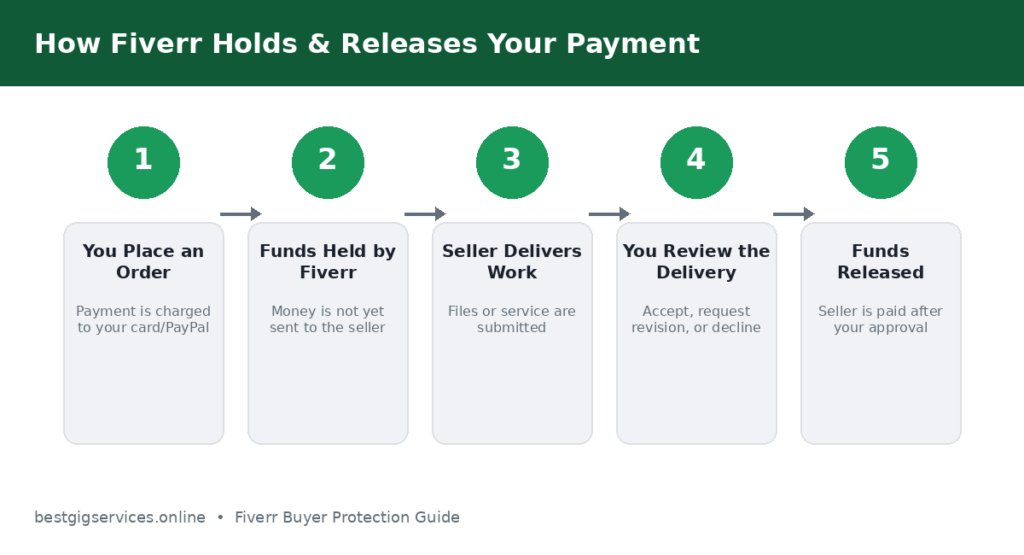
When you pay for a gig on Fiverr, your money does not go straight into the seller’s pocket. Instead, Fiverr holds the funds in your account balance until the order is marked complete. This is similar to how an escrow service works in real estate: a neutral third party holds the money until both sides fulfill their end of the deal.
Here is the general flow of what happens to your payment:
- You place an order and pay – Fiverr charges your card, PayPal, or other payment method immediately.
- Funds are held by Fiverr – The money sits in a pending state, not yet released to the seller.
- The seller delivers the work – Once they upload the files or complete the service, the clock starts on your review period.
- You review the delivery – You can accept it, ask for a revision, or decline it if it does not meet the requirements.
- Funds are released – Once you approve the delivery (or the auto-acceptance period passes), the funds move into the seller’s account balance. Even then, sellers usually cannot withdraw the money for a short clearance period.
This holding period is the single biggest reason Fiverr buyer protection works. It means a seller cannot simply take your money and disappear the moment you click “pay.” They only get paid once they have actually delivered something.
What Happens If You Are Not Happy With the Delivery?
Not every project goes perfectly on the first try, and Fiverr knows this. That is why the platform builds revisions and dispute options directly into the order process.
Requesting a Revision
If the delivered work does not match what you asked for, your first step should always be requesting a revision. Most gigs come with a set number of free revisions listed directly on the gig page, so check that before you order if revisions matter to you.
When requesting a revision, be specific. Vague feedback like “this isn’t what I wanted” rarely helps. Instead, point to the exact part of the brief that was missed and explain what needs to change. Clear communication here often solves the problem without needing to escalate anything further.
Declining the Delivery
If the work is far off from what was agreed, or the seller has ignored your requirements entirely, you can decline the delivery. This keeps the order open and prevents Fiverr from automatically marking it as complete and releasing payment.
What If the Seller Won’t Cooperate?
If a seller becomes unresponsive, argumentative, or simply refuses to fix legitimate issues, this is where Fiverr’s official dispute system comes into play.
The Fiverr Resolution Center Explained
The Resolution Center is Fiverr’s built-in mediation tool. It exists so that buyers and sellers do not have to sort out disagreements entirely on their own. You can access it directly from your order page whenever there is a problem.
Through the Resolution Center, you can:
- Request a mutual cancellation, where both parties agree to cancel the order and you get your money back as Fiverr credit or a refund.
- Request an extension if the seller needs more time and you are willing to wait.
- Ask for partial completion if only part of the work was delivered satisfactorily.
- Escalate to Fiverr’s Customer Support team if the seller does not respond or you cannot reach an agreement.
Once Fiverr’s support team steps in, they will review the order details, the delivery, and the messages exchanged between you and the seller. Based on that evidence, they decide whether a refund, partial refund, or other resolution is appropriate.
This is why keeping your communication on Fiverr’s messaging system is so important. If Fiverr ever needs to review a case, they can only see what happened inside the platform. Conversations that happen over outside email or messaging apps are much harder to prove and are actually against Fiverr’s Terms of Service.
What Fiverr Buyer Protection Actually Covers
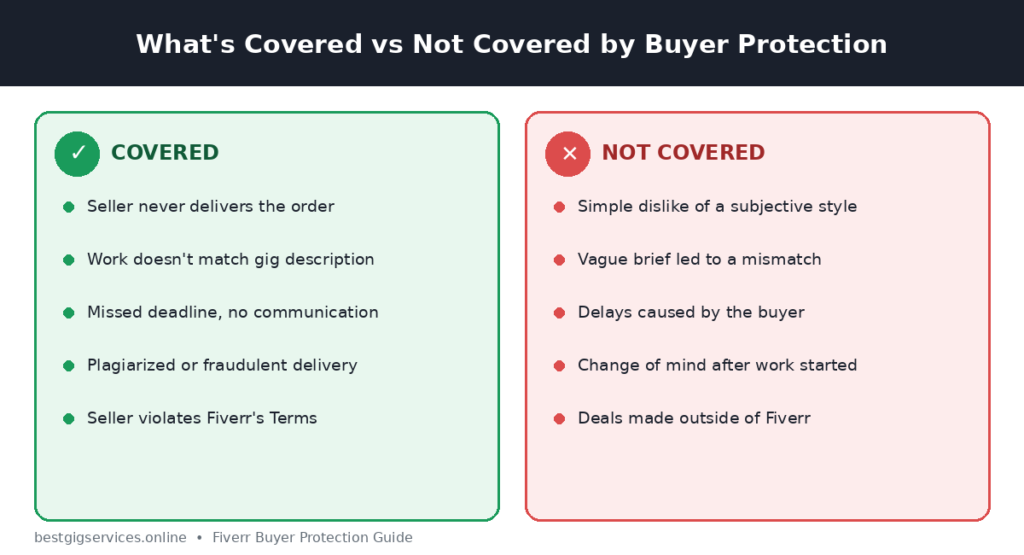
To use this system well, you need a realistic picture of where the protection applies. Here is what is generally covered:
- Non-delivery – The seller never delivers anything at all within the agreed timeframe.
- Work that does not match the gig description – For example, you ordered a logo package and received a single low-quality image.
- Missed deadlines without communication – If a seller goes silent and misses the delivery date.
- Fraudulent or plagiarized work – Content that is copied from elsewhere or clearly not original when originality was promised.
- Sellers violating Fiverr’s Terms of Service – This includes asking you to pay outside the platform or trying to scam you into unsafe payment methods.
What Fiverr Buyer Protection Does Not Cover
It is just as important to understand the limits. Buyer protection is generous, but it is not unlimited. Here is what typically falls outside its scope:
- Simple dissatisfaction with a subjective creative choice – If a seller delivered exactly what was described in the brief, but you personally do not like the style, that is a harder case to win, especially if requirements were vague to begin with.
- Buyer’s own unclear instructions – If your original brief was vague or missing key details, and the seller reasonably interpreted it differently than you intended, Fiverr may see this as a communication issue rather than a seller failure.
- Delays caused by the buyer – If you were slow to respond to questions or approve concepts, and this pushed back the delivery, that delay is not really the seller’s fault.
- Change of mind after work has already started – Ordering a service and then deciding you no longer want it, after the seller has already begun working, is treated differently than a seller failing to deliver.
- Anything agreed to and completed outside of Fiverr – Fiverr’s protection only extends to transactions that happen on their platform through their payment system.
This is exactly why writing a clear, detailed order brief before you even place an order matters so much. The clearer your instructions, the stronger your position if something needs to be disputed later.
Step-by-Step: What to Do If Something Goes Wrong on Fiverr
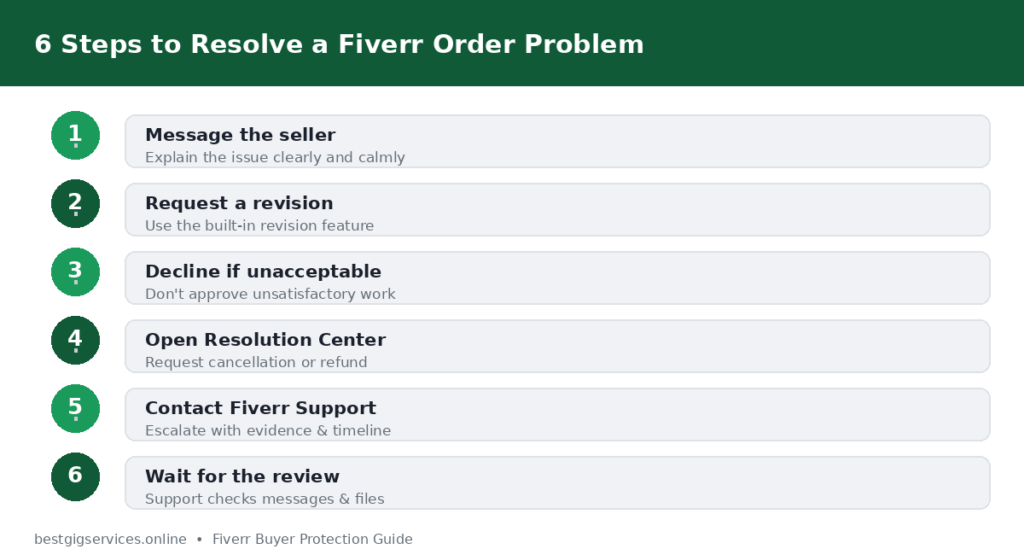
Here is a simple process to follow if you run into a problem with a Fiverr order.
Step 1: Message the seller first. Explain calmly and specifically what is wrong. Most issues get resolved at this stage because sellers want good reviews and repeat business.
Step 2: Use the revision request feature. If a revision is available, use it rather than immediately escalating. This keeps the process on record and gives the seller a fair chance to fix things.
Step 3: Decline the delivery if it is unacceptable. Do not accept work you are not satisfied with just to “move on.” Declining keeps your options open.
Step 4: Open a request in the Resolution Center. If the seller is unresponsive or unwilling to fix the issue, formally request a cancellation or partial refund through the Resolution Center.
Step 5: Contact Fiverr Customer Support. If you and the seller cannot agree, escalate the case. Provide screenshots, the original brief, and a clear timeline of what happened.
Step 6: Wait for Fiverr’s review. Support teams typically review the order history, delivered files, and message thread before making a decision. This can take a few business days depending on the case’s complexity.
Following these steps in order not only increases your chances of a fair outcome, it also mirrors exactly how Fiverr’s own support team expects disputes to be handled.
Refunds: How They Actually Work
When a Fiverr refund is approved, the money is usually returned to you as Fiverr credit first, which can be used for future orders. In many cases, you can request the funds back to your original payment method instead, though this can take longer to process depending on your bank or payment provider.
Refund timing depends on the type of resolution:
- Mutual cancellations are usually processed almost immediately.
- Support-reviewed disputes can take a few days, since a human agent needs to examine the case.
- Payment provider refunds (back to your card or PayPal) can take additional business days on top of Fiverr’s own processing time.
Extra Layers of Protection Worth Knowing About
Beyond the core order protection, Fiverr has a few additional features that add to buyer safety.
Verified Seller Levels
Fiverr ranks sellers into levels (New Seller, Level 1, Level 2, and Top Rated Seller) based on their order history, ratings, and response times. While this is not a protection mechanism by itself, ordering from an established seller with a strong track record naturally lowers your risk.
Public Reviews and Ratings
Every completed order results in a public review. Because sellers depend heavily on their ratings for future business, this creates a strong incentive to deliver quality work and resolve issues fairly rather than risk a bad review.
Secure Payment Processing
Fiverr does not expose your payment details to sellers. All transactions are processed through Fiverr’s own payment system, which means a seller never actually sees your card number or banking information. This closes off an entire category of scams that exist on less secure freelance platforms.
Anti-Fraud Monitoring
Fiverr actively monitors for suspicious account behavior, including sellers who try to move buyers off-platform to avoid fees or protections. If a seller asks you to pay them directly through PayPal, bank transfer, or any method outside of Fiverr, this is a major red flag and a direct violation of Fiverr’s rules. Reporting it protects both you and future buyers.
Practical Tips to Get the Most Out of Buyer Protection
Knowing the system exists is only half the battle. Here is how to actually use it wisely:
- Write a clear, detailed brief before ordering. The more specific you are, the easier it is to prove what was promised if a dispute arises.
- Keep every conversation inside Fiverr’s messaging system. Never move discussions to email, WhatsApp, or other outside apps.
- Check the gig’s revision policy before you order. Some gigs include unlimited revisions, others include none.
- Review the seller’s profile, ratings, and recent reviews. A consistent history of five-star ratings is a strong signal of reliability.
- Never pay a seller outside of Fiverr. If you do, you lose every layer of protection this article has described.
- Respond to delivery notifications promptly. Orders can auto-complete after a set number of days, so don’t let deliveries sit unreviewed.
- Use screenshots as you go. If you ever need to escalate a dispute, having a clear record of what was discussed saves time and strengthens your case.
Common Fiverr Scams Buyer Protection Helps Prevent
Understanding the actual scams this system guards against makes the value of buyer protection much clearer.
- The “pay me outside Fiverr” scam – A seller asks for direct payment to avoid platform fees, then disappears once paid.
- The bait-and-switch delivery – A seller advertises one quality level in their gig examples, then delivers something far lower quality.
- The plagiarism trap – A seller delivers content copied from another source instead of original work.
- The endless delay – A seller keeps requesting “just one more day” indefinitely without ever delivering.
- The fake urgency upsell – A seller pressures you into paying for expensive add-ons mid-order, claiming the base package can’t be completed otherwise.
Each of these scenarios is exactly what the Resolution Center and Fiverr’s support team are built to handle, provided the transaction stayed on the platform.
How Fiverr’s Protection Compares to Other Freelance Platforms
If you have used other freelance marketplaces before, you might be wondering how Fiverr’s system stacks up. Broadly speaking, most established freelance platforms use some version of held payments and dispute resolution, but the details differ quite a bit.
On some platforms, payment is released to the freelancer in stages tied to milestones you set up manually. This gives you more granular control, but it also puts more responsibility on you to structure the project correctly from the start. Fiverr’s model is simpler: you pay for a defined gig package, the seller delivers, and you approve or dispute. There is less setup involved, which is part of why Fiverr is popular with buyers who want small, well-defined tasks completed quickly.
Other marketplaces sometimes charge buyers extra for “protection plans” or premium support tiers. Fiverr does not do this. The core protections described in this article, escrow-style holding, the Resolution Center, and support escalation, are simply part of using the platform. You are not paying an additional fee to access them.
Where Fiverr sometimes falls short compared to milestone-based platforms is on very large, long-term projects. Because Fiverr’s system is built around individual gig orders, extremely complex, multi-month projects can be harder to structure safely. For those situations, breaking the work into smaller, clearly scoped gig orders, rather than one enormous order, tends to work better and keeps you within the protections this article describes.
A Realistic Example of Buyer Protection in Action
To make this more concrete, imagine you order a basic logo design gig. The gig description promises three initial concepts and two revisions. Here is how a dispute might realistically unfold:
The seller delivers only one concept, not the three that were promised. Instead of accepting it out of frustration or uncertainty, you message the seller directly, quoting the gig description and pointing out the missing concepts. The seller apologizes and says they will send the rest within 24 hours.
If they follow through, the issue resolves itself with no need to escalate further. But suppose they go silent instead. At that point, you decline the delivery rather than letting the order auto-complete, and you open a request in the Resolution Center explaining that the gig promised three concepts and only one was received.
Fiverr’s support team can then look at the original gig description, your order requirements, and the actual delivered files. Because the gig clearly advertised three concepts, this is a straightforward case, and a refund or completion of the missing work is a likely outcome. This example shows why the specific wording of a gig, and keeping everything documented inside Fiverr, matters so much when protection actually needs to be used.
A Quick Word From the Seller’s Side
It’s worth understanding that Fiverr’s system is designed to be fair to sellers too, not just buyers. Sellers who deliver quality work on time build up levels, ratings, and visibility. Sellers who repeatedly fail to deliver, or who are found violating Fiverr’s terms, can lose their account entirely. This two-sided accountability is actually part of what makes buyer protection effective. It is not just about individual disputes; it is about an ecosystem where good behavior is rewarded and bad behavior has real consequences.
Frequently Asked Questions
Does Fiverr guarantee a full refund on every order?
No. Refunds depend on the specific circumstances of the order, whether the seller met the agreed requirements, and whether Fiverr’s support team determines the buyer’s claim is valid.
How long does a Fiverr dispute usually take to resolve?
Simple mutual cancellations can be resolved within minutes. Support-reviewed disputes often take a few business days, depending on how many details need to be checked.
Can I get a refund after I already accepted the delivery?
It is much harder, though not always impossible. Once you mark an order complete, you are confirming the work meets your expectations. Contact support quickly if you discover a problem shortly after acceptance.
What should I do if a seller asks me to pay outside of Fiverr?
Decline and report the seller to Fiverr immediately. This request itself is a violation of Fiverr’s terms and a major warning sign.
Is my payment information safe when I order on Fiverr?
Yes. Fiverr processes all payments internally, so sellers never see your card or bank details directly.
Final Thoughts
Fiverr buyer protection is not a single feature you turn on. It is a layered system built from escrow-style payment holding, a structured dispute process through the Resolution Center, transparent reviews, and strict enforcement of platform rules. Used correctly, it gives you a genuinely safer way to hire freelancers online compared to many other platforms.
The best strategy is simple: write clear briefs, keep every conversation on Fiverr, check gig details before ordering, and use the Resolution Center the moment something feels off. Do that, and you put yourself in the strongest possible position to enjoy everything Fiverr has to offer, with a real safety net underneath you.