Wondering where to hire website designers in 2026? This in-depth guide covers the 8 best platforms — Fiverr, Upwork, Toptal, Dribbble & more — with pricing, pros, cons, and step-by-step hiring advice.
Your website is the first handshake between your business and a potential customer. When that handshake is weak — slow loading, visually confusing, or broken on mobile — visitors leave within seconds and rarely come back. Hiring a skilled website designer is one of the most valuable investments a business can make in 2026, and the good news is: there are more platforms than ever to find outstanding talent.
The challenge is knowing which platform to use, how much to pay, and how to avoid costly mistakes that leave you with a half-finished site and an empty wallet.
This guide breaks down exactly where to hire website designers in 2026, covering every major platform in detail — pricing, pros, cons, and who each one is best suited for. Whether you’re a solo entrepreneur launching a portfolio site, a startup building an e-commerce store, or an established brand ready for a full redesign, you’ll find the right match here.
Table of Contents
Why Hiring the Right Web Designer Matters More in 2026
Web design has changed dramatically over the past few years. It’s no longer about making something that simply looks attractive. Today’s websites must:
- Load in under 2 seconds on mobile (Google’s Core Web Vitals standard)
- Be fully responsive across phones, tablets, and desktops
- Have clear conversion paths that guide visitors toward action
- Follow accessibility standards (WCAG 2.1)
- Integrate smoothly with CMS platforms like WordPress, Webflow, or Shopify
- Be built with SEO fundamentals baked in from day one
A designer who checks all these boxes is genuinely difficult to find if you don’t know where to look. Generic job boards waste your time. Asking a friend-of-a-friend introduces risk. The right freelance platforms, on the other hand, give you access to pre-screened talent, transparent pricing, protected payments, and real review data.
Let’s get into the platforms.
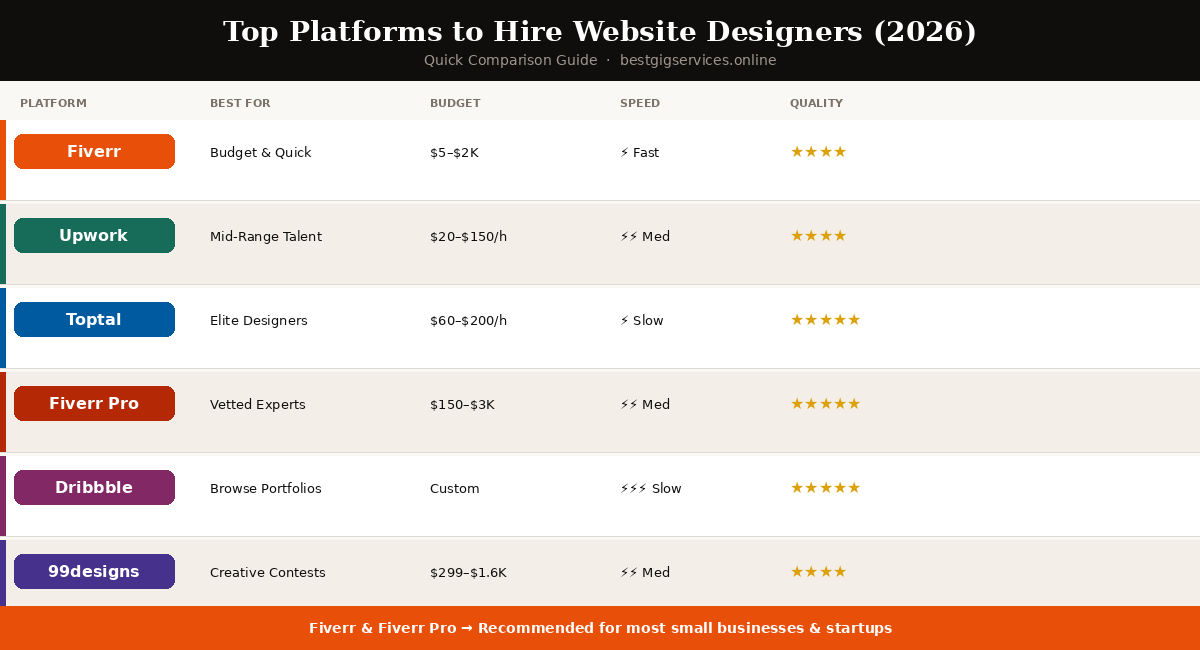
Platform Comparison At a Glance
| Platform | Best For | Starting Budget | Vetting | Speed |
|---|---|---|---|---|
| Fiverr | Budget projects, small sites | $50 | Community ratings | Same day |
| Fiverr Pro | Quality freelancers, mid-budget | $150 | Manual vetting | 1–2 days |
| Upwork | Mid-range, complex projects | $500 | Portfolio + ratings | 1–3 days |
| Toptal | Premium quality, zero compromise | $2,000+ | Top 3% screened | 24–48 hrs |
| Dribbble | Aesthetic-specific, niche styles | $1,000+ | Portfolio-based | 3–10 days |
| Behance | Branding-heavy projects | $500+ | Portfolio-based | 3–7 days |
| 99designs | Multiple concepts, contests | $299 | Tiered levels | 7 days |
| Long-term hires, contracts | $1,500+ | Work history | 1–3 weeks |
The 7 Best Places to Hire Website Designers in 2026
1. Fiverr — Best for Budget-Conscious Projects and Fast Turnarounds
Best for: Small businesses, startups, solo entrepreneurs, landing pages
Price range: $50 – $2,000+ per project
Vetting level: Community ratings + Fiverr Choice badges
Time to hire: Same day
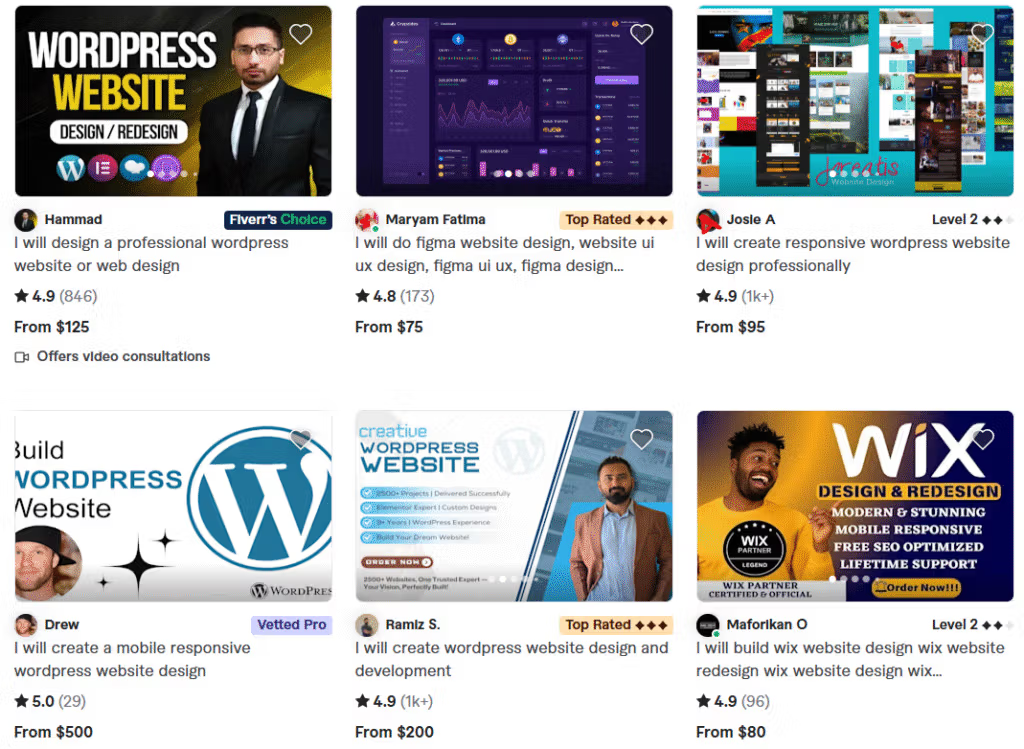
Fiverr remains the most popular entry point for anyone hiring a website designer for the first time. With millions of active gigs across every possible niche — WordPress design, Shopify stores, Webflow builds, custom HTML/CSS, and more — the sheer volume of choice is unmatched anywhere else.
What makes Fiverr genuinely useful in 2026 is the structure it puts around every transaction. Each gig comes with a clearly defined scope, a fixed price, a delivery timeline, and a stated number of revisions. You know exactly what you’re getting before you hand over a cent. Fiverr holds your payment in escrow and only releases it once you approve the delivered work — meaning you’re financially protected throughout.
How to get the best results on Fiverr:
The biggest mistake buyers make on Fiverr is choosing a web designer based on price alone. A $49 website design offer might sound like a steal, but the output is typically a reused template with your logo slapped on top. Instead, sort by seller rating, look for designers with Top Rated or Fiverr Choice status, check that their portfolio includes real websites (not mockups), and read their most recent reviews carefully.
Write a specific, detailed brief. Vague instructions produce vague results. The more clarity you provide about your brand, target audience, preferred style, and technical requirements, the better the final output will be.
Fiverr Pro — for businesses that need higher quality
Fiverr Pro is a curated layer within Fiverr that manually vets designers before they can offer Pro-tier services. Pro sellers have industry experience, strong portfolios, and a track record of delivering complex projects. Pricing starts higher — typically $150 to $3,000+ per project — but the quality jump is significant. If your budget sits in the $500–$2,000 range and you want professional-grade work without the complexity of a full agency engagement, Fiverr Pro is one of the sharpest options available.
Verdict: Fiverr is the go-to platform for getting a professional-looking website built quickly and affordably. It’s ideal for businesses with a defined project scope and a tight budget.
2. Upwork — Best for Mid-Range Projects with Ongoing Collaboration
Best for: Growing businesses, complex builds, ongoing design relationships
Price range: $20 – $150+ per hour, or fixed-price projects from $500–$10K
Vetting level: Portfolio-based with community ratings
Time to hire: 1–3 days
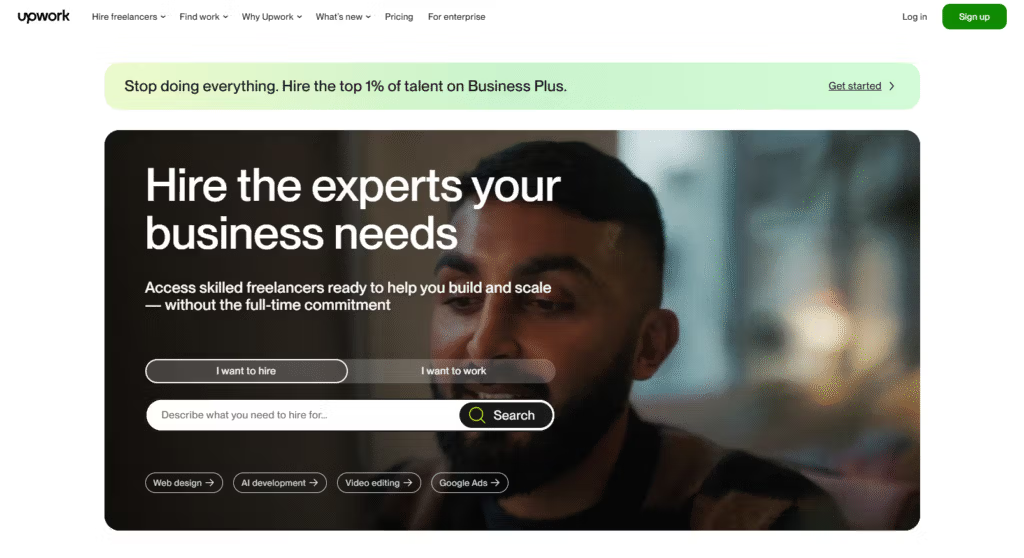
Upwork is the world’s largest freelance marketplace by active talent, and it gives you more control over the hiring process than almost any other platform. You post a detailed job description, set your budget range, and within hours you receive proposals from designers around the world. Each proposal comes with a portfolio, a cover letter, and a proposed rate.
The platform handles contracts, milestone-based payments, time tracking (for hourly contracts), and disputes — creating a structured working environment that suits projects requiring multiple rounds of feedback and iteration.
Upwork shines when your project has complexity that a simple gig can’t handle. A multi-page e-commerce store with custom functionality, a SaaS product landing page, or a brand redesign that requires several collaborative sessions all benefit from Upwork’s flexibility. You can set milestone payments tied to deliverables — for example, pay 30% after wireframes are approved, 40% after the design is signed off, and 30% on final delivery.
One key limitation: Upwork relies heavily on self-reported credentials and community ratings. There’s no central vetting like Toptal offers, which means the quality spread is wide. You can find exceptional designers on Upwork — and you can also find disappointing ones. The key is knowing how to evaluate proposals and how to ask the right questions before committing.
Verdict: Upwork is excellent for businesses with defined projects in the $500–$5,000 range who want an engaged, collaborative freelancer and the flexibility to iterate.
3. Toptal — Best for Elite, Pre-Vetted Talent
Best for: Businesses that need premium quality with zero compromise
Price range: $60 – $200+ per hour
Vetting level: Accepts fewer than 3% of applicants after multi-stage screening
Time to hire: 24–48 hours for match; trial week available
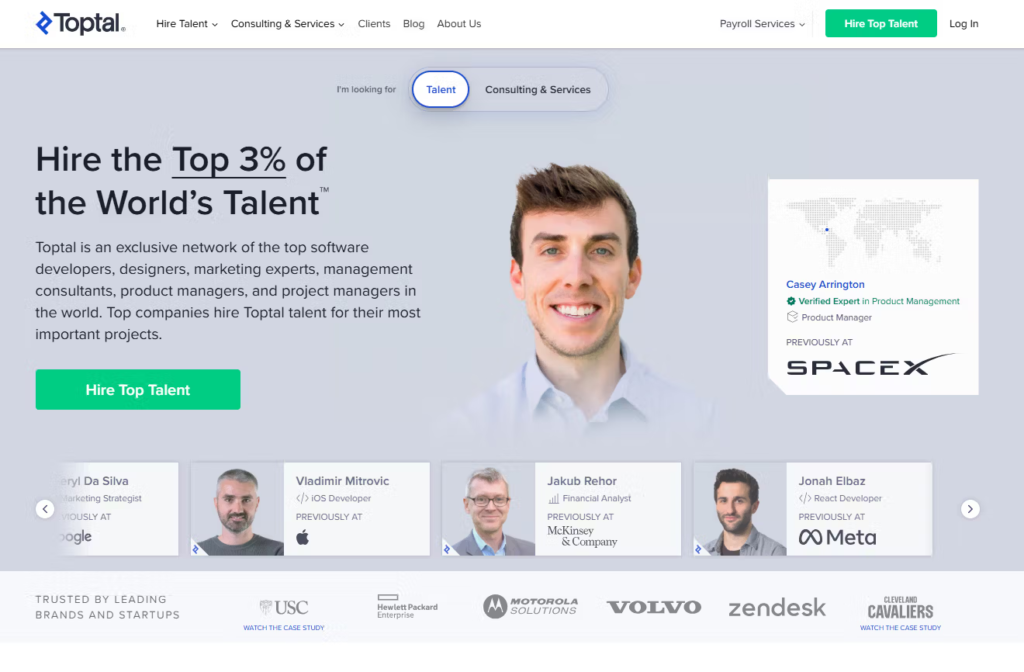
Toptal has built its reputation on one promise: you get the top 3% of freelance talent. Every designer on the platform goes through portfolio reviews, language assessments, technical skill evaluations, and test projects before being allowed to work with clients. The result is a talent pool that is smaller than Upwork or Fiverr but dramatically more consistent in quality.
If you’re building a product that will carry your brand’s reputation — a flagship website for a funded startup, a high-conversion landing page for a major product launch, or an enterprise-level platform — Toptal removes the guesswork entirely. You fill out a brief, and a Toptal matcher connects you with two or three designers they believe fit your needs. You then do a paid trial week to confirm the fit before committing to a longer engagement.
The trade-off is cost. Toptal designers don’t come cheap, and the platform model adds a layer of overhead. If your budget is under $2,000, Toptal probably isn’t the right fit. But for projects where quality directly affects revenue — and where a botched hire would be genuinely expensive — Toptal is one of the most reliable hiring decisions you can make.
Verdict: Toptal is built for teams and founders who refuse to compromise on quality and have the budget to back it up.
4. Dribbble — Best for Discovering Portfolio Talent and Niche Specialists
Best for: Brands with specific aesthetic goals, luxury businesses, design-forward projects
Price range: Fully negotiable; typically $50–$200/hour
Vetting level: Portfolio-driven, no formal screening
Time to hire: 3–10 days (requires direct outreach)
Dribbble is where the design world showcases its best work. Unlike the structured marketplaces above, Dribbble functions more like an art gallery than a hiring platform. Designers post their work publicly, you browse until you find a style that resonates with your brand, and then you reach out directly to inquire about availability and pricing.
This approach is slower than posting a job on Fiverr or Upwork, but it’s extraordinarily powerful when you need a very specific aesthetic. If your brand is luxury and editorial, if you need a UI that feels surgical and modern, or if you want a designer whose existing portfolio already looks like what you want — Dribbble is unbeatable for discovery.
Dribbble also hosts a job board where you can post project listings and attract inbound applications. Many of the top independent designers in the world maintain active Dribbble profiles, and finding one whose style aligns with your vision is a genuinely valuable discovery.
Verdict: Don’t use Dribbble to find cheap talent quickly. Use it to find the right designer when quality and aesthetic alignment matter more than speed and price.
5. Behance — Best for Adobe-Ecosystem Designers and Creative Professionals
Best for: Branding projects, graphic-heavy websites, visual storytelling
Price range: Negotiable; varies by designer
Vetting level: Portfolio-driven, Adobe-integrated
Time to hire: 3–7 days
Behance is Adobe’s design portfolio network, which makes it particularly strong for finding designers who work heavily within the Adobe Creative Suite — Photoshop, Illustrator, XD, and more. Many of the world’s most talented graphic designers, illustrators, and brand identity specialists maintain active Behance profiles.
For website design specifically, Behance is most valuable when your project involves strong visual branding — custom illustrations, rich photography integration, complex typography systems, or a brand identity that needs to translate seamlessly into a web environment.
Like Dribbble, Behance requires proactive outreach rather than structured proposals. Browse portfolios, shortlist designers whose style matches your vision, and contact them through the platform’s messaging system. Many designers on Behance also post their availability and client inquiry details directly on their profiles.
Verdict: Behance is the right discovery tool for projects where visual branding and creative identity are central to the design brief.
6. 99designs (by Vista) — Best for Running Design Contests
Best for: Logo + website packages, brand identity, businesses wanting multiple concepts
Price range: $299 – $1,599 for contest packages
Vetting level: Community ratings; tiered designer levels
Time to hire: 7 days for contest results
99designs operates on a fundamentally different model from every other platform on this list. Rather than hiring a single designer directly, you launch a design contest where multiple designers submit concepts based on your brief, and you choose the winner.
This approach has a unique advantage: you receive several different creative directions before committing to one. If you’re not entirely sure what visual direction your brand should take, a 99designs contest gives you real options to compare — not just mockups in a proposal, but actual, completed design explorations.
The platform is particularly strong for logo design, brand identity, and website design packages. You set your budget, write a detailed brief (99designs guides you through this with structured questions), and typically receive 30–100+ designs within the first few days. You give feedback, designers iterate, and at the end of seven days you select your winner and receive all final files.
One important note: 99designs works best when you invest time in writing a genuinely detailed brief. Contest submissions are only as targeted as your instructions. Vague briefs produce generic entries.
Verdict: 99designs suits businesses that want to explore multiple creative directions before committing, and that want a combined logo + website identity package.
7. LinkedIn — Best for Hiring Experienced Designers for Ongoing Roles
Best for: Businesses looking for long-term contractors or full-time hires
Price range: Fully negotiable; typically $40–$120/hour
Vetting level: Work history verified; recommendations visible
Time to hire: 1–3 weeks
LinkedIn is underused as a web designer hiring platform, but it’s one of the most powerful options available — particularly if you want a long-term relationship rather than a one-off project. LinkedIn profiles show full work history, endorsements from colleagues and clients, recommendations, and links to portfolio sites.
You can post a job listing that targets designers by skill set, location, and experience level. Alternatively, you can search directly for designers using LinkedIn’s advanced filters — searching for “web designer,” filtering by location, experience level, and past employers — and reach out with a direct connection request and message.
LinkedIn also provides a layer of social proof that anonymous freelance profiles can’t match. When a designer has 15 recommendations from past clients, a work history with recognizable companies, and a portfolio website linked from their profile, you can do genuine due diligence before ever sending a message.
Verdict: LinkedIn is the right platform when you need a trusted, experienced designer for an ongoing relationship — not a one-and-done gig.
How to Hire a Website Designer: A Step-by-Step Process
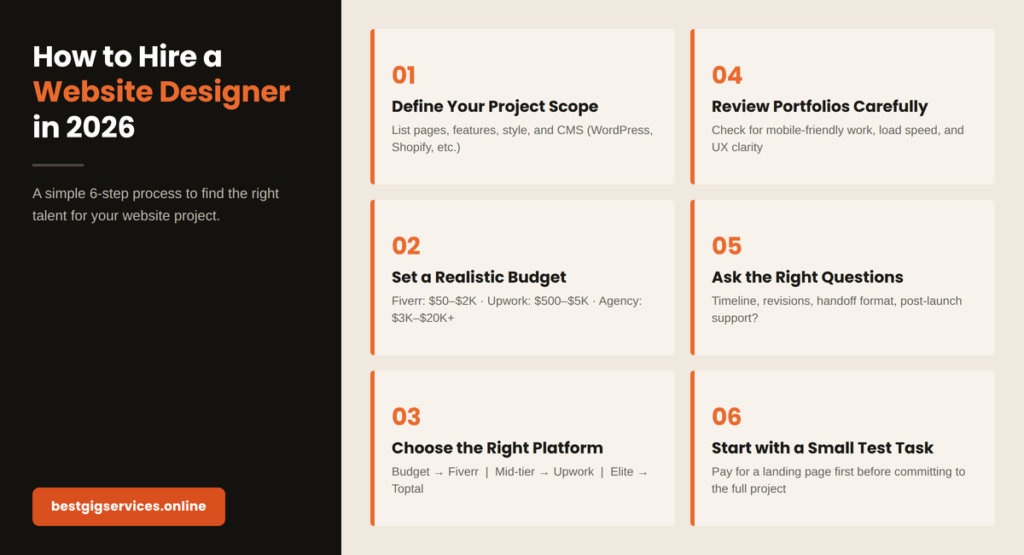
Knowing which platform to use is only half the battle. Hiring well requires preparation. Here’s the exact process to follow:
Step 1 — Define Your Project Scope in Writing
Before you post a job or contact a single designer, write down:
- Website purpose: Is this an e-commerce store, a service business site, a portfolio, a blog, or an app landing page?
- Page count: How many pages does the site need? (Homepage, About, Services, Contact = 4 pages minimum)
- Platform preference: Do you want WordPress, Webflow, Shopify, or coded from scratch?
- Design style: Collect 3–5 reference websites that represent the visual direction you like
- Deadline: When does the site need to be live?
- Must-have features: Contact forms, newsletter integration, booking system, payment processing?
The more specific your brief, the more accurate your proposals will be — and the less room there is for scope creep later.
Step 2 — Set a Realistic Budget
Here’s a straightforward breakdown of what different budgets get you in 2026:
- Under $200: A simple 3–5 page site built on a WordPress template, with your content dropped in. Expect a polished but off-the-shelf look.
- $200 – $800: A customized template-based site on Fiverr or Upwork with unique visual elements, basic SEO setup, and mobile optimization.
- $800 – $3,000: A genuinely custom design with a clear visual identity, original layouts, UX-focused structure, and proper handoff documentation. This is the sweet spot for most small businesses.
- $3,000 – $10,000+: Custom-built, conversion-optimized sites with unique development, animations, third-party integrations, and ongoing support. Agency-level work.
Don’t set a budget that’s unrealistically low for what you actually need. A $100 website for an e-commerce business with 200 products will never get you where you want to go.
Step 3 — Choose the Right Platform for Your Budget
Match your budget to the platforms most likely to deliver at that price point:
- Under $500 → Fiverr (standard gigs, Top Rated sellers)
- $500 – $2,000 → Fiverr Pro or Upwork
- $2,000 – $5,000 → Upwork or 99designs
- $5,000+ → Toptal, vetted agencies, or LinkedIn senior contractors
Step 4 — Evaluate Portfolios With These Specific Criteria
When reviewing a designer’s portfolio, don’t just ask “does this look nice?” Ask:
- Does their work cover my industry or a similar one? A designer with 20 portfolio pieces, all of which are restaurant sites, might not be the right fit for a SaaS landing page.
- Are the sites mobile-responsive? Open their portfolio examples on your phone. If they break or look cramped, that tells you everything.
- Do the designs guide the user toward action? Look for clear call-to-action buttons, logical page hierarchy, and clean navigation.
- Are real, live websites included — or just static mockups? A portfolio full of Figma mockups and no live URLs is a yellow flag. Live sites prove real-world execution capability.
- Is the loading speed reasonable? Paste a portfolio URL into Google PageSpeed Insights. A designer who builds slow sites should not be building yours.
Step 5 — Ask the Right Questions Before You Hire
A brief interview — even just a few written questions — saves enormous headaches later. Ask:
- What is your typical delivery timeline for a project of this size?
- How many revision rounds are included?
- Do you hand off design files (Figma, PSD) as well as the live site?
- Will you provide post-launch support if something breaks?
- Do you use a page builder (Elementor, Divi) or code directly?
- Have you worked with [your specific platform — WordPress/Shopify/Webflow] before?
Any designer worth hiring will answer these questions clearly and confidently.
Step 6 — Start with a Small Test Task
Unless you’re hiring through Toptal (which has its own paid trial model), always test a new designer before committing your full project budget.
Ask them to design a single landing page, redesign your homepage concept, or create three header layout options. Pay fairly for this test task. What you learn from a small paid test — their communication style, whether they hit the deadline, how they handle feedback, whether the output matches the brief — is worth far more than any proposal or portfolio review.
Common Mistakes to Avoid When Hiring a Website Designer
Choosing purely on price. The $49 gig that promises a “professional, beautiful, unique website” is almost always a template with your logo inserted. If you want a site that does real business work, you need to invest at least a few hundred dollars — ideally more.
Skipping the brief. Walking into a hiring conversation with nothing more than “I need a website” is a recipe for confusion and disappointment. Designers can only create what they’re briefed to create. Ambiguity in the input guarantees ambiguity in the output.
Not checking for mobile performance. Over 60% of web traffic globally now comes from mobile devices. A website that only looks good on a desktop is functionally broken for the majority of your audience.
Ignoring revision terms. Before you hire anyone, understand exactly how many revision rounds are included in the price. Some designers include unlimited revisions; others charge per round after the first. Know this before you start, not after you’re mid-project.
Not asking about file delivery. When the project ends, you should receive the original design files (Figma, Adobe XD, or PSD), along with login credentials for the CMS and hosting. If a designer insists on keeping these, walk away.
Hiring someone who disappears post-launch. Ask explicitly whether they offer post-launch support and at what rate. Websites always need small fixes after launch — broken mobile views, typos that snuck through, plugin conflicts. A designer who will respond to those quickly is worth more than one who ghosts you the moment they deliver the final files.
Fiverr vs Upwork vs Toptal: Which Should You Actually Use?
This is the most common question, and the honest answer depends entirely on your situation.
Use Fiverr if: You have a limited budget (under $800), a clearly defined project scope, and need fast delivery. Fiverr excels at single deliverables with fixed scope. It’s the fastest path from brief to finished website for small businesses, bloggers, and service providers.
Use Upwork if: Your project requires ongoing collaboration, has a budget between $800 and $5,000, and involves enough complexity that you want to communicate directly throughout the process. Upwork gives you more flexibility to iterate and more control over the working relationship.
Use Toptal if: You have a budget of $5,000 or more, quality is non-negotiable, and you cannot afford the risk of a mediocre hire. Toptal’s vetting process eliminates the guesswork and connects you with genuinely experienced professionals.
For most small businesses and startups reading this guide, Fiverr Pro or Upwork will be the right answer in 2026. They offer the best balance of quality, cost, speed, and protection for the budget ranges most independent businesses are working with.
What to Expect at Different Price Points in 2026
Understanding what your money actually buys helps you set realistic expectations and make better hiring decisions.
A $200 – $500 budget gets you a well-customized WordPress or Shopify theme with your branding applied, your content inserted, and basic mobile optimization. The visual identity is borrowed from a template, but the execution is professional.
A $500 – $1,500 budget opens the door to genuinely custom layout work — unique section designs, original visual elements, and a site that doesn’t look like a template. At this level, you should expect proper mobile responsiveness testing, basic on-page SEO setup (meta titles, image alt tags, clean URL structure), and a clear handoff.
A $1,500 – $5,000 budget is where design strategy enters the picture. Designers at this level bring UX thinking, user flow planning, conversion rate optimization awareness, and the experience to build something that does more than look good — it guides visitors toward action. This is the right investment for businesses where the website is a primary sales or lead generation tool.
Above $5,000, you’re in full-service territory — original development, custom functionality, animated interactions, comprehensive brand guidelines, post-launch analytics setup, and ongoing support agreements.
Quick FAQ: Hiring Website Designers in 2026
How much does a freelance website designer charge in 2026?
Rates vary widely by platform and experience level. On Fiverr, project-based gigs range from $50 to $2,000+. On Upwork, hourly rates run $20–$150 per hour. Elite designers on Toptal typically charge $60–$200 per hour.
How long does a website design project take?
A simple 5-page site typically takes 2–4 weeks. A custom business site with 10–20 pages usually runs 4–8 weeks. Complex e-commerce or application sites can take 2–4 months.
What’s the difference between a web designer and a web developer?
A web designer handles the visual layout, user experience, color palette, typography, and overall aesthetic. A web developer takes the design and builds the functional, coded website. Many freelancers on platforms like Fiverr and Upwork offer both services, but it’s important to confirm this before hiring.
Can I hire a website designer for a Fiverr affiliate blog site?
Absolutely. A well-designed affiliate blog improves time-on-site metrics, reduces bounce rate, and makes it easier to guide readers toward your affiliate links naturally. Hiring a WordPress designer on Fiverr to set up a clean, fast, SEO-friendly blog theme is one of the most cost-effective investments an affiliate marketer can make.
What should I provide to a website designer when hiring?
Provide: your domain details, brand assets (logo, colors, fonts if you have them), 3–5 example websites you like, a list of pages needed, all written content (or let them know you need help sourcing it), and a clear deadline.
Final Recommendation: Where to Start Today
If you’re reading this and ready to hire, here’s the simplest action plan:
- Head to Fiverr.com and search for “WordPress website design.” Filter by Top Rated Seller and Fiverr Pro. Review 5–10 portfolios.
- Write your project brief using the scope-definition checklist from Step 1 above.
- Contact 3 designers who have portfolios that match your style. Ask them the qualification questions from Step 5.
- Assign a small test task to your favourite candidate before committing the full budget.
- Review deliverables against your brief at every milestone and communicate clearly throughout.
The best website designers in 2026 are accessible, affordable, and available right now. The only thing standing between you and a high-performing website is taking the first step.
Conclusion
Hiring a website designer in 2026 has never been more accessible — but the landscape is crowded enough that making a smart choice requires knowing where to look and what to look for. Fiverr and Fiverr Pro are the strongest starting points for most small businesses and affiliate site owners, offering fast turnarounds, protected payments, and talent across every budget range. Upwork is the right step up when your project is complex and collaborative. Toptal is the answer when quality is everything and budget is not the primary constraint.
Use this guide, write a tight brief, evaluate portfolios carefully, start with a test task, and you’ll hire with confidence.
This article is part of the BestGigServices.online hiring guide series. We cover the best freelance platforms, gig services, and Fiverr tips to help you find and hire skilled professionals online.