If you have ever scrolled through Fiverr at 1 a.m. trying to find “the one” web designer for your business site, you already know the feeling: hundreds of gigs, thousands of reviews, and no real way to tell who is actually good until you have already paid. I have hired, tested, and reviewed dozens of Fiverr web design gigs over the past few years, and the truth is that most bad outcomes are not bad luck. They are the result of a handful of avoidable mistakes that buyers make over and over again.
This guide breaks down the 10 most common mistakes people make when hiring a Fiverr web designer, why each one costs you time and money, and exactly what to do instead. Whether you are building a landing page for a side hustle or a full e-commerce store, this checklist will help you hire smarter and avoid the headaches that come with a rushed decision.
Why Hiring the Right Fiverr Web Designer Actually Matters
A website is often the first impression a potential customer has of your business. A slow, poorly coded, or badly designed site does not just look unprofessional; it actively costs you sales. On a marketplace as large as Fiverr, the skill gap between sellers is enormous. Some are agency-trained developers offering affordable rates on the side. Others are beginners who copy templates and hope for the best. Your job as a buyer is to filter out the noise, and that starts with knowing where most people go wrong.
Fiverr itself is not the problem. The platform simply connects buyers and sellers at scale, and like any large marketplace, quality varies enormously from one gig to the next. The buyers who consistently get great results are not the ones who got lucky. They are the ones who followed a repeatable process: they compared offers carefully, communicated clearly before spending money, and verified claims instead of taking them at face value. The ten mistakes below are drawn from patterns that show up again and again in freelance marketplace complaints, buyer forums, and post-mortems of failed website projects. Avoiding them will not guarantee perfection, but it will put the odds heavily in your favor.
Let’s get into the mistakes.
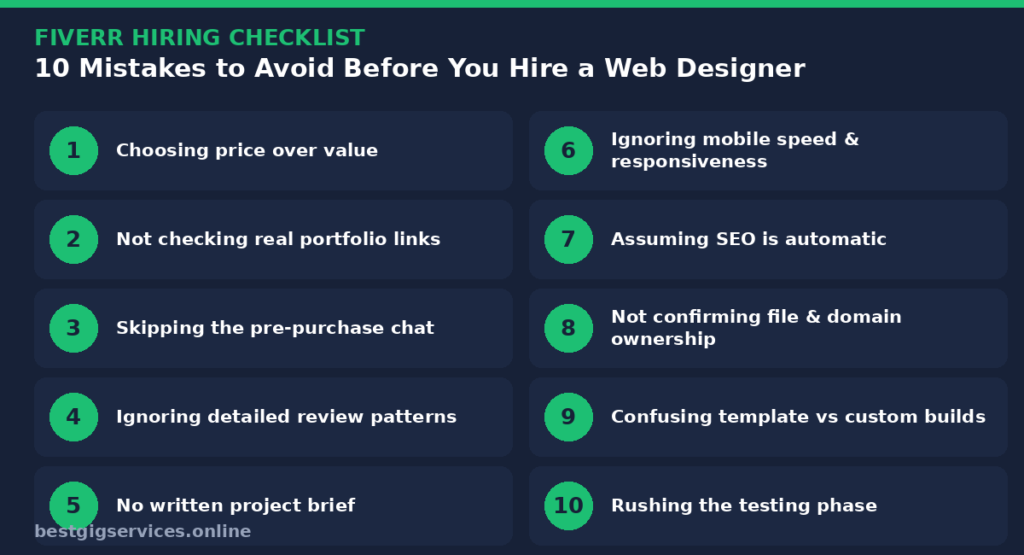
1. Choosing a Designer Based on Price Alone
This is the single biggest mistake I see, and it is understandable. Fiverr gigs can range from $15 to $1,500 for what looks like the same service on paper: “I will design your website.” Naturally, a lot of buyers gravitate toward the cheapest option, especially if they are on a tight budget.
The problem is that price on Fiverr rarely reflects effort in a linear way. A $15 gig often means a designer is churning out dozens of near-identical template sites a week with almost no customization, no real testing, and no time budgeted for revisions. When something breaks after delivery, you may find the seller has already moved on to the next order in the queue.
This does not mean you need to spend a fortune. It means you should judge value, not price. Compare what is actually included: number of pages, number of revisions, whether the price includes basic SEO setup, mobile responsiveness, and post-delivery support. Two gigs priced $50 apart can have wildly different scopes of work once you read the fine print. Always read the full package description before deciding a price is “too high” or “a steal.”
A useful mental model here is cost per outcome rather than cost per gig. A $40 site that needs to be rebuilt three months later because it cannot handle basic traffic, will not accept form submissions correctly, or ranks nowhere on Google is far more expensive than a $200 site that works properly from day one. Factor in your own time as well. Every hour you spend chasing a seller for fixes, troubleshooting a broken plugin, or redoing work is time taken away from actually running your business. When you compare gigs, try building a simple table with three or four sellers, listing price, number of pages, number of revisions, delivery time, and anything extra like SEO or hosting setup. Seeing the comparison laid out side by side almost always makes the “best deal” far more obvious than judging price in isolation.
2. Not Checking Portfolio Work Outside the Fiverr Profile Page
Fiverr profile portfolios can be misleading. Some sellers display polished mockups that were never actually built as functioning websites, or they showcase templates purchased from marketplaces like ThemeForest and simply reskin them for every client screenshot. A pretty image in a portfolio tile tells you almost nothing about whether the underlying site works, loads quickly, or is properly coded.
Before hiring, ask the seller directly for links to three or four live websites they personally built, ideally ones that are still active and being used by real businesses. Open those sites on both desktop and mobile. Check how fast they load, whether buttons and forms actually function, and whether the design holds up when you resize the browser window. If a seller hesitates to provide live links or only offers static screenshots, treat that as a warning sign rather than an oversight.
3. Skipping the Message-Before-You-Buy Step
Fiverr allows you to message a seller before placing an order, and this step is far more important than most buyers realize. A quick conversation reveals a lot: how quickly they respond, whether they understand your project in plain English, whether they ask clarifying questions about your goals, and whether their communication style matches yours.
Ordering blind, without any conversation, is like hiring an employee without an interview. You might get lucky, but you are relying on luck rather than judgment. Use this pre-purchase chat to describe your business, your target audience, and your must-have features. A skilled designer will usually respond with thoughtful questions about your niche, your competitors, or your content, rather than immediately pushing you toward the most expensive package.
4. Ignoring Reviews That Mention Revisions and Communication
Star ratings on Fiverr can be deceiving because many buyers leave five stars out of politeness, even when the experience was mediocre. The real signal is in the written reviews, specifically the ones that mention communication, revision turnaround, and how the seller handled problems.
When scanning reviews, look for recurring patterns rather than one-off comments. If multiple reviews mention slow replies, unfinished work, or having to fight for revisions, that pattern is far more predictive of your own experience than a handful of five-star ratings with no detail. Pay close attention to any negative reviews as well. A seller with 500 reviews and a 4.9 rating might still have a cluster of one-star reviews describing the exact same issue, such as missed deadlines or hidden charges for basic changes.
5. Not Defining Your Own Requirements Before Contacting Sellers
A huge number of failed Fiverr projects trace back to the buyer, not the seller. If you approach a designer with only a vague idea like “I want a nice website for my business,” you are handing over creative control to someone who does not know your brand, your customers, or your goals nearly as well as you do.
Before you even browse gigs, write a short brief for yourself. Include your business name and what it does, three to five competitor websites you like or dislike, the core pages you need (home, about, services, contact, and so on), any must-have features like booking forms or payment integration, and your general color or style preference. This does not need to be a formal document, a few bullet points in a notes app is enough. Sellers consistently deliver better results when the buyer arrives with clarity, because it removes guesswork and reduces the number of revision rounds needed.
Think of the brief as a filter as much as a planning tool. When you send the same clear brief to two or three different sellers, you can compare their responses directly. Does one seller ask better clarifying questions than the others? Does one immediately suggest a page structure that makes more sense for your industry? These small signals, gathered before any money changes hands, are often more revealing than a portfolio review, because they show you how the seller thinks and problem-solves in the context of your specific project rather than a generic showcase piece.
6. Overlooking Mobile Responsiveness and Page Speed
It is easy to fall in love with a beautiful desktop screenshot and forget to check how the design behaves on a phone, even though most website traffic today comes from mobile devices. A site that looks stunning on a 27-inch monitor can be a broken, unreadable mess on a smartphone if the designer did not build it with a mobile-first approach.
Page speed is the other overlooked factor. A visually heavy site with unoptimized images and bloated code can take five or six seconds to load, and studies on user behavior consistently show that a large share of visitors abandon a page after just a few seconds of waiting. Before finalizing any order, explicitly ask the seller how they handle image compression, caching, and mobile testing. Once you receive a draft, test it yourself using free tools like Google PageSpeed Insights and Google’s Mobile-Friendly Test rather than taking the seller’s word for it.
7. Assuming SEO Basics Are Automatically Included
Many buyers assume that any professionally designed website will naturally show up on Google. In reality, basic on-page SEO, things like proper heading structure, meta titles and descriptions, image alt text, clean URL structures, and an XML sitemap, has to be deliberately built in. Some Fiverr gigs include this as standard, others charge extra, and some skip it entirely unless you ask.
Clarify exactly what SEO elements are included in your package before you order. At minimum, ask whether the designer will set proper title tags and meta descriptions for each page, use a logical heading hierarchy (one H1 per page, organized H2s and H3s), compress and label images correctly, and submit a sitemap to Google Search Console. If full SEO strategy work is out of scope for your budget, that is fine, but you should know that going in rather than discovering it after launch when your beautiful new site is invisible in search results.
8. Not Clarifying Ownership of Files, Domain, and Hosting Access
This mistake can be the most expensive one on this list. Some Fiverr sellers build sites on their own hosting accounts or under their own developer logins, particularly for platforms like WordPress, and do not hand over full admin access unless it is explicitly requested. If your relationship with that seller ever sours, or they simply disappear (which does happen on freelance marketplaces), you can be locked out of your own website.
Before the project starts, confirm in writing through Fiverr’s messaging system that you will receive full ownership of the domain, hosting account (or migration to your own hosting), all theme and plugin licenses, and admin-level login credentials upon completion. For WordPress projects specifically, make sure you get admin access to the WordPress dashboard, not just a “viewer” or editor role. Keeping this conversation in Fiverr’s official chat also protects you if a dispute arises later, since Fiverr can review message history during resolution.
It is worth being just as careful about premium plugins and themes. Some designers use paid tools under their own personal license and simply reuse that license across multiple client sites, which can violate the terms of that license and leave you without support or updates once the project wraps up. Ask directly whether any paid themes or plugins were used, and if so, whether the license will be transferred to you or whether you will need to purchase your own. It is a small question that can save you from a nasty surprise when a plugin stops receiving updates or security patches a few months after launch.
9. Overlooking the Difference Between Template Customization and Custom Design
Not all “custom website design” gigs mean the same thing. A large percentage of affordable Fiverr web design gigs actually involve customizing a pre-built theme, for example a WordPress theme or an Elementor template, rather than building a site from scratch. This is not inherently bad; template-based sites can be fast to launch, budget-friendly, and perfectly professional. The problem arises when a buyer expects a fully bespoke design but receives a lightly modified template, or vice versa, when a buyer only needed a simple template site but paid custom-development prices.
Ask directly whether the gig involves a theme or page builder (like Elementor, Divi, or WordPress Gutenberg) or fully hand-coded HTML, CSS, and JavaScript. Neither option is objectively better, they serve different needs and budgets, but you should know which one you are paying for so your expectations match the final deliverable.
10. Rushing the Timeline and Skipping a Testing Phase
Fiverr’s delivery countdown can create a false sense of urgency. Buyers sometimes accept a rushed delivery just to “get it over with,” skip testing the site thoroughly, and only discover broken contact forms, missing pages, or layout issues on mobile weeks later, often after the free revision window has already closed.
Build a buffer into your expectations from the start. Even if a gig promises a three-day turnaround, plan for at least a few extra days to test every page, click every button, submit every form, and check the site across multiple browsers and devices before marking the order complete on Fiverr. Once you approve delivery, most sellers are far less willing (or, depending on the gig terms, no longer able) to make free changes. Treat the final approval step as your last checkpoint, not a formality.
A Quick Pre-Hiring Checklist
Before you commit to a Fiverr web designer, run through this short list:
- Have you compared what is actually included in each package, not just the price?
- Have you viewed at least three live, working websites the seller personally built?
- Have you messaged the seller and gauged their communication and understanding of your project?
- Have you read reviews specifically mentioning revisions and communication issues?
- Do you have a written brief of your goals, must-have pages, and style preferences?
- Have you asked how mobile responsiveness and page speed will be handled?
- Have you clarified what SEO basics are included?
- Have you confirmed you will receive full ownership of your domain, hosting, and admin access?
- Do you know whether you are getting a custom build or a customized template?
- Have you allowed enough time to thoroughly test the site before final approval?
If you can check off every item on this list, you are in a far stronger position than the average Fiverr buyer, and you dramatically reduce the odds of an expensive redo down the line.
Final Thoughts
Fiverr remains one of the most accessible places to find affordable web design talent, and plenty of buyers walk away with sites that serve their business well for years. The difference between a smooth experience and a frustrating one usually comes down to preparation on the buyer’s side. Slow down before you order, ask the questions in this guide, and treat the hiring process with the same seriousness you would apply to hiring an in-house employee. Your website is often the first handshake with a new customer, and it is worth getting right the first time.
None of these ten mistakes require special technical knowledge to avoid. They require patience, a short amount of upfront planning, and a willingness to ask direct questions before money changes hands. The buyers who skip these steps are not necessarily careless, they are usually just busy and eager to get a project moving. But a rushed hiring decision almost always costs more time in the long run than the few extra hours spent vetting a seller properly upfront. Treat this guide as a repeatable checklist for every website project you outsource, not a one-time read, and you will find that hiring on Fiverr becomes far less of a gamble and far more of a predictable, manageable process.
Frequently Asked Questions
Is Fiverr a good place to hire a web designer?
Yes, for many small businesses and solo entrepreneurs, Fiverr offers a wide range of skill levels and price points. The key is vetting sellers carefully rather than picking the first gig that appears in search results.
How much should I expect to pay for a professional website on Fiverr?
Prices vary widely based on scope, but a basic multi-page business website with mobile responsiveness and light SEO setup commonly falls in the low-to-mid three-figure range, while more complex e-commerce or custom-coded builds can run considerably higher.
What is the biggest red flag when hiring a Fiverr web designer?
Reluctance to share live examples of past work, combined with vague answers about ownership of hosting, domain, or admin access, are two of the clearest warning signs.
Should I always choose the highest-rated seller?
Ratings are a useful starting point, but reading the written reviews for patterns around communication and revisions will tell you more than the star average alone.
Do I need a separate developer for SEO after my site is built?
Not necessarily. Basic on-page SEO can and should be handled during the design process. Ongoing SEO strategy, content marketing, and link building are typically separate services, but the technical foundation should be in place from day one.