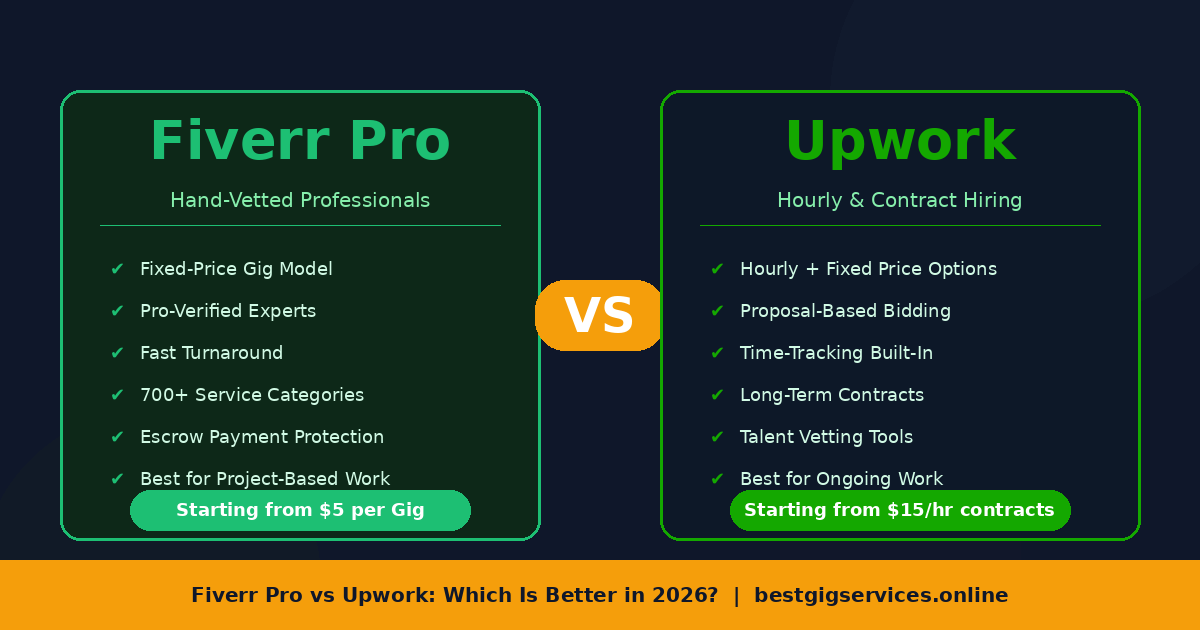
Fiverr Pro vs Upwork — an honest, in-depth comparison for businesses in 2026. Discover pricing, talent quality, speed, and which platform fits your exact needs.
If you’ve been trying to decide between Fiverr Pro and Upwork in 2026, you’re not alone. Both platforms dominate the freelance marketplace landscape, and both have genuine strengths — but they serve very different business needs in very different ways.
This isn’t a generic “both are great” review. This is a real, practical breakdown based on how each platform actually functions for business owners, startup founders, and marketing teams trying to get quality work done without overspending or wasting weeks on hiring.
By the end of this article, you’ll know exactly which platform fits your situation — and why.
Table of Contents
What Is Fiverr Pro?
Before diving into the comparison, it’s worth clarifying what Fiverr Pro actually is, because many people confuse it with the standard Fiverr marketplace.
Fiverr Pro is a curated layer within the Fiverr platform that features hand-vetted freelancers who have gone through a rigorous application process. These aren’t just any sellers — they’re professionals with verified credentials, impressive portfolios, and a track record of delivering premium-quality work.
While the broader Fiverr marketplace has millions of sellers at varying skill levels (some excellent, some not), Fiverr Pro narrows the field dramatically. When you hire a Fiverr Pro seller, you’re accessing talent that Fiverr’s internal team has reviewed and approved. The experience is closer to working with a boutique agency than browsing a crowded marketplace.
Fiverr Pro operates on the same Gig-based, fixed-price model as regular Fiverr. You browse listings, review portfolios, select a package, and purchase. The key difference is the assurance of professional quality that comes with the Pro badge.
What Is Upwork?
Upwork is a different kind of animal entirely. Rather than a browse-and-buy model, Upwork is structured around job postings and proposals. As a client, you post a project or role, write a description of what you need, and wait for freelancers to submit proposals — including their rates and relevant experience.
You then review those proposals, shortlist candidates, conduct interviews (via Upwork’s messaging system), and hire the person you feel is the strongest fit. For hourly engagements, Upwork provides a built-in time-tracking desktop application that logs the freelancer’s screen activity and hours worked automatically.
Upwork is the dominant platform for longer-term, more complex, or ongoing work arrangements. It’s where businesses find virtual assistants who work 40 hours a week, developers embedded in product teams for months, and content writers on rolling retainer contracts.
The Core Difference in One Sentence
Fiverr Pro is a marketplace where you buy professional services the way you’d buy a product online — instantly, at a fixed price. Upwork is a hiring platform where you recruit, interview, and contract freelancers the way you’d engage a staffing agency.
That single distinction explains nearly every other difference between the two.
Side-by-Side Comparison: Fiverr Pro vs Upwork
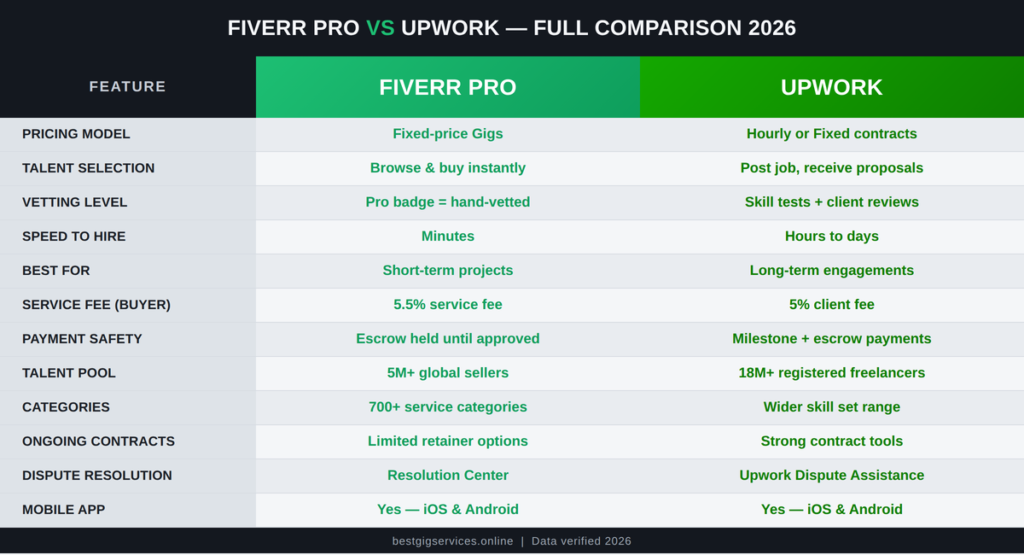
Let’s get into the specifics across the dimensions that matter most to business buyers.
1. Pricing Model
Fiverr Pro: Fixed-price Gigs. You see the price before you commit. No negotiation, no hourly guesswork. A Pro Gig for brand identity design might be $400. You know exactly what you’ll pay before you click “purchase.”
Upwork: Flexible — either hourly or fixed-price contracts. Hourly rates can range from $15 per hour for general tasks up to $250+ per hour for specialized technical or consulting work. For hourly work, your final bill depends on how many hours are actually logged.
The verdict on pricing: If budget predictability matters to you, Fiverr Pro wins. If you need flexibility for work that’s hard to scope upfront, Upwork’s hourly model makes more sense.
2. Service Fees
Understanding what each platform charges beyond the listed price is critical for accurate budgeting.
Fiverr Pro buyers pay a 5.5% service fee on all purchases, with a minimum fee of $2.50 applied to orders under $50. On the seller side, Fiverr takes 20% of the Gig price — which means sellers factor that into their listed rates.
Upwork clients pay a 5% client marketplace fee on all contracts. Freelancers on Upwork pay a tiered service fee: 20% on the first $500 earned with a client, dropping to 10% between $500.01 and $10,000, and 5% beyond $10,000 — incentivizing long-term relationships.
The verdict on fees: Both platforms charge comparable buyer fees (5–5.5%). Upwork’s tiered freelancer fee structure does encourage longer-term relationships, which can ultimately benefit clients through lower effective rates over time.
3. Talent Quality and Vetting
This is arguably the most important factor for businesses who care about the actual output.
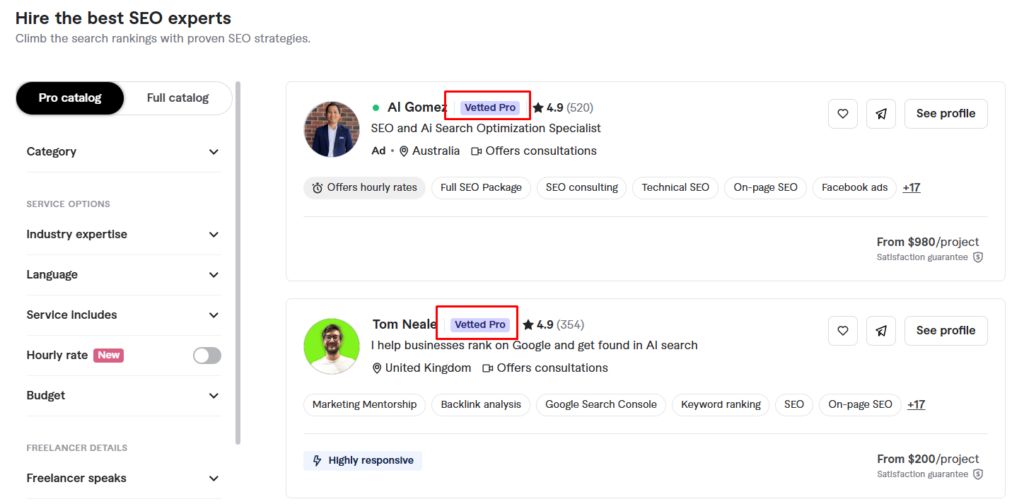
Fiverr Pro: Sellers earn the Pro badge through a formal vetting process that includes reviewing their portfolio, verifying their professional background, and assessing communication skills. The Pro designation is a meaningful quality signal — not just a badge you earn by completing a certain number of orders.
That said, the broader Fiverr marketplace (non-Pro sellers) is far more mixed. If you accidentally hire outside the Pro tier, quality can be inconsistent. Always confirm the Pro badge when searching.
Upwork: Upwork’s vetting is different. Talent Scout programs exist for high-demand categories, and some specialists carry “Expert-Vetted” designation. But in the general marketplace, vetting is largely handled through skills tests, portfolio reviews, and — most importantly — client feedback scores accumulated over time. A freelancer with a Job Success Score above 90% and hundreds of hours logged is generally a safe hire.
The challenge on Upwork is the proposal stage itself. For every strong proposal, you’ll likely receive several low-effort, template-filled bids. Filtering through them takes time and experience.
The verdict on quality: Fiverr Pro gives you a more streamlined path to verified quality. Upwork’s quality ceiling is arguably higher for deeply specialized technical roles, but finding that talent requires more effort.
4. Speed to Hire
Fiverr Pro Hiring: You can go from discovering a seller to having an active project in under five minutes. Browse, read the Gig, purchase, send a brief. That’s it. If the seller has short delivery times listed, work can begin immediately.
Upwork Hiring: Even a smooth hiring process on Upwork typically takes one to three days minimum. You write a job post, wait for proposals, review applications, message shortlisted candidates, conduct interviews, agree on terms, and then initiate the contract. For urgent business needs, this timeline is a genuine limitation.
The verdict on speed: Fiverr Pro wins decisively for any situation where you need work started quickly.
5. Best Project Types
This is where understanding your own business needs is essential.
Fiverr Pro excels for:
- Logo design and brand identity packages
- Blog posts, web copy, and product descriptions
- Social media graphics and content
- Promotional and explainer videos
- Website design mockups and landing pages
- Podcast intros and voiceovers
- One-time audits (SEO audits, UX reviews, etc.)
- Translation and transcription work
- Pitch deck design
Upwork excels for:
- Ongoing virtual assistant work (20–40 hrs/week)
- Long-term software development projects
- Embedded marketing or operations roles
- Full-scale mobile app or web platform builds
- Ongoing social media or content management
- Research projects requiring deep subject familiarity
- HR, legal, or financial advisory roles
- Multi-phase projects requiring sustained collaboration
6. Communication and Collaboration
Fiverr Pro: Communication happens within Fiverr’s built-in messaging system. After purchasing a Gig, you submit a brief — answering the seller’s required questions — and the project begins. You can exchange messages throughout the project, but the structure is transactional by nature.
Upwork: Upwork’s platform is built more explicitly for collaboration. You can conduct video interviews before hiring, integrate Zoom calls, use milestone-based project structures, and build a working relationship over weeks or months. The platform is designed for ongoing engagement, not just single transactions.
The verdict on collaboration: For short, well-defined tasks, Fiverr Pro’s structure is perfectly adequate. For complex projects requiring relationship-building, regular check-ins, and iterative feedback over time, Upwork’s collaboration tools are superior.
7. Payment Protection
Fiverr Pro: Funds are held in escrow from the moment you place an order. The seller only receives payment after you approve the delivery. You have three days to review the work, and if revisions are needed, you can request them within the scope agreed in the Gig. Disputed orders go to Fiverr’s Resolution Center, which can issue partial or full refunds in cases where the seller failed to deliver as described.
Upwork: For fixed-price projects, Upwork uses milestones — you fund individual milestones as you go, and the freelancer requests payment after completing each phase. For hourly contracts, Upwork’s payment system processes charges weekly based on logged hours, with a review window before billing. Disputes go through Upwork’s Dispute Assistance process.
The verdict on payment protection: Both platforms offer strong buyer protection. Fiverr Pro’s model is simpler. Upwork’s milestone system gives more granular control over complex, multi-phase projects.
Pros and Cons: A Clear-Eyed Look
Fiverr Pro: Pros
- Hire in minutes with no application or bidding process
- Fixed pricing removes budget guesswork entirely
- Vetted professionals clearly identified by platform badge
- Enormous range of categories in one place
- Strong buyer protection through escrow system
- Easy to compare multiple sellers before committing
Fiverr Pro: Cons
- Not designed for long-term, ongoing contract work
- Lacks time-tracking tools for hourly arrangements
- Communication structure can feel transactional
- The standard marketplace quality varies wildly outside Pro tier
- Harder to build deep, sustained working relationships
Upwork: Pros
- Excellent infrastructure for long-term and retainer-based work
- Hourly billing with automated time tracking
- Ability to interview and assess candidates before hiring
- Milestone-based payment gives control over multi-phase work
- More suitable for complex, evolving project scopes
- Strong freelancer accountability tools built into the platform
Upwork: Cons
- Slower hiring process — days, not minutes
- Proposal volume can be overwhelming and inconsistent in quality
- Client 5% fee plus freelancer fees mean higher effective costs
- Requires more effort upfront to write a compelling job post
- Learning curve for new clients unfamiliar with the platform
Which Platform Has Better Customer Support?
This is a question many comparison articles skip, but it matters when something goes wrong.
Fiverr Pro offers customer support through its Resolution Center for order disputes, a general support ticket system, and — for Fiverr Business customers — access to a dedicated customer success manager. Response times on standard support tickets can vary, but the Resolution Center process is well-documented and follows clear procedures.
Upwork has a more robust support infrastructure for business clients, particularly those using Upwork Business or Enterprise plans. Live chat support, dedicated account management, and a formal Dispute Assistance process are available. For enterprise-level companies, Upwork provides direct account support that goes well beyond what individual users receive.
The verdict on support: Both are adequate for standard use. Upwork edges ahead for enterprise clients with complex needs.
Fiverr Pro vs Upwork: For Specific Business Types
Let’s get even more specific based on the kind of business you’re running.
For solo entrepreneurs and freelancers: Fiverr Pro is almost always the better starting point. You can get professional design, copywriting, or technical work done quickly and affordably without navigating a complex hiring process.
For small businesses (2–20 employees): A hybrid approach works well. Use Fiverr Pro for project-based creative work (branding, content, video). Use Upwork when you need an ongoing resource like a part-time marketing coordinator or a VA who works regular hours.
For startups in growth mode: Fiverr Pro is powerful for rapid execution — getting landing pages designed, pitch decks polished, or product descriptions written without the delays of traditional hiring. Upwork becomes valuable when you need to embed a developer or growth marketer for a sustained period.
For established companies and agencies: Both platforms serve different functions simultaneously. Fiverr Pro handles overflow creative and content work. Upwork handles longer-term contractor relationships that sit closer to part-time employment in structure.
What About Fiverr Business vs Upwork Business?
Both platforms have enterprise or team-oriented tiers worth mentioning.
Fiverr Business is a dedicated workspace for teams that need to manage multiple freelance relationships under one account. It includes consolidated billing, shared team access, a dedicated customer success manager, and access to a curated network of pre-vetted professionals. For companies that regularly use freelancers across departments, Fiverr Business adds meaningful structure.
Upwork Business (and Upwork Enterprise) offer similar team management features with additional compliance tools, talent cloud capabilities for building your own pre-approved freelancer roster, and dedicated account support. Upwork’s enterprise offering is generally more sophisticated for very large organizations running significant contractor operations.
The Affiliate Angle: Fiverr Pro’s Program vs Upwork’s
If you’re a content creator, blogger, or entrepreneur who earns income through affiliate marketing — as many readers of this site do — there’s an important distinction between the two platforms worth knowing.
Fiverr’s Affiliate Program is one of the most generous in the freelance marketplace space. Affiliates can earn between $15 and $150 per new buyer (CPA model) depending on the category, or opt for a Revenue Share model. The affiliate dashboard is clean, the cookie window is generous, and the range of creative assets available makes promotion straightforward.
Upwork’s Affiliate Program exists but is generally considered less competitive in terms of payout rates and program features compared to Fiverr’s offering.
For affiliate marketers and content sites in the freelance, business, or marketing niches, Fiverr’s affiliate program consistently outperforms Upwork’s on a per-referral earnings basis.
Final Verdict: Fiverr Pro or Upwork in 2026?
There is no single “better” platform — only the right platform for your specific situation.
Choose Fiverr Pro when:
- You have a defined, scoped project with clear deliverables
- You need work completed quickly — days, not weeks
- You prefer fixed pricing with no billing surprises
- Your project falls neatly into a service category (design, writing, video, etc.)
- You’re testing outsourcing for the first time and want low friction
Choose Upwork when:
- You need an ongoing contractor relationship (weeks or months)
- Hourly billing and time tracking are important for your workflow
- Your project is complex, evolving, or hard to scope upfront
- You want to interview and evaluate candidates before committing
- You’re building a distributed team or virtual staff
The smart move for most businesses in 2026: Use both. Fiverr Pro for project-based creative and marketing work. Upwork for longer-term technical or operational roles. The two platforms complement each other more than they compete.
Frequently Asked Questions
Is Fiverr Pro more expensive than Upwork?
Not necessarily. Fiverr Pro gigs range from around $100 to several thousand dollars depending on the service. Upwork hourly rates can accumulate quickly on longer projects. For a one-time deliverable, Fiverr Pro is often more cost-effective. For extended engagements, Upwork’s rates may work out lower.
Is Upwork more trustworthy than Fiverr?
Both platforms are legitimate and have strong buyer protection mechanisms. Fiverr’s escrow system and Upwork’s milestone payments both protect clients effectively. Neither platform has a meaningful trustworthiness advantage over the other.
Can I use both Fiverr Pro and Upwork simultaneously?
Absolutely. Many businesses use Fiverr for project-based creative work and Upwork for ongoing operational or technical support simultaneously. There’s no reason to be exclusive to one.
Which platform is better for finding a web developer?
For a short-term web project with defined scope, Fiverr Pro has excellent developers. For a complex, multi-month build where you want to interview candidates and track hours, Upwork is the stronger choice.
Does Fiverr Pro guarantee quality?
The Pro badge indicates that Fiverr has reviewed and approved the seller’s credentials and portfolio. It’s a meaningful quality signal, but no platform can guarantee the outcome of any specific project. Reading the seller’s recent reviews and communicating clearly about your requirements remains essential.
Which platform is better for beginners?
Fiverr Pro is far more beginner-friendly from a buyer perspective. The browse-and-buy model requires no knowledge of how to write effective job postings, evaluate proposals, or conduct hiring interviews. For someone new to outsourcing, Fiverr Pro’s structure removes almost all friction from the process.
Resources to Help You Get Started
Ready to explore both platforms and find the right freelancers for your business?
For curated Fiverr service recommendations, honest seller reviews, and category-by-category guides to getting the best results on Fiverr, visit BestGigServices.online — your trusted resource for navigating the Fiverr marketplace with confidence.
Whether you’re hiring your first freelancer or scaling an existing outsourcing operation, making an informed platform choice is the first step toward getting professional results without overspending.
How to Get the Best Results Regardless of Which Platform You Choose
Whichever platform you decide to start with, a few universal principles consistently separate businesses that get great results from freelance outsourcing and those that don’t.
Write a Clear, Detailed Brief
This applies whether you’re filling out a Fiverr seller’s onboarding questions or writing an Upwork job posting. The more specific you are about your goals, target audience, tone of voice, format requirements, and examples of work you admire, the closer the final output will be to what you actually want.
Vague briefs produce vague results. A detailed brief — even a simple two-page document covering your brand guidelines, objectives, and reference examples — transforms the quality of work you receive from almost any competent freelancer.
Start Smaller Than You Think You Need To
Even if you’re planning a large engagement, starting with a small, lower-stakes test project is almost always worth it. On Fiverr Pro, this might mean ordering a single piece of content from a writer before commissioning a full content calendar. On Upwork, it might mean starting a freelancer on a two-week paid trial before offering a three-month contract.
This approach costs a little more in the short term but dramatically reduces the risk of investing heavily in a working relationship that doesn’t perform as expected.
Communicate Throughout, Not Just at the Start
Many buyers submit a brief, disappear for five days, then review the delivery with fresh eyes and disappointment. Active check-ins during longer projects — even just a quick message halfway through to confirm the direction is right — prevent significant misalignments and revision cycles.
This matters more on Upwork for longer projects, but it applies on Fiverr Pro too, especially for complex deliverables like brand identity work or website development.
Build a Preferred Seller List
After working with freelancers on either platform, track the ones who consistently deliver quality, communicate professionally, and meet deadlines. On Fiverr, you can save favorite sellers. On Upwork, you can invite previously worked-with freelancers to new contracts directly.
Building this curated list is one of the highest-leverage things you can do as a regular outsourcer. Over time, you stop spending hours searching and vetting new sellers for every project — you simply reach back out to people you already trust.
Understand What Each Platform Is Optimized For
The biggest mistake businesses make is using the wrong platform for the wrong job — hiring a long-term virtual assistant through Fiverr’s transactional structure, or trying to get a simple logo made through Upwork’s proposal-and-interview process. Each platform is optimized for specific use cases. Use them accordingly and you’ll get better results dramatically.
2026 Trends: How Both Platforms Are Evolving
Both Fiverr and Upwork are actively developing new features and responding to shifts in the broader freelance economy. A few trends worth watching in 2026:
AI-integrated services: Both platforms now host a growing number of freelancers who specialize in AI-assisted workflows — content creators who use AI tools responsibly as part of their process, developers building AI-powered applications, and data specialists helping businesses implement machine learning solutions. This category is growing fast on both platforms.
Subscription and retainer models: Fiverr has been expanding its subscription Gig options, allowing buyers to lock in recurring monthly deliveries with preferred sellers. This moves the platform slightly closer to Upwork territory for ongoing work arrangements.
Enterprise focus: Both platforms are investing heavily in their enterprise and business-tier offerings, recognizing that larger organizations represent their highest-value customers. Expect more sophisticated team management, compliance, and analytics tools from both as 2026 progresses.
Vetted talent programs: The industry-wide shift toward higher-quality, pre-vetted talent continues. Both platforms are investing in making their top-tier talent more visible and accessible, responding to buyer demand for quality assurance rather than sheer volume of options.
A Final Word on Choosing Wisely
The freelance economy in 2026 is more mature, more competitive, and more full of opportunity than at any previous point. Platforms like Fiverr Pro and Upwork have made it genuinely possible for businesses of any size — from solo founders to mid-market companies — to access professional expertise that would have been cost-prohibitive or geographically impossible a decade ago.
The decision between them isn’t really about which platform is “better.” It’s about which one is better suited to the specific work you need done, the timeline you’re working within, and the working relationship style your projects require.
Use this guide as your reference point whenever that question comes up. And when you’re ready to find your next Fiverr freelancer, make sure to explore the curated recommendations and category guides at BestGigServices.online — built specifically to help you get more value from every dollar you spend on Fiverr.