You placed an order, paid upfront as Fiverr requires, and now something’s gone wrong. Maybe the seller went quiet. Maybe the delivery doesn’t match the gig description at all. Maybe you just clicked “buy” on the wrong package by mistake. Whatever the reason, the question is the same: can you actually get that money back, and how?
The short answer is yes, in most situations — but Fiverr’s refund system isn’t a single button. It’s a layered process built around cancellations, a Resolution Center, and a set of rules that change depending on whether your order is still active or already marked complete. This guide breaks down exactly how it works, what you’re entitled to, and the steps to follow so you’re not guessing your way through a support ticket.
Table of Contents
How Fiverr Refunds Actually Work
Before diving into the process, it helps to understand one thing that surprises a lot of buyers: Fiverr refunds don’t go straight back to your card or PayPal by default.
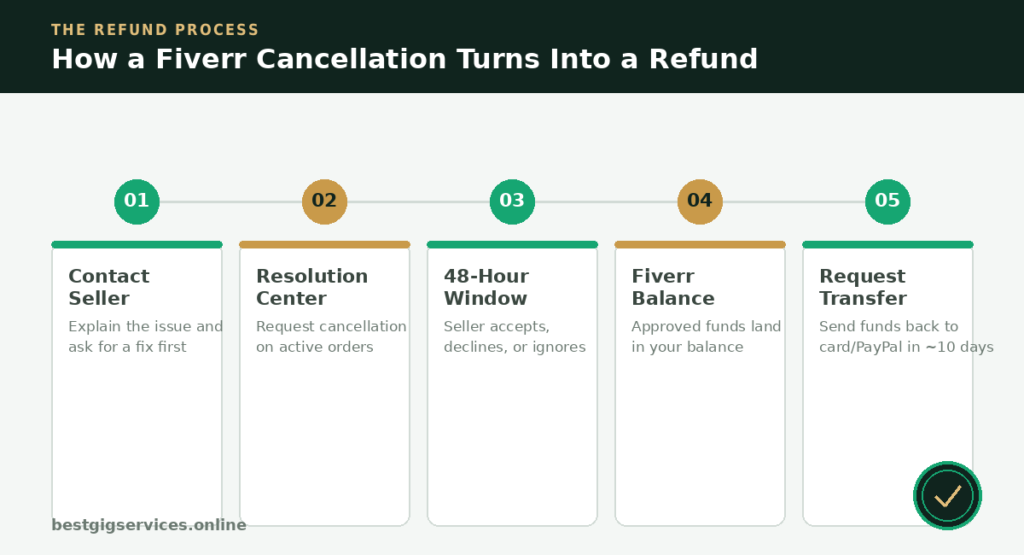
When an order is canceled, the funds are first credited to your Fiverr Balance, not your original payment method. That balance sits in your account and is automatically applied toward your next purchase. If you’d rather have the money sent back to the card or PayPal account you originally paid with, you have to request that separately, using the “Request a Refund” button under the Available Balances tab in Billing and Payments.
A few practical details worth knowing:
- Fiverr can only refund the same payment method you originally used. There’s no option to redirect a refund to a different card or account.
- Requesting a refund to your original payment method is currently only available through the Fiverr website or the iOS app, not through the Android app.
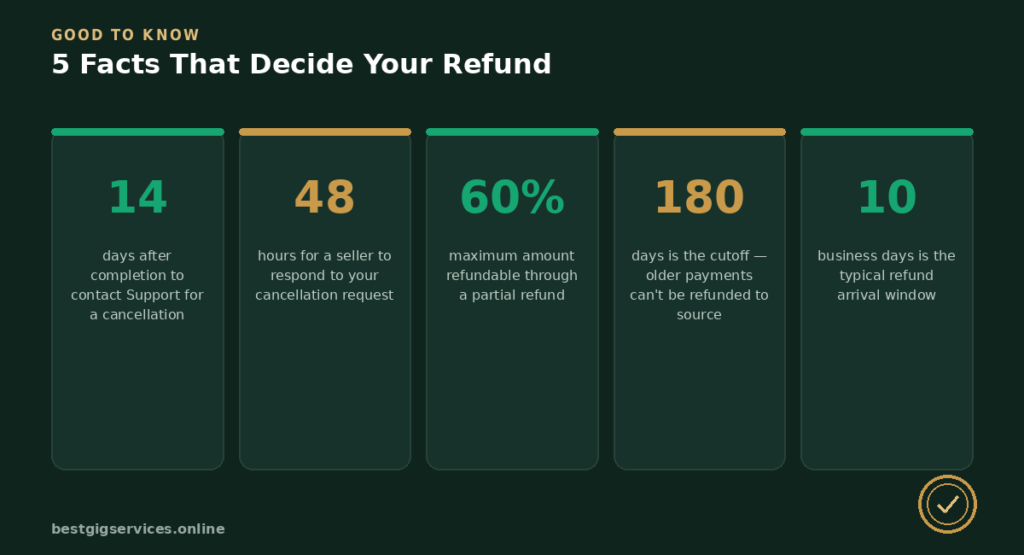
- Once approved, refunds to a card or PayPal typically arrive within 10 business days, depending on how quickly your bank or provider processes it.
- If your original payment was made more than 180 days ago, or if that payment method is no longer active, the refund request can fail outright. In that case, canceling the order still credits your Fiverr Balance, but the money can’t be pushed back out to a dead card or closed account.
- Fiverr Credits are a different animal entirely. They’re non-refundable and expire three months after you receive them, so they can’t be converted back into cash under any circumstance.
Step 1: Understand What “Cancellation” Actually Means Here
On Fiverr, a refund is really just the financial side-effect of a successful order cancellation. There’s no separate “refund request” for an active order — you request a cancellation, and if it’s approved, the refund process follows automatically.
This matters because it shapes your entire strategy. Your first move isn’t to demand money back; it’s to cancel the order the right way, through the right channel, with the right justification.
Step 2: Try to Resolve It With the Seller First
Fiverr explicitly encourages buyers and sellers to sort out problems between themselves before anything is escalated. In practice, this isn’t just a formality — many sellers would rather revise a delivery, extend a deadline, or offer a partial refund than have a cancellation show up against their account, since cancellations can affect their completion rate and search visibility.
Before opening a dispute, send a clear, specific message explaining exactly what’s wrong and what you’d consider a fair resolution: a revision, a partial refund, or a full cancellation. This single step resolves a large share of Fiverr disputes without needing Fiverr’s involvement at all.
Step 3: Use the Resolution Center for Active Orders
If direct communication doesn’t get you anywhere, the Resolution Center is your next stop — but only while the order is still active, meaning it hasn’t yet been marked as completed.
Here’s the process:
- Go to your Orders page and open the order in question.
- Click Resolution Center on the right-hand side of the order page.
- Choose Cancel order, select a reason, and add a short explanation.
- Click Send Request.
From here, the seller has 48 hours to accept or decline your cancellation request. If they don’t respond in that window, the order is automatically canceled and the refund process kicks in on your behalf.
There are two situations where you don’t even need the seller’s approval to cancel:
- Before you’ve submitted your project requirements. If you paid but haven’t yet sent the seller the details they need to start, you can cancel immediately — though this specific option is only available on the Fiverr website, not the app.
- When the order is very late. If delivery is more than 24 hours past the agreed deadline, you can cancel without waiting on the seller’s response.
One quirk to keep in mind: if there’s already an open dispute on the order — say, a delivery-date extension request — you’ll need to withdraw that first before you can submit a cancellation request. Fiverr only allows one active Resolution Center request per order at a time.
Step 4: What Happens If the Order Is Already Marked Completed?
This is where a lot of buyers get stuck. Once an order status flips to “Completed” — either because you approved the delivery or because the review window passed automatically — the Resolution Center is no longer available for that order.
That doesn’t mean you’re out of options. You have 14 days from the completion date to contact Fiverr’s Customer Support team directly and request a cancellation or refund. You’ll need to explain the issue and provide any evidence that supports your case: screenshots, message history, or a comparison between what was promised and what was delivered. Support reviews these requests individually, so a well-documented case tends to move faster than a vague complaint.
Past that 14-day mark, getting money back becomes considerably harder, since there’s no longer a built-in mechanism designed for it.
Partial Refunds: A Middle Ground Worth Knowing About
Not every issue calls for canceling the whole order. If the scope changed, the delivery was late, or you’re only partly satisfied, a partial refund can be a faster, less disruptive fix — you keep the delivered work, and the seller returns a portion of what you paid.
There’s an important detail here: only the freelancer can formally initiate a partial refund offer through the Resolution Center. As a buyer, you can’t submit one yourself — you request it by messaging the seller directly and agreeing on an amount, and they send the formal offer from their side.
Some rules that apply to partial refunds:
- The order must still be active, with an original value over $50.
- The refund amount must be at least $5 and no more than 60% of the original order price.
- Only the primary order amount is covered — any extras added afterward aren’t included in the calculation.
- Only one partial refund is allowed per order, and once accepted, it can’t be reversed or followed by another request.
- For milestone-based orders, a partial refund is only possible on the first milestone, before it’s marked complete.
- If you don’t respond to a partial refund offer within 3 days, it automatically expires.
Partial refunds are also available on completed orders, but only by contacting Customer Support directly, since the Resolution Center closes once an order is marked complete.
The Fiverr Pro Satisfaction Guarantee

If you booked through Fiverr Pro, there’s an extra layer of protection worth knowing about. Eligible Pro-managed orders come with a satisfaction guarantee: if the final delivery genuinely doesn’t meet what was agreed, you can contact Customer Support within 14 days of completion and request a full refund.
A couple of caveats apply. The refunded amount is credited to your Fiverr Pro Balance rather than sent back to your card automatically, and this guarantee does not cover hourly orders. It’s also worth knowing that if your refund is approved, you lose the right to use any part of the delivered work — the freelancer retains full ownership of what was created, since the transaction is being unwound.
What Actually Qualifies for a Refund (and What Doesn’t)
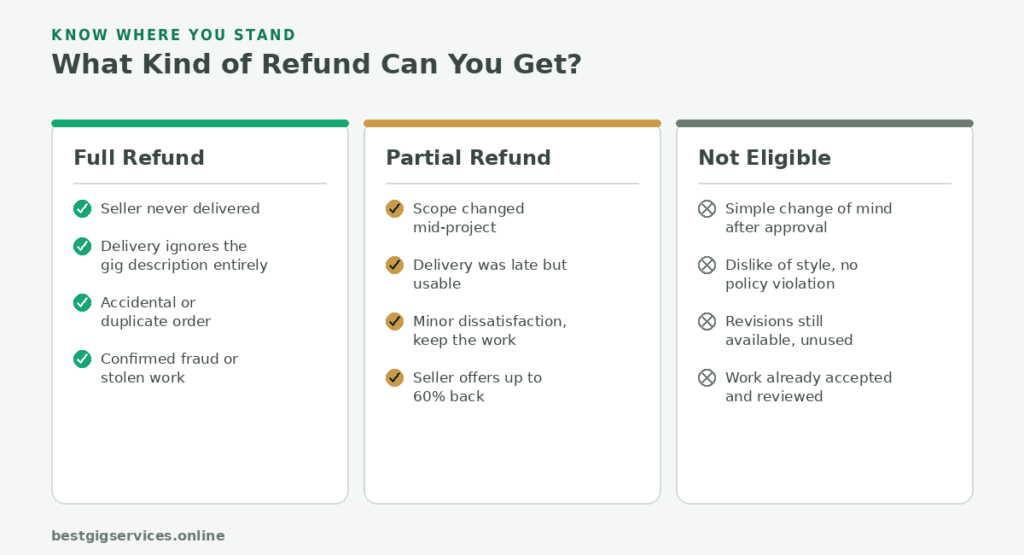
This is the part buyers most often get wrong. Simply not loving the final result isn’t, by itself, grounds for an automatic cancellation. Fiverr’s process is built around giving the seller a fair chance to fix the problem before money moves.
Situations that typically support a legitimate refund request:
- The seller never delivered, or went unresponsive for an extended period after the deadline passed
- What was delivered is substantially different from what the gig description promised
- The seller is unwilling to revise clearly agreed-upon deliverables
- You were charged for an order you never intended to place (accidental purchase)
- Evidence of fraudulent behavior, such as plagiarized or stolen work
Situations that are more complicated, or where a straight cancellation usually isn’t the first tool to reach for:
- General subjective dissatisfaction with the quality, when the seller is still offering revisions within the agreed scope
- Wanting a refund after already approving the delivery and using the work, without a substantive complaint
- Buyer’s remorse on a correctly delivered order
Fiverr’s own guidance is fairly direct on this point: if you’re not happy with a delivery, don’t approve it while planning to dispute it afterward — request a revision first. Once you accept a delivery, your negotiating position for a refund weakens considerably, since the order is treated as fulfilled.
How Long Does a Fiverr Refund Actually Take?
Assuming your cancellation is approved, here’s the realistic timeline:
- Immediately — the refunded amount appears in your Fiverr Balance.
- If you request a transfer to your original payment method — you’ll get an estimated arrival time on-screen, though Fiverr doesn’t send a separate “refund completed” confirmation.
- Typically within 10 business days — the money reaches your card or PayPal account, assuming your payment provider doesn’t add extra processing delays.
You can track recent refund activity by visiting the Available Balances tab and opening Refund History, which shows a timeline of requests made in the last 30 days.
A Few Tips to Avoid Ever Needing a Refund
The best refund is the one you never have to request. A handful of habits go a long way:
- Write a detailed brief before ordering, so there’s no ambiguity about what you’re paying for.
- Confirm scope and deadline in the message thread before the seller starts, not after.
- Never approve a delivery you haven’t fully reviewed, even if the countdown timer is pressuring you to.
- Keep all communication and payment on Fiverr. Moving a conversation off-platform, even briefly, removes you from Fiverr’s protection entirely if something goes wrong.
- Use revisions before jumping to cancellation. It’s faster, preserves the working relationship, and is usually what Fiverr’s own support team will ask you to try first anyway.
Frequently Asked Questions
Does Fiverr refund the service fee, not just the gig price?
Yes. When a cancellation is approved, the full order amount — including the service fee — is credited back to you, not just the freelancer’s portion.
Can I get a refund if I simply changed my mind?
If you haven’t yet submitted your project requirements, you can cancel immediately without needing the seller’s approval. Once work has started, you’ll generally need the seller to agree to the cancellation.
What if the seller declines my cancellation request?
You can escalate to Fiverr Customer Support, especially if you have evidence the delivery didn’t match the gig description or the seller was unresponsive.
Is there a limit to how many refunds I can request?
Fiverr monitors refund activity to prevent abuse, and unusually frequent refund requests can trigger account review. Legitimate, well-documented requests for real issues aren’t something to worry about.
Can I get a refund after leaving a review?
It’s technically possible if you escalate to Customer Support with a valid reason, but it becomes a harder case to make once an order has been marked complete and reviewed, so it’s best to raise concerns before that point.
Do chargebacks work differently from Fiverr refunds?
Yes. A chargeback goes through your bank or card issuer rather than Fiverr directly, and it can override Fiverr’s own resolution process. It’s generally a last resort, since it can also affect your buyer standing on the platform.
Final Thoughts
Fiverr’s refund system isn’t instant, and it isn’t automatic — but it is genuinely usable if you understand how it’s structured. The key moves are simple: try to resolve issues directly with the seller first, use the Resolution Center while the order is still active, know the 14-day window if the order’s already completed, and understand that a refund almost always starts as a cancellation rather than a standalone request. Handle it in that order, with clear documentation, and getting your money back becomes a straightforward process rather than a frustrating guessing game.