If you have ever typed “hire a freelancer” into Google, you already know the two names that show up first: Fiverr and Upwork. Both platforms connect millions of buyers with independent talent, both have been around for over a decade, and both get recommended constantly — often for completely opposite reasons. One article tells you Fiverr is faster and cheaper. The next tells you Upwork is more reliable for serious projects. Neither answer is wrong, exactly. They are just answering different questions.
This guide is Fiverr vs Upwork written specifically for buyers trying to decide where to hire in 2026 — not for freelancers trying to decide where to sell their services. It walks through how each platform actually works, what you will pay after all the fees are added in, how talent quality and vetting differ, and which platform tends to fit which kind of project. By the end, you should be able to match your specific hiring situation to the right marketplace instead of guessing.
The Core Difference: Gigs vs. Proposals
Everything else about Fiverr and Upwork flows from one structural difference in how each marketplace is built.
Fiverr is seller-first. Freelancers create “gigs” — pre-packaged service listings with a fixed scope, a set price (or a few pricing tiers), and a stated delivery time. As a buyer, you browse, compare listings, and essentially “add to cart” the way you would on an e-commerce site. You are choosing from what already exists rather than describing what you need and waiting for responses.
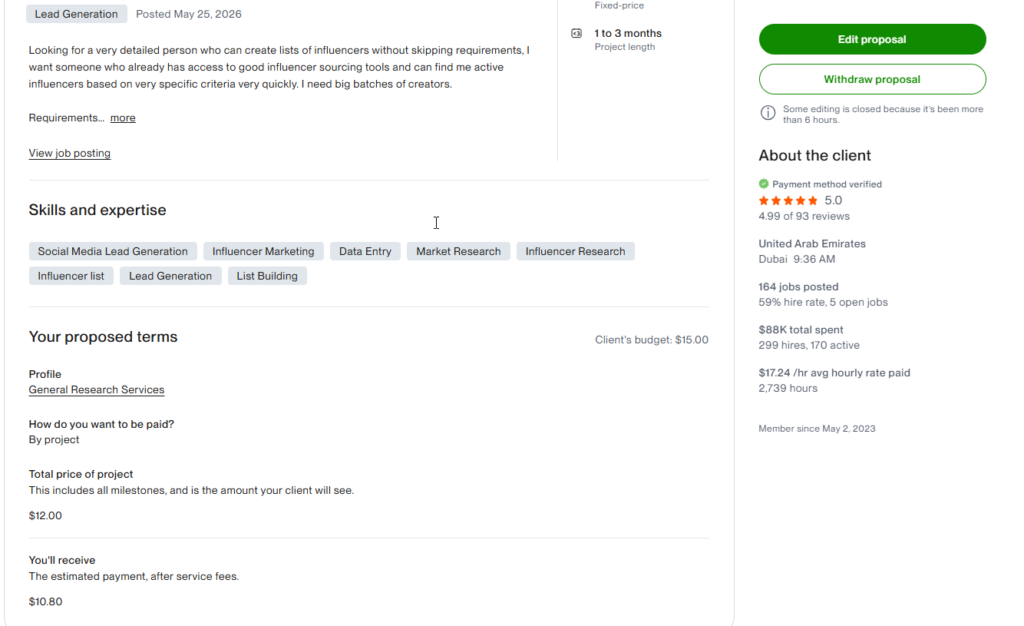
Upwork is buyer-first. You post a job description outlining what you need, and freelancers submit proposals with their approach, rate, and relevant experience. You review the proposals, message a shortlist, and select who to hire. It is closer to a hiring process than a shopping process.
Neither approach is inherently better — they are just optimized for different situations. Fiverr’s model is efficient when you already know exactly what you want and just need someone to execute it. Upwork’s model is stronger when your project needs some back-and-forth to define scope, or when you want to evaluate multiple candidates against your specific brief before committing.
How Pricing and Fees Actually Compare
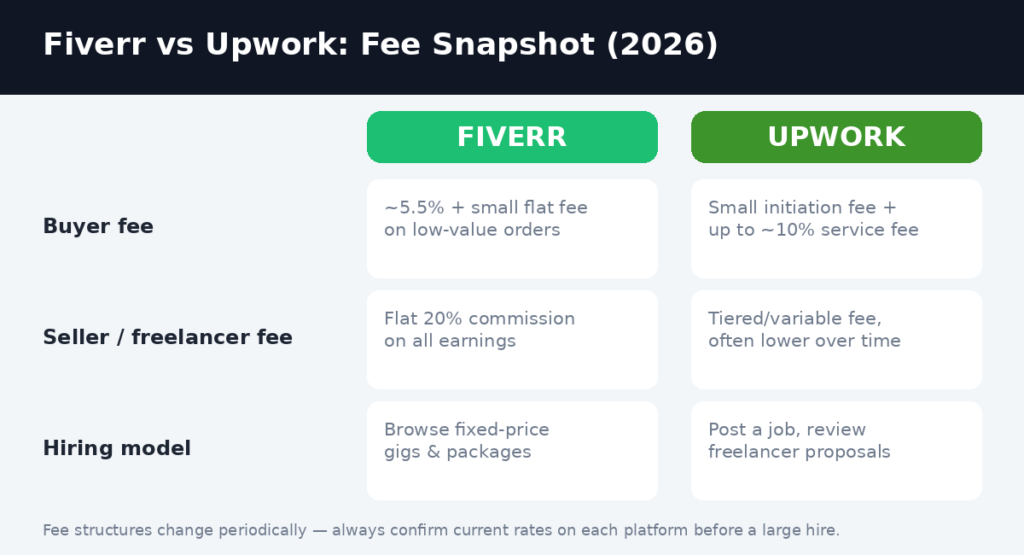
This is where most buyer comparisons get muddy, because the two platforms structure their fees completely differently, and the numbers you will see quoted online vary depending on when the source was written. Here is the clearest picture available as of 2026.
On Fiverr, buyers pay the seller’s listed gig price (or a custom quote) plus a standard buyer service fee of roughly 5.5%, and a small additional flat fee — commonly a few dollars — on orders that fall under a lower spending threshold. Sellers on Fiverr are charged a flat 20% commission on their earnings regardless of order size or how long they have worked with a given buyer.
On Upwork, buyers typically pay a one-time contract initiation fee (a small amount, generally under $15) plus a service or processing fee that can run up to around 10% depending on the contract type and plan. Freelancer-side fees on Upwork have historically used a tiered structure that starts higher for new client relationships and decreases as a freelancer bills more with the same buyer over time, though the platform has also been reported to be simplifying toward a flatter rate in various markets. Because fee structures on both platforms are adjusted periodically, it is worth checking the current fee page on whichever platform you plan to use before budgeting a large project.
What this means practically for buyers:
- For a single, clearly defined small task, Fiverr’s flat, transparent gig price is usually easier to estimate upfront because there is no proposal negotiation involved.
- For an ongoing relationship with the same freelancer, Upwork’s fee structure can become more cost-efficient over time for the freelancer, which sometimes translates into more competitive quoted rates from experienced Upwork freelancers who value repeat business.
- Neither platform’s advertised commission rate is the full story — always factor in the buyer-side service fee and any per-order minimums when comparing a quoted price across platforms.
The bottom line: Fiverr’s fee model rewards speed and simplicity, while Upwork’s model is built around the economics of longer relationships. If you are only comparing headline commission percentages without accounting for how you actually plan to use the platform, you are comparing the wrong numbers.
Talent Vetting and Quality Control
Buyers frequently ask which platform has “better” freelancers. The honest answer is that both have excellent talent and both have inconsistent talent — the real difference is in how each platform helps you filter for quality.
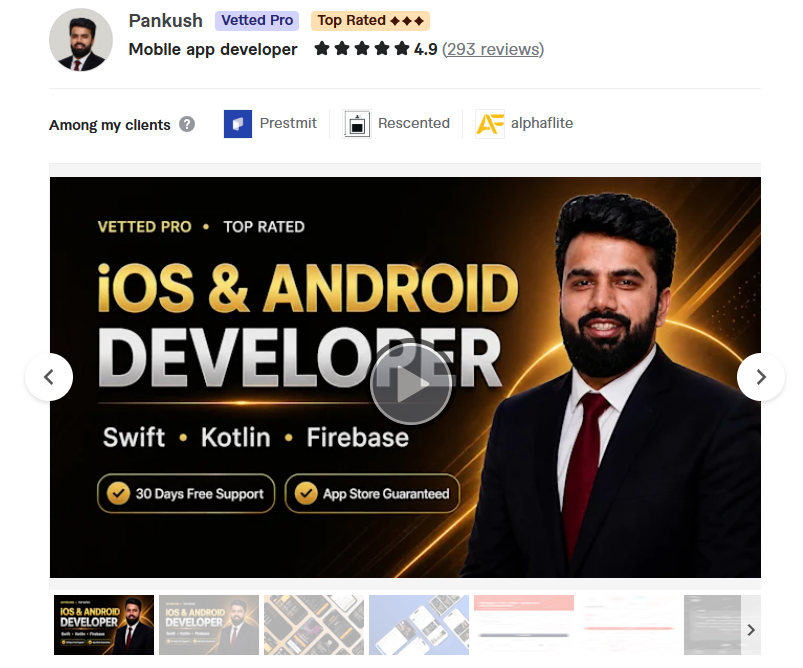
Fiverr relies primarily on a seller-level system (New Seller, Level 1, Level 2, Top Rated) based on order history, ratings, and response time, combined with buyer reviews on individual gigs. On top of the standard marketplace, Fiverr Pro adds a manually vetted layer where sellers are reviewed for professional background and portfolio quality before they can list Pro gigs, giving buyers a way to filter specifically for agency-caliber talent when the project justifies it.
Upwork uses a Job Success Score calculated from client feedback and project outcomes, along with optional skill certifications and an invite-only Expert-Vetted program for the platform’s most rigorously screened freelancers. Upwork also allows freelancers to build a visible work history and hourly-tracked project record, which can give buyers more transparency into how someone has actually performed across multiple past clients.
For buyers, the practical takeaway is this: on Fiverr, your quality signal comes mostly from gig-level reviews and seller badges tied to one type of service. On Upwork, your quality signal comes from a broader freelancer profile built across many different client relationships and contract types. If you want to evaluate someone’s overall track record as a professional rather than just their rating on one specific listing, Upwork’s profile structure tends to give you more to work with.
Project Types Each Platform Handles Best
Fiverr tends to be the stronger choice for:
- Well-defined, one-off deliverables — a logo, a short video edit, a product description, a voiceover
- Projects where you already know exactly what “done” looks like and do not need much back-and-forth to define scope
- Fast turnaround needs, since many gigs list delivery windows measured in days rather than weeks
- Buyers who prefer browsing finished portfolios and fixed prices over reviewing proposals
Upwork tends to be the stronger choice for:
- Complex or evolving projects where scope may shift as work progresses
- Long-term or recurring engagements, such as an ongoing content calendar, continuous development work, or a retained marketing consultant
- Hourly work that needs time tracking and activity logs for accountability
- Projects that benefit from comparing multiple detailed proposals against a custom brief before hiring
A useful mental test: if you can describe your project in a single sentence and expect a single deliverable back, Fiverr’s gig model will usually get you there faster. If your project needs a conversation before anyone can accurately scope it, Upwork’s proposal-based hiring process is built for that conversation.
Buyer Protections and Payment Security
Both platforms hold funds in escrow until work is approved, which protects buyers from paying for undelivered work on either marketplace. The mechanics differ slightly in practice.
On Fiverr, payment is tied to the specific gig order, and revisions or disputes are generally handled within the context of that single transaction through Fiverr’s resolution center. This works well for discrete, bounded projects where the deliverable is clearly defined from the start.
On Upwork, milestone-based payments are common for larger projects, meaning funds are released in stages as agreed-upon portions of work are completed and approved. Hourly contracts additionally use time-tracking software that logs activity, which some buyers find reassuring for accountability on longer engagements, though it does add a layer of oversight that not every freelancer or client prefers.
Neither system is without friction. Fiverr’s structure can feel limiting if a project’s scope legitimately needs to expand mid-order. Upwork’s milestone and time-tracking tools add more administrative overhead than a simple one-time gig purchase. Choose based on how much structure your specific project actually needs, rather than assuming more oversight is automatically better.
Onboarding Experience: What It’s Like to Hire on Each Platform
If you have never used either platform, the first-time experience differs enough to be worth walking through.
Hiring on Fiverr starts with a search bar. You type in what you need, browse gig listings, filter by budget, delivery time, or seller level, and open a few gigs that look promising to compare portfolios, packages, and reviews. From there, you either place an order directly against a listed package or message the seller to request a custom quote for something slightly different from their standard offering. The entire process, from search to order, can realistically take under fifteen minutes for a simple task.
Hiring on Upwork starts with writing a job post describing your project, budget expectations, and timeline. Once published, freelancers begin submitting proposals, and you will typically want to allow at least a day or two to gather enough submissions to compare meaningfully. You then review profiles, work history, and proposal content, message your shortlist with any clarifying questions, and formally hire through a contract that defines payment terms. This process takes longer upfront but often results in a more tailored match for complex needs.
Neither onboarding flow is objectively harder — Fiverr optimizes for speed, Upwork optimizes for fit. If you are hiring under time pressure for something simple, that difference alone may decide the platform for you.
A Side-by-Side Snapshot
| Factor | Fiverr | Upwork |
|---|---|---|
| Hiring model | Browse pre-made gigs, buy directly | Post a job, review proposals |
| Best for | Fixed-scope, one-off tasks | Complex, evolving, or long-term work |
| Typical seller fee | Flat 20% commission | Tiered/variable, often lower over time |
| Typical buyer fee | ~5.5% plus a small flat fee on low-value orders | Small contract initiation fee plus a service fee |
| Vetting signal | Seller levels, reviews, optional Pro tier | Job Success Score, work history, Expert-Vetted badge |
| Payment structure | Per-gig order, escrow-based | Milestones or tracked hourly billing |
| Time to hire | Often same-day | Usually a day or two for proposals |
Treat this table as a starting reference rather than a permanent snapshot — both platforms adjust fees and features periodically, so it is worth a quick check of each platform’s current documentation before a high-value hire.
Which Platform Should You Actually Choose?
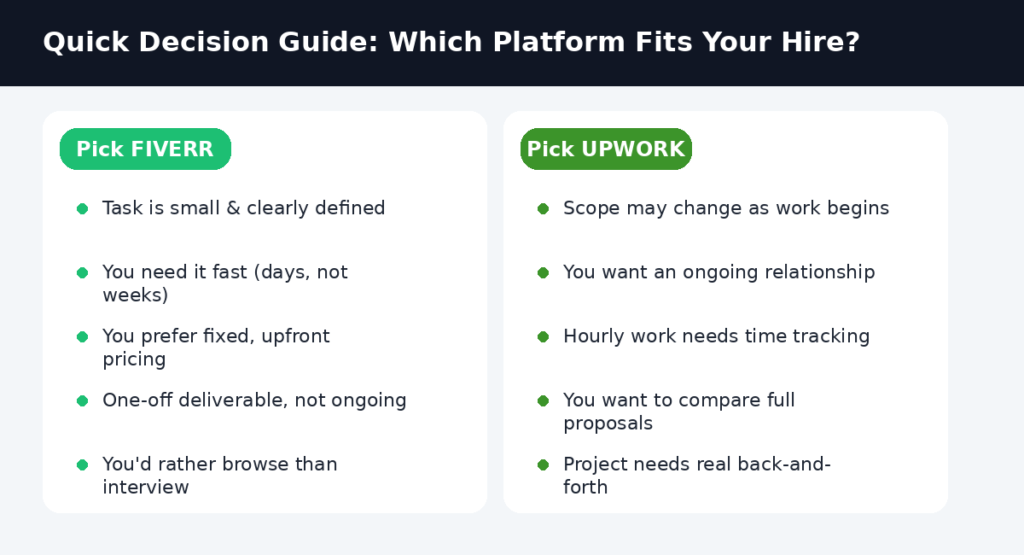
Instead of picking a “winner,” it is more useful to match the platform to your project type.
Choose Fiverr if: you need a fast turnaround on a clearly scoped task, you are comfortable buying from a portfolio and set price rather than negotiating scope, your budget is modest, or you are testing a new type of deliverable before committing to a bigger investment.
Choose Upwork if: your project will likely need scope discussions before a price makes sense, you want an ongoing relationship with the same freelancer over multiple months, you need hourly time tracking for accountability, or you are hiring for a role that benefits from reviewing a freelancer’s full history across many past clients rather than a single gig’s reviews.
Consider using both if: you regularly need different types of freelance help. Many experienced buyers keep a Fiverr relationship for quick, recurring small tasks — graphics, short edits, simple writing — while using Upwork for larger, more strategic engagements that benefit from a proposal-and-interview process. There is no rule that says you have to pick only one platform for every kind of hire.
Common Mistakes Buyers Make on Either Platform
A few patterns show up repeatedly among buyers who end up unhappy with a freelance hire, regardless of which platform they used.
Choosing the cheapest option without checking recent reviews. On both platforms, a seller’s older reviews can reflect a different level of experience than their current work. Prioritize recent feedback over an overall star average.
Being vague about deliverables. Whether you are writing a Fiverr gig message or an Upwork job post, ambiguity in your brief almost always leads to a mismatch in expectations. Specify format, length, revisions included, and deadline explicitly.
Ignoring platform fees when comparing quotes. A freelancer’s quoted rate is not always the final number you pay. Factor in buyer-side fees before comparing a Fiverr gig price directly against an Upwork proposal.
Skipping a small test project for larger hires. Especially on Upwork, where engagements can scale into months of work, starting with a smaller paid test task before committing to a large contract reduces the risk of a costly mismatch.
Real-World Hiring Scenarios
Abstract comparisons only go so far. Here is how the decision typically plays out for a few common hiring situations.
Scenario: You need a logo and basic brand kit for a new small business. This is a bounded, well-understood deliverable with a clear finish line. Fiverr is usually the faster and more cost-predictable route — browse portfolios, pick a package that matches your budget, and you can often have concepts back within a few days. Unless you specifically need agency-level branding strategy work, there is rarely a reason to go through a full proposal process for this kind of task.
Scenario: You are building a content marketing engine that needs a writer publishing two articles a week, indefinitely. This is exactly the kind of recurring, evolving relationship Upwork’s contract tools are built for. You can set up an ongoing contract, track deliverables over time, and adjust scope as your content strategy shifts, without renegotiating a brand-new gig order every single time.
Scenario: You need a single explainer video for a product launch next week. Time pressure and a bounded deliverable both point toward Fiverr. Search video editing or animation gigs, filter by delivery time, and compare a handful of portfolios that match your style. A proposal-and-interview cycle on Upwork would likely cost you time you do not have for a one-off deliverable like this.
Scenario: You are a startup founder who needs a part-time developer for the next six months to build out a product roadmap. This calls for the deeper vetting, hourly time tracking, and long-term contract structure Upwork was designed around. You will want to review full work histories, conduct a short interview, and possibly start with a smaller paid trial task before committing to the larger engagement — all of which fit Upwork’s hiring flow more naturally than a single Fiverr gig order.
Scenario: You are not sure yet exactly what you need — just that your social media presence needs help. This is a case where Upwork’s proposal process can actually help you think through scope, since freelancers responding to a job post will often ask clarifying questions and suggest an approach based on their experience. Fiverr’s browse-and-buy model works best when you already know what you are buying, so an undefined need is better served by a conversation first.
International Buyers and Global Talent Access
Both platforms operate globally, but the buyer experience differs slightly depending on where you and your freelancer are located. Fiverr’s flat commission and fixed gig pricing tend to translate cleanly across currencies and regions, since the price you see on a gig listing is the price you pay before fees, regardless of where the seller is based. This predictability is part of why Fiverr has built such a large base of international buyers purchasing smaller, fixed-price tasks.
Upwork’s proposal-based model means pricing naturally varies more by region, since freelancers set their own hourly or project rates based on their local market and experience level. This can work in a buyer’s favor when hiring from regions with a lower cost of living relative to the buyer’s own currency, though it also means more variation in quotes for the same type of work depending on which freelancers respond to your job post.
If currency conversion and predictable checkout totals matter most to you, Fiverr’s fixed-price structure tends to remove more guesswork. If you are optimizing for the best possible talent match regardless of location and are comfortable evaluating a wider spread of rates, Upwork’s open proposal system gives you a broader lens into the global freelance market for a given role.
Frequently Asked Questions
Is Fiverr cheaper than Upwork for buyers?
It depends on the project. For small, one-off tasks, Fiverr’s flat, transparent gig pricing is often easier to budget for. For larger or ongoing engagements, Upwork’s fee structure and hourly tracking can end up more cost-efficient once you account for the full scope of work involved.
Which platform has better freelancers, Fiverr or Upwork?
Both platforms host high-quality freelancers and both have inconsistent sellers mixed in. The more useful question is which platform’s vetting signals — Fiverr’s seller levels and Pro tier, or Upwork’s Job Success Score and Expert-Vetted badge — give you clearer visibility into the specific kind of quality you need for your project.
Can I hire the same freelancer long-term on Fiverr, or is that only possible on Upwork?
You can absolutely rehire the same Fiverr seller repeatedly, and many buyers do. Upwork’s contract structure is simply built with longer, ongoing engagements more explicitly in mind, with tools like milestones and time tracking designed for that use case.
Is Upwork only for freelancers, or can small businesses hire there too?
Solo buyers, small businesses, and large enterprise teams alike widely use Upwork. Its proposal-based hiring process scales from a single freelance task to building out an entire remote team.
What happens if I am not satisfied with delivered work on either platform?
Both platforms offer dispute resolution processes and hold payments in escrow until work is approved, giving buyers some protection against paying for undelivered or unsatisfactory work. The specific revision and dispute process differs by platform, so review the current policy before placing a high-value order.
Do I need a business account to hire on Fiverr or Upwork?
No, both platforms allow individual buyers to hire without a dedicated business account. Business-specific plans and team tools exist on both platforms for buyers who want shared dashboards, team seats, or centralized billing across multiple hires.
Final Thoughts
Fiverr and Upwork are not really competing for the same hire — they are built around two different ways of thinking about freelance work. Fiverr treats hiring like shopping: browse, compare, buy. Upwork treats hiring like recruiting: post a role, review candidates, select the best fit. Neither approach is universally superior, and the “better” platform genuinely depends on what you are trying to get done.
If your project is small, well-defined, and time-sensitive, Fiverr will likely get you a finished result faster and with less overhead. If your project is complex, likely to evolve, or benefits from an ongoing relationship with accountability tools built in, Upwork’s proposal-based model and contract structure are probably worth the extra setup time. Many experienced buyers end up using both platforms for different kinds of work — and understanding the real differences covered here should make it much easier to decide which one fits the hire you are making right now.