If you’ve spent any time browsing Fiverr for a freelancer, you’ve probably noticed a small “Pro” badge sitting next to some seller profiles. It looks almost like a footnote — easy to skip past. But that little badge represents an entirely different hiring experience, a different pricing reality, and, for freelancers, a completely different career track.
I’ve hired on both sides of Fiverr — standard gigs for quick, low-stakes tasks and Fiverr Pro for projects where a mistake would have actually cost me money or a client relationship. The difference isn’t just marketing spin. It shows up in how briefs are handled, how fast people respond, and how often you have to explain yourself twice. This guide breaks down exactly what separates Fiverr from Fiverr Pro, who each option is actually built for, and how to decide which one deserves your budget.
Quick Answer: The Core Difference
Regular Fiverr is an open marketplace. Anyone can create a seller account, list a gig, and start taking orders the same day. Fiverr Pro is a curated layer sitting on top of that same marketplace, made up of freelancers who applied, submitted a portfolio, and were manually approved by Fiverr’s vetting team. Regular Fiverr optimizes for choice and affordability. Fiverr Pro optimizes for consistency and accountability at a noticeably higher price.
That’s the one-sentence version. Now let’s get into the details that actually matter when you’re deciding where to spend your money — or where to build your freelance career.
What Is Regular Fiverr?
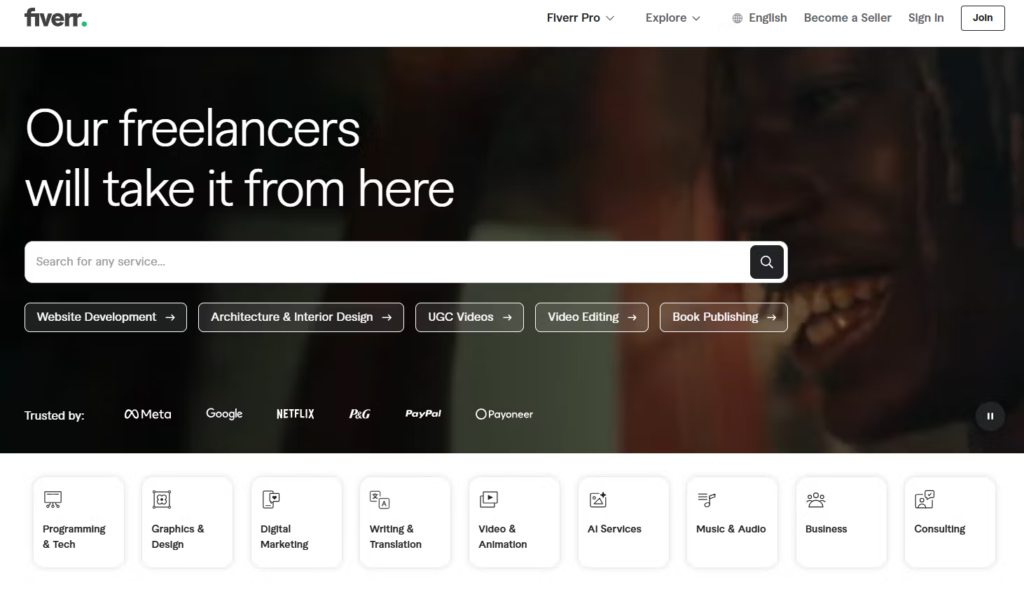
Regular Fiverr is the marketplace most people picture when they hear the name: millions of freelancers (“sellers”) across hundreds of categories, listing gigs that start as low as $5 and scale up based on scope, add-ons, and delivery speed. Anyone with a skill and an internet connection can open a seller account, publish a gig, and start accepting orders the same afternoon — there’s no formal approval process, no portfolio review board, and no minimum experience requirement.
That openness is exactly what makes Fiverr valuable for casual and budget-conscious buyers. It also means quality is uneven. Some sellers genuinely are excellent at their craft and simply haven’t built pricing power yet. Others are new, still learning, or juggling far more clients than they can realistically serve well. As a buyer, the burden of figuring out which is which falls on you — through reviews, portfolio samples, response times, and a bit of trial and error.
Key Traits of Regular Fiverr
- Open enrollment — anyone can become a seller without prior vetting
- Wide price range — from $5 micro-gigs to several-thousand-dollar packages
- Massive category coverage — over 700 service categories, from logo design to AI chatbot development
- Buyer-driven quality control — reviews, ratings, and seller levels (New Seller, Level 1, Level 2, Top Rated) are earned through performance on the platform itself
- Fast onboarding — you can post a request or message a seller within minutes of creating an account
What Is Fiverr Pro?
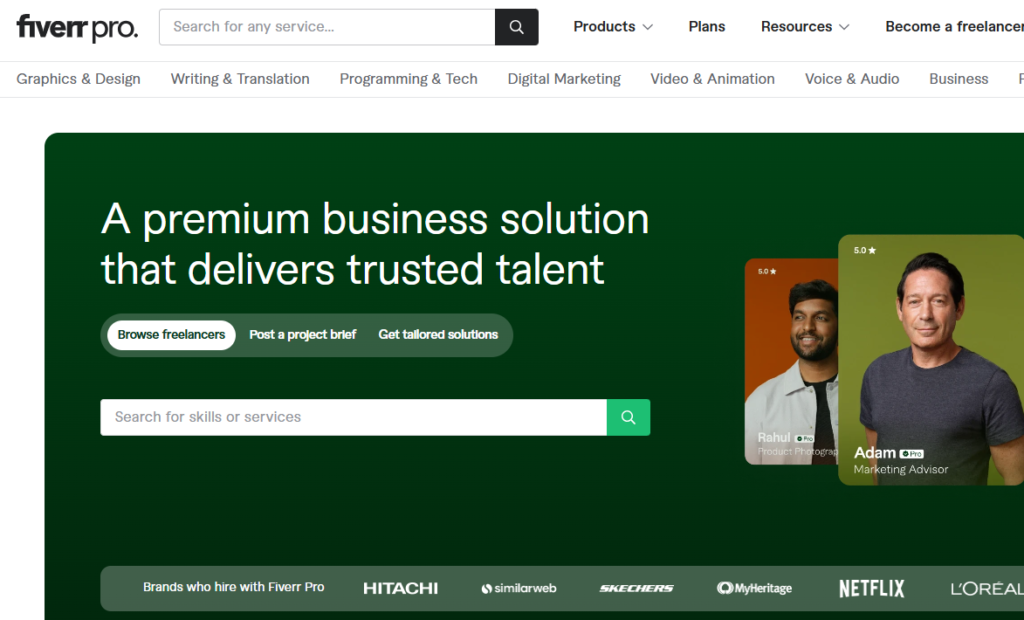
Fiverr Pro is Fiverr’s invitation-only tier for freelancers who’ve already proven themselves elsewhere. Instead of self-selecting into the marketplace, Pro applicants submit a portfolio, work history, and often client references, which Fiverr’s internal team manually reviews before granting the Pro badge. Depending on the category, the process can also include a skills assessment or a short interview.
The result is a much smaller, hand-picked pool of sellers who’ve already demonstrated real-world track records in fields like web development, branding, video production, AI/ML engineering, and enterprise-level marketing. Because the vetting bar is high, acceptance rates are low — industry estimates put Fiverr Pro approval somewhere in the single digits to low double digits of applicants, and that figure shifts depending on how saturated a given category already is.
For buyers, this translates into a shorter search, fewer surprises, and — in most cases — a dedicated account or success manager who can step in if a project gets complicated. For freelancers, it means access to clients with bigger budgets and less price sensitivity, in exchange for a tougher application and, often, stricter standards to maintain the badge.
Key Traits of Fiverr Pro
- Manual vetting — a real human reviews portfolios, work samples, and sometimes references before approval
- Higher price floor — Pro gigs typically start well above regular Fiverr pricing and can run several times higher for comparable work
- Smaller, curated pool — fewer sellers per category, but more consistent quality within that pool
- Business-oriented tools — team collaboration features, shared freelancer lists, and streamlined approval workflows
- Dedicated support — access to a success manager rather than relying solely on standard customer support
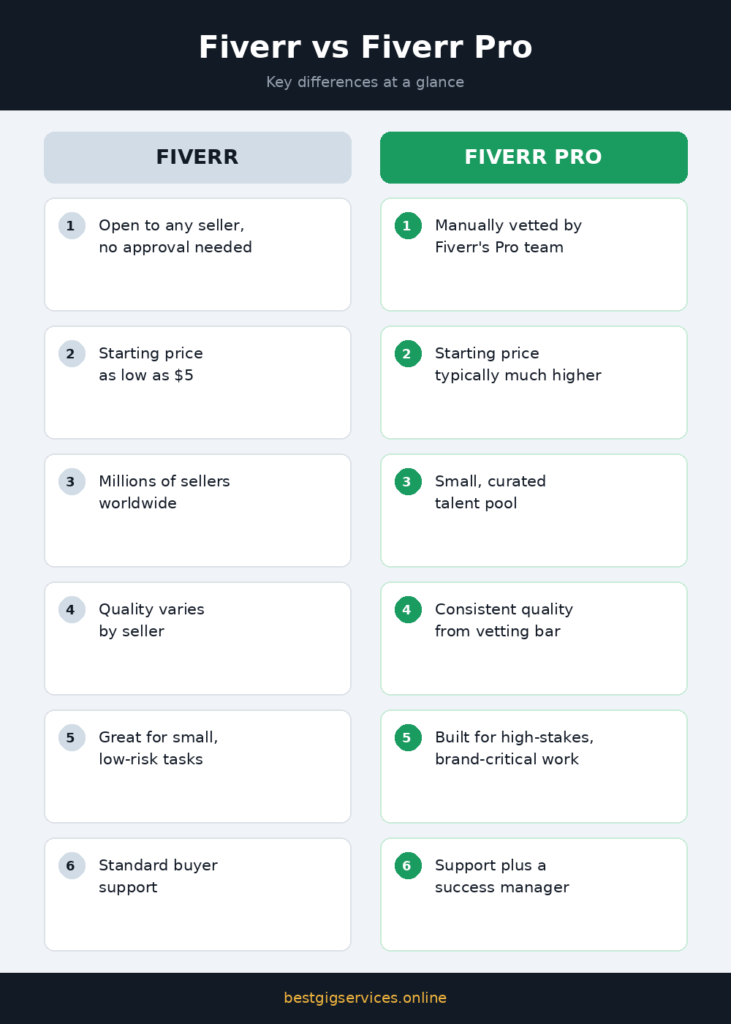
Fiverr vs Fiverr Pro: Side-by-Side Comparison
| Feature | Regular Fiverr | Fiverr Pro |
|---|---|---|
| Seller vetting | Open to anyone, no approval needed | Manual review, portfolio, and often an interview |
| Starting price | As low as $5 | Typically starts much higher, often several hundred dollars |
| Talent pool size | Millions of sellers worldwide | A curated, much smaller pool per category |
| Quality consistency | Varies widely; depends on the individual seller | Generally consistent due to the vetting bar |
| Best suited for | Small tasks, tight budgets, quick turnarounds | High-stakes projects, brand-critical work, enterprise needs |
| Support | Standard buyer support and dispute resolution | Standard support plus, in many cases, a success manager |
| Acceptance rate for sellers | No formal acceptance process | Roughly single digits to low double digits, depending on the category |
| Ideal buyer | Solopreneurs, startups, individuals | Agencies, growing companies, teams with bigger budgets |
How Fiverr Pro Vetting Actually Works
If you’re a freelancer wondering whether to apply, it helps to understand what actually happens behind the scenes. The process generally unfolds in a few stages:
- Application submission. You provide your professional background, a resume or CV-style summary, and links to previous work.
- Portfolio evaluation. Fiverr’s internal reviewers assess originality, professionalism, and whether your samples reflect genuine client work rather than practice pieces.
- Reference checks (category-dependent). For some fields, especially higher-ticket services, you may need to supply contact details for past clients who can confirm your work.
- Skills or technical assessment. Categories like development, translation, and copywriting sometimes include a graded test to confirm the claimed skill level.
- Interview (less common). A small percentage of applicants go through a live conversation with someone on Fiverr’s Pro team.
The entire cycle can take anywhere from about a week to well over a month, and Fiverr has increasingly leaned on third-party verification partners to handle parts of this review, which adds thoroughness but also adds time.
Pricing: Why Fiverr Pro Costs So Much More
The price gap between regular Fiverr and Fiverr Pro isn’t arbitrary — it reflects a different value proposition on both sides of the transaction.
On regular Fiverr, sellers compete largely on price and volume, especially at the lower end of the market. A $5 or $25 gig works because the seller can take on many similar orders quickly, often using templates or streamlined workflows. That model is great for buyers who need something simple and are comfortable managing quality themselves.
Fiverr Pro sellers operate differently. They typically take on fewer, larger projects, spend more time on discovery and revisions, and price their time closer to what they’d charge a direct client outside the platform. It’s not unusual for a Pro gig to cost three to ten times more than a comparable regular Fiverr listing, particularly in specialized fields like AI development, enterprise branding, or high-production video work.
The real question isn’t “which is cheaper” — it’s “which is cheaper for what I actually need.” A rushed $15 logo might be perfectly fine for a personal side project. That same shortcut on a funded startup’s brand identity could cost far more to fix later than it would have cost to do right the first time.
Who Should Use Regular Fiverr?
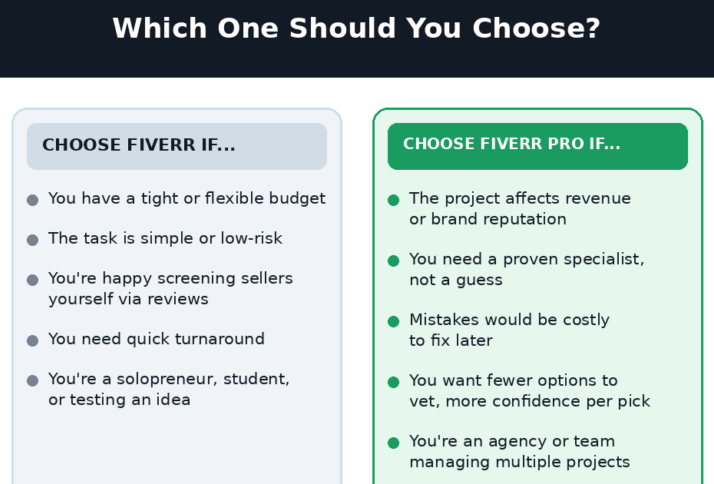
Regular Fiverr makes the most sense when:
- You’re working with a limited or flexible budget
- The task is relatively simple, well-defined, or low-risk if it needs a revision
- You’re comfortable screening sellers yourself using reviews, portfolios, and sample chats
- You need something quickly and don’t require ongoing collaboration
- You’re a solopreneur, student, or small business testing an idea before investing heavily
Think logo concepts for a side hustle, quick voiceover work, basic social media graphics, simple data entry, or a one-off blog post. These are tasks where the sheer size of the regular Fiverr marketplace works in your favor — you can compare dozens of sellers, negotiate directly, and find a good fit without paying a premium.
Who Should Use Fiverr Pro?
Fiverr Pro earns its price tag when:
- The project directly affects revenue, brand reputation, or a major launch
- You need a specialist with a proven, verifiable track record rather than an unknown quantity
- Mistakes or delays would be expensive to fix later
- You want fewer sellers to evaluate and more confidence in each one
- You’re an agency, funded startup, or marketing team managing multiple simultaneous projects and want reusable freelancer lists or a dedicated point of contact
Good examples include a full website rebuild, a production-ready AI chatbot with proper backend architecture, investor-pitch video production, or a complete brand identity system for a company preparing to scale. In these situations, the cost difference between Pro and regular Fiverr is often smaller than the cost of redoing the work if a rushed, unvetted seller gets it wrong.
Fiverr Pro vs Regular Fiverr for Freelancers
This comparison isn’t only about buyers — plenty of freelancers are trying to decide whether applying for Pro status is worth the effort.
Staying on regular Fiverr means you keep full control over your gig listings, pricing experiments, and category positioning without external approval. You can launch new gigs instantly, test different niches, and build your seller level (New Seller, Level 1, Level 2, Top Rated Seller) purely through your own performance metrics.
Applying for Fiverr Pro makes more sense once you already have a solid portfolio and want access to clients with bigger budgets who are specifically searching for vetted talent. The tradeoff is the application effort itself, the possibility of rejection, and — in many categories — the expectation that you maintain a higher standard of professionalism and responsiveness once you’re in.
Neither path is objectively “better.” A skilled freelancer without a Pro badge can still build a thriving business on regular Fiverr by focusing on a specific niche and delivering consistently great reviews. Pro status simply removes some of the friction of proving yourself to buyers who specifically want that reassurance upfront.
Common Misconceptions About Fiverr Pro
“Fiverr Pro sellers are always better than regular sellers.” Not necessarily. There are excellent, highly experienced sellers on regular Fiverr who simply haven’t applied to Pro, and there are Pro sellers whose specialty doesn’t perfectly match your specific project. The badge signals a vetting process was completed — it doesn’t guarantee a perfect fit every time.
“Fiverr Pro is a separate website.” It isn’t. Fiverr Pro sellers and gigs live within the same Fiverr platform and account system. You don’t need a separate login or a different app — Pro is simply a filtered, verified subset of the existing marketplace.
“Fiverr Pro has a monthly subscription fee.” For buyers, there’s no recurring membership cost to browse or hire Pro talent. You pay per project, the same pay-as-you-go structure used across the rest of Fiverr, just at Pro-level rates.
“You can just pay extra to get the Pro badge.” Badges aren’t purchasable. They’re earned through the application and vetting process described above, and Fiverr can revoke Pro status if a seller’s quality or responsiveness slips over time.
How to Decide: A Simple Framework
Ask yourself three questions before choosing between Fiverr and Fiverr Pro:
- What happens if this goes wrong? If a mediocre result is a minor inconvenience, regular Fiverr’s lower cost and larger selection make sense. If a poor result damages your brand, delays a launch, or requires a costly redo, the Pro premium is protecting you against a bigger loss.
- How much time can I spend vetting sellers myself? Regular Fiverr rewards buyers who are willing to compare portfolios, read reviews carefully, and message a few candidates before committing. Fiverr Pro shortcuts that process by front-loading the vetting work.
- What’s my actual budget ceiling? Be honest about whether you can absorb a price that’s several times higher than the regular marketplace rate. If not, regular Fiverr with careful seller selection is the more realistic path — and it’s entirely possible to get excellent results there with the right screening.
Final Verdict
Fiverr and Fiverr Pro aren’t competitors — they’re two tiers of the same ecosystem, built for two different situations. Regular Fiverr remains one of the most accessible ways to get affordable creative and technical work done, especially if you’re willing to do a bit of homework before hiring. Fiverr Pro trades that affordability for a shorter search and a much more consistent floor on quality, which matters most when the stakes of the project are genuinely high.
If you’re just starting out, testing an idea, or working with a tight budget, regular Fiverr gives you room to experiment without overcommitting. Once your project’s outcome starts to carry real financial or reputational weight, shifting that specific task over to Fiverr Pro is often the more cost-effective decision in the long run — even at a higher sticker price.
Real-World Scenarios: Which Tier Actually Wins
Numbers and feature lists only tell part of the story, so it helps to walk through a few realistic hiring situations and see how the decision plays out in practice.
Scenario 1: A solo Etsy seller needs product photo editing. This is a textbook case for regular Fiverr. The task is well-defined, the risk of a bad outcome is low (you can always request a revision or hire someone else for $10), and there are hundreds of qualified sellers who specialize in exactly this kind of work. Paying Pro-level rates here would be overkill — you’d be spending enterprise-level money on a task that doesn’t need enterprise-level guarantees.
Scenario 2: A seed-funded startup needs its entire brand identity built before a demo day pitch. This is where Fiverr Pro earns its premium. A logo, color system, and pitch deck template all need to look cohesive and credible in front of investors. A rushed or inconsistent result here doesn’t just cost money to fix — it can undercut the credibility of the pitch itself. Paying more for a vetted branding specialist with a proven portfolio is a rounding error compared to the funding on the line.
Scenario 3: A mid-size e-commerce brand wants a custom AI chatbot integrated into its checkout flow. Technical categories like AI and web development show some of the widest quality gaps between tiers. A regular seller might resell a template chatbot service with minimal customization, while a Pro-vetted developer is more likely to build a proper backend, handle edge cases, and document the work for future maintenance. Since a broken checkout experience directly costs sales, this is another situation where Pro’s higher floor pays for itself.
Scenario 4: A blogger needs twenty short product descriptions written by next week. Volume, speed, and a modest budget make this a clear fit for regular Fiverr. You can screen a handful of writers, check sample work, and likely find several who can deliver solid results well within budget. Fiverr Pro’s smaller talent pool and higher rates aren’t necessary for a task this straightforward.
Notice the pattern across these examples: the decision rarely comes down to “Fiverr is worse” or “Pro is always better.” It comes down to how much is riding on the outcome and how much time you’re willing to spend vetting sellers yourself.
Mistakes to Avoid When Choosing Between the Two
Even after understanding the differences, buyers and freelancers alike tend to make a few predictable mistakes when navigating these two tiers.
Assuming price alone signals quality. On regular Fiverr, a higher price doesn’t automatically mean a better seller — some sellers price aggressively simply because they’re new and building reviews. Always check the portfolio and recent feedback, not just the price tag.
Skipping the brief because “it’s just Fiverr.” Whether you’re hiring through the regular marketplace or Fiverr Pro, a vague brief produces vague results. Pro sellers can work with unclear instructions more gracefully because of their experience, but a clear, detailed brief will always get you a better outcome faster, regardless of tier.
Defaulting to Pro for every project “just to be safe.” This is the mirror image of the first mistake. Not every task needs a vetted specialist, and routinely overpaying for simple work eats into a budget that could fund more ambitious projects elsewhere.
Ignoring response time and communication style. A seller’s portfolio tells you about their skill; their responsiveness during the initial message exchange tells you about the experience you’ll have working with them. This applies equally on both tiers, though Pro sellers are generally held to a stricter communication standard by Fiverr itself.
Not reading the fine print on revisions. Revision policies vary by seller and package, not by tier. Before committing, always confirm how many revisions are included and what counts as a scope change versus a simple fix.
A Quick Note on Trust and Safety
Regardless of which tier you use, Fiverr’s core buyer protections apply platform-wide: secure payment processing, order-based communication logs, and a structured dispute resolution process if a delivery doesn’t match what was promised. Fiverr Pro doesn’t operate on a separate trust system — it simply adds a layer of pre-screening before a seller ever reaches your search results. That’s worth knowing if you’re weighing the two purely on a “which one is safer” basis; the honest answer is that both benefit from the same underlying platform protections, and the real difference is in how much pre-screening has already happened before you start browsing.
Frequently Asked Questions
Is Fiverr Pro worth the extra cost?
It depends on the project. For high-stakes work like web development, branding, or investor-facing content, the consistency Fiverr Pro provides often justifies the premium. For simple, low-risk tasks, regular Fiverr usually delivers comparable value at a fraction of the price.
Can regular sellers eventually become Fiverr Pro sellers?
Yes. Any seller can apply for Fiverr Pro once they have a strong enough portfolio and track record, regardless of how long they’ve been on the platform.
Does Fiverr Pro guarantee better results than regular Fiverr?
It significantly improves your odds of consistent quality because of the manual vetting process, but no marketplace tier can guarantee a perfect outcome on every single project. Clear briefs and good communication still matter on both tiers.
Is there a membership fee to access Fiverr Pro as a buyer?
No. There’s no subscription or membership cost to browse and hire Fiverr Pro talent. You pay per project, the same as anywhere else on the platform.
How much more expensive is Fiverr Pro compared to regular Fiverr?
Pricing varies by category, but it’s common to see Fiverr Pro gigs priced anywhere from a few times to around ten times higher than a comparable regular Fiverr listing, reflecting the seniority and vetting level of the sellers involved.
Disclosure: This post contains affiliate links. If you sign up or make a purchase through these links, we may earn a small commission at no extra cost to you. This helps support the free content on this site.