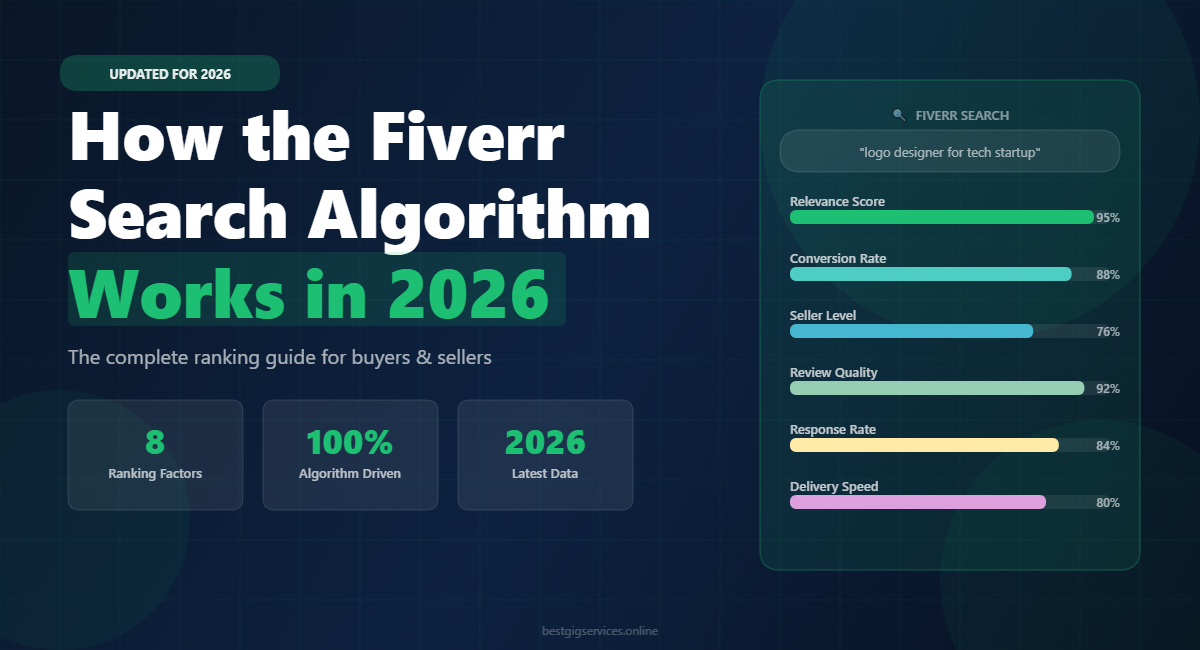
Discover exactly how the Fiverr search algorithm works in 2026. Learn the ranking factors, seller signals, and buyer strategies that determine which gigs appear at the top — and how to use them to your advantage.
If you have ever searched for a freelancer on Fiverr and wondered why certain gigs appear at the very top of results while others — sometimes with better reviews — are buried three pages deep, you are not alone. The answer lies inside Fiverr’s search algorithm, a sophisticated ranking engine that most buyers and sellers barely understand.
Whether you are a buyer trying to find the best possible freelancer quickly, or a seller trying to get your gig seen by the right people, understanding how the Fiverr search algorithm operates in 2026 gives you a meaningful edge. This guide breaks the entire system down — from the core ranking signals to buyer behavior patterns — in plain language, with no fluff.
Table of Contents
What Is the Fiverr Search Algorithm?
The Fiverr search algorithm is the automated system that decides which gigs appear — and in what order — when someone types a query into Fiverr’s search bar. Think of it as Fiverr’s version of Google: a ranking engine designed to match the most relevant, highest-quality gigs to each specific search query.
Fiverr has never published a complete, official breakdown of its ranking formula. What we know comes from years of seller community observation, pattern testing across thousands of gigs, Fiverr’s own public seller guidance, and how similar marketplace algorithms tend to work. The picture that emerges is a multi-factor system that weighs relevance, performance history, buyer experience, and platform behavior simultaneously.
The algorithm’s primary goal is not to reward the best sellers or the cheapest gigs. Its goal is to maximize successful transactions. Every time a buyer searches and finds a seller they are happy with, Fiverr earns revenue. The algorithm is tuned, above everything else, to make that outcome happen as often as possible.
The Core Ranking Factors on Fiverr in 2026
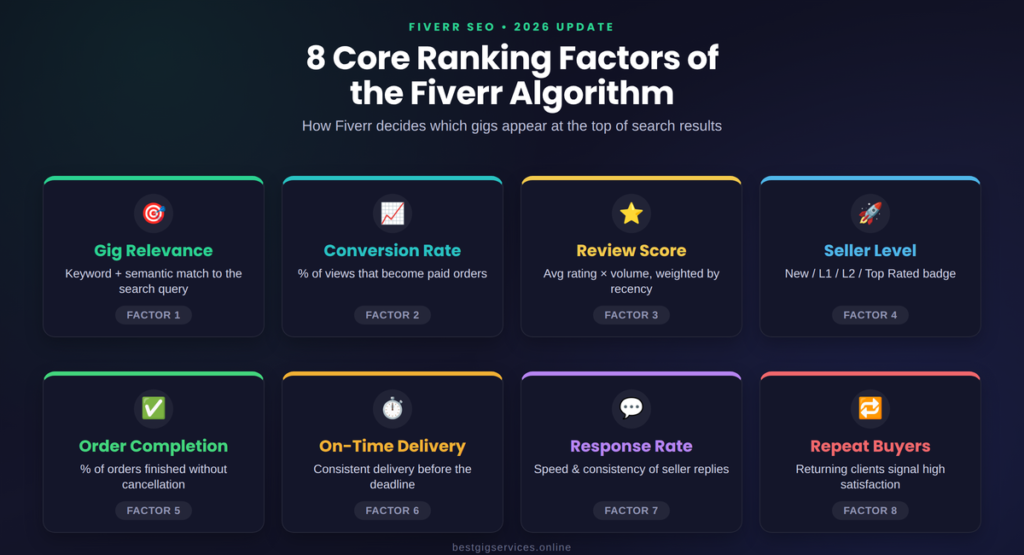
1. Gig Relevance to the Search Query
The most fundamental factor is how well your gig matches what the buyer typed. Fiverr’s algorithm reads the text across your gig title, description, tags, and category — and compares it against the search query to determine relevance.
This is not just keyword matching. Fiverr uses semantic understanding, meaning the algorithm recognizes related concepts even when the exact words do not match. If someone searches for “product description writer,” a gig titled “e-commerce copywriter for Amazon and Shopify listings” can still rank well because the algorithm understands the contextual relationship.
What this means for buyers: Using specific, descriptive search terms returns far more relevant results than broad, generic ones. Instead of searching “designer,” try “minimalist logo designer for tech startups.” The algorithm reads your query deeply.
What this means for sellers: Every word in your gig title, description, and tags is an opportunity to establish relevance. Do not stuff keywords — write naturally for buyers, with the understanding that natural, specific language also signals relevance to the algorithm.
2. Gig Performance History
Once a gig has been live for some time, its performance history becomes one of the most powerful ranking signals. Fiverr’s algorithm tracks a range of performance metrics over a rolling time window — not just all-time totals — meaning recent behavior matters more than older history.
Key performance metrics tracked:
- Order completion rate: The percentage of orders started that were successfully completed without cancellation. Cancellations — even mutual ones — hurt this metric and can significantly drop gig visibility.
- On-time delivery rate: Whether orders are delivered before the deadline. Consistently late deliveries are treated by the algorithm as a signal of poor service quality.
- Seller response rate: How quickly and consistently a seller responds to buyer messages. A high response rate signals availability and professionalism.
- Review score and volume: Both the average star rating and the total number of reviews matter. A gig with a 4.8 average from 300 reviews is treated differently from a gig with a 4.8 average from 8 reviews.
- Repeat buyer rate: When a buyer comes back to order from the same seller again, Fiverr reads this as a strong quality signal. Algorithms across every major marketplace treat repeat purchases as meaningful validation.
3. Conversion Rate
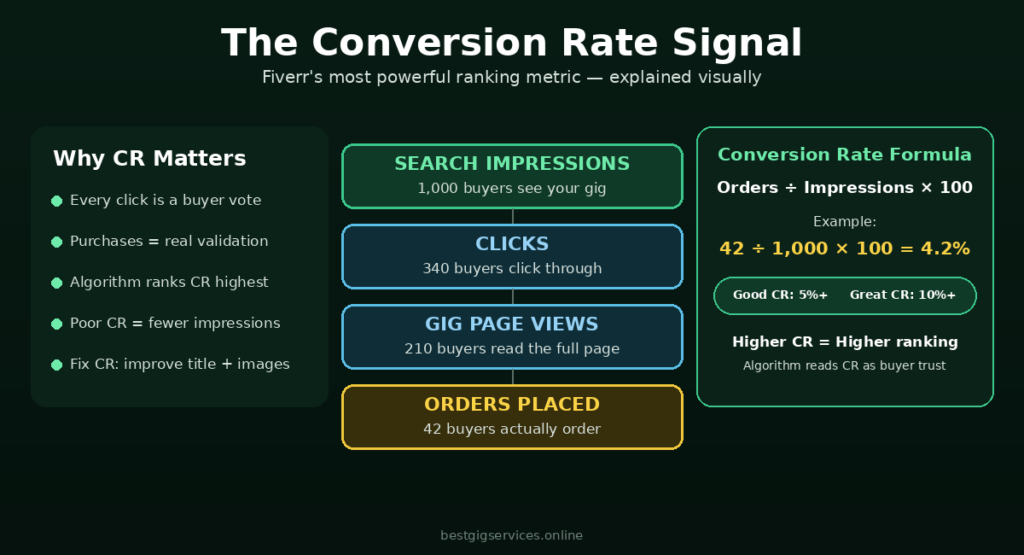
Conversion rate — the percentage of people who view a gig and then actually place an order — is arguably the most important signal the algorithm uses to evaluate quality. It is the clearest market signal available: buyers who click, read the gig, and still place an order are voting with their wallet.
Fiverr tracks impressions (how often your gig appears in search), clicks (how often buyers click through to your gig page), and orders (how often those clicks become purchases). A gig that gets clicked often but ordered rarely signals something is misaligned — pricing, description, or portfolio quality.
From a buyer’s perspective, the algorithm is essentially crowdsourcing quality assessment. Gigs that many different buyers convert on — independent of each other — are elevated in results because they consistently produce confident purchase decisions.
4. Fiverr Seller Level
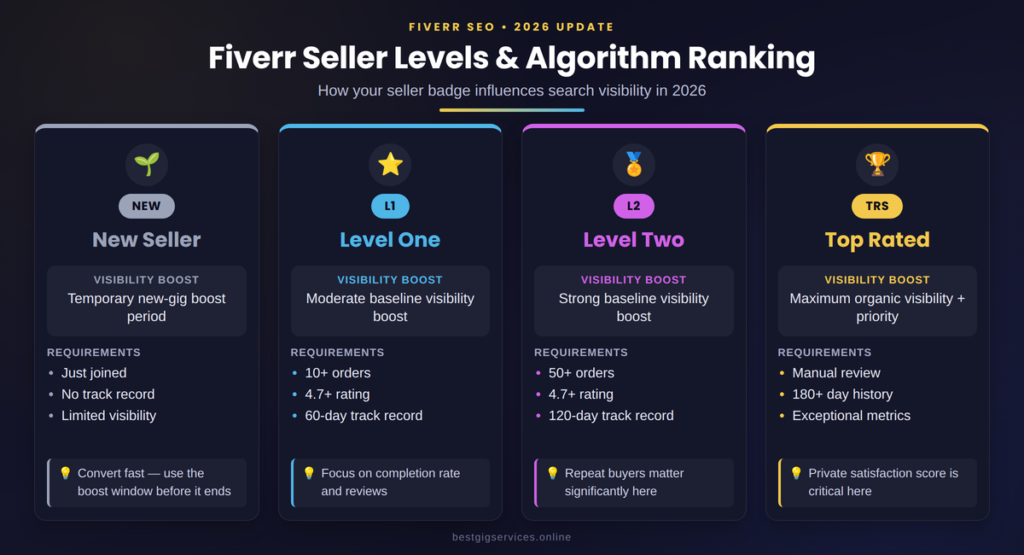
Fiverr’s seller level system — New Seller, Level One, Level Two, and Top Rated Seller — feeds directly into the algorithm. Higher-level sellers receive a baseline visibility boost because their level badge represents a verified track record of performance.
However, seller level alone does not guarantee top ranking. A Level Two seller with a declining order completion rate and mixed recent reviews will often rank below a Level One seller who has strong recent performance across all metrics. The algorithm is dynamic: it rewards current behavior, not past achievement.
5. Buyer Satisfaction Signals (Public and Private)
Beyond the star rating visible on every gig, Fiverr collects private buyer satisfaction data that never appears publicly. After every completed order, buyers are asked internal satisfaction questions that Fiverr uses to calibrate its rankings — independent of whether the buyer leaves a written review.
This private feedback layer means a seller could have a 4.9 public rating while their private satisfaction score is lower — and the algorithm will reflect the private score. Consistently delivering work that genuinely delights buyers, rather than just avoiding negative public reviews, is the only reliable strategy.
6. Gig Freshness and Activity
The algorithm applies a freshness signal: gigs that have recent activity — new orders, new reviews, recent updates — are treated as more relevant than gigs that have gone dormant. Sellers who go weeks without any orders or who have not updated their gig in months tend to see gradual ranking erosion.
This is why many successful sellers periodically refresh their gig description, update their portfolio samples, or add new FAQ entries — not just to improve content, but to signal ongoing activity to the algorithm.
7. Promoted Gigs (Paid Placement)
Since Fiverr introduced its Promoted Gigs advertising system, paid placement has become a visible part of search results. Gigs with an active promotion budget appear at the top of certain search pages with a small “Sponsored” label.
Importantly, promoted gigs still need to convert well to remain cost-effective. Fiverr’s promotion system uses a cost-per-click model, and sellers who pay for clicks but convert poorly end up spending money without benefit. The algorithm essentially lets you buy visibility — but quality still determines whether that visibility translates into orders.
For buyers, knowing that some top-positioned results are promoted means it is always worth scrolling past the first row to compare both promoted and organically ranked options.
8. Buyer Search Behavior and Personalization
One of the more sophisticated elements of Fiverr’s 2026 algorithm is personalization. The search results a buyer sees are not identical for every user typing the same query. Fiverr adjusts results based on:
- Previous search and purchase history: If you have previously hired for web design work, design-related gigs may appear earlier in unrelated searches.
- Budget range of past orders: Buyers who have consistently ordered premium packages may see higher-priced gigs surfaced more prominently.
- Location and language: Fiverr adapts results based on the buyer’s region, surfacing sellers who have served buyers from similar markets successfully.
- Time of day and device: Fiverr collects behavioral data at this level of granularity to optimize match quality.
This personalization layer means two buyers searching for the exact same phrase may see notably different top results — and both sets of results are technically “correct” from the algorithm’s perspective.
How Fiverr Handles New Seller Gigs
A common frustration among new sellers is that their gigs receive almost no impressions initially, making it nearly impossible to build the performance history the algorithm rewards. Fiverr is aware of this cold-start problem and addresses it in two ways.
First, new gig listings receive a temporary boost period — often called the “new gig boost” in seller communities — where the algorithm surfaces them in search results to gather initial performance data. This period typically lasts a few days to a couple of weeks. During this window, a gig’s click and conversion behavior is analyzed to project its ranking potential.
Second, Fiverr places new sellers in a dedicated “New Arrivals” filter that buyers can access when searching. This filter specifically surfaces recently listed gigs, giving new sellers a targeted audience of buyers who intentionally want to discover fresh talent.
The implication for new sellers is clear: the new gig boost window is critical. A gig that converts well during this initial exposure period gets elevated into organic rankings. A gig that generates clicks but no orders during this window is deprioritized.
Fiverr’s Category and Subcategory Ranking
Fiverr’s search algorithm operates slightly differently depending on whether a buyer uses the search bar or browses through categories. When browsing by category, the algorithm emphasizes category-specific performance signals — meaning a gig’s performance within its specific subcategory matters more than its overall Fiverr performance.
A graphic designer who ranks on the first page within “Minimalist Logo Design” may not rank on the first page within the broader “Logo Design” category, because the competition pool and performance benchmarks differ significantly between them.
For buyers, this means that narrowing your search to a specific subcategory often surfaces more relevant specialists than a broad category browse would. For sellers, being precisely positioned in the correct subcategory — rather than the most popular one — often produces better ranking outcomes.
The Role of Gig Packages and Pricing in Rankings
Pricing is a subtler ranking signal than most people expect. Fiverr does not simply favor cheap gigs or expensive ones. Instead, the algorithm examines pricing relative to conversion rate within a given search context.
A gig priced at $200 that converts at 12% may outrank a $20 gig that converts at 4% — because the $200 gig is generating higher-value transactions at a rate that satisfies more buyers. Fiverr’s revenue increases when higher-value orders close, and the algorithm reflects that commercial reality.
However, gigs that are dramatically overpriced relative to their category norm will see reduced impressions because the algorithm anticipates lower conversion probability. Pricing sweet spots exist within every subcategory, and sellers who study what their successfully ranking competitors charge tend to find them faster.
How Fiverr Pro Affects Search Results
Fiverr Pro is a curated tier of vetted, agency-quality sellers. When a buyer applies the “Pro” filter to search results, they enter a separate ranking environment where the base pool is restricted to Pro-verified sellers and the ranking signals shift accordingly.
Within Pro search, the conversion rate and repeat buyer signals carry even greater weight, because the baseline expectation of quality is already elevated. Pro sellers who consistently maintain high order values and repeat client relationships dominate Pro search results in ways that parallel how overall performance shapes standard search.
For buyers who need high-stakes deliverables, filtering by Pro is a reliable way to access talent that has been independently verified — and the algorithm within that filtered environment still differentiates meaningfully between Pro sellers.
What the Fiverr Algorithm Does NOT Care About
Understanding what the algorithm ignores is just as useful as understanding what it rewards.
Age of the gig: An older gig does not automatically outrank a newer one. What matters is recent performance, not longevity. A six-month-old gig with strong conversion rates will outrank a three-year-old gig with declining metrics every time.
Number of gigs a seller has: Having ten active gigs does not dilute or amplify the ranking of any individual gig. Each gig is evaluated independently based on its own performance signals.
Price alone: As discussed above, the algorithm does not favor cheap gigs as a rule. Conversion rate within pricing context matters more than the price itself.
Profile bio length or seller social media following: These external signals have no documented effect on Fiverr’s internal ranking system. Buyers arrive on Fiverr to hire within the platform, and the algorithm is built entirely around on-platform behavior.
How Fiverr Buyers Can Use Algorithm Knowledge to Search Better
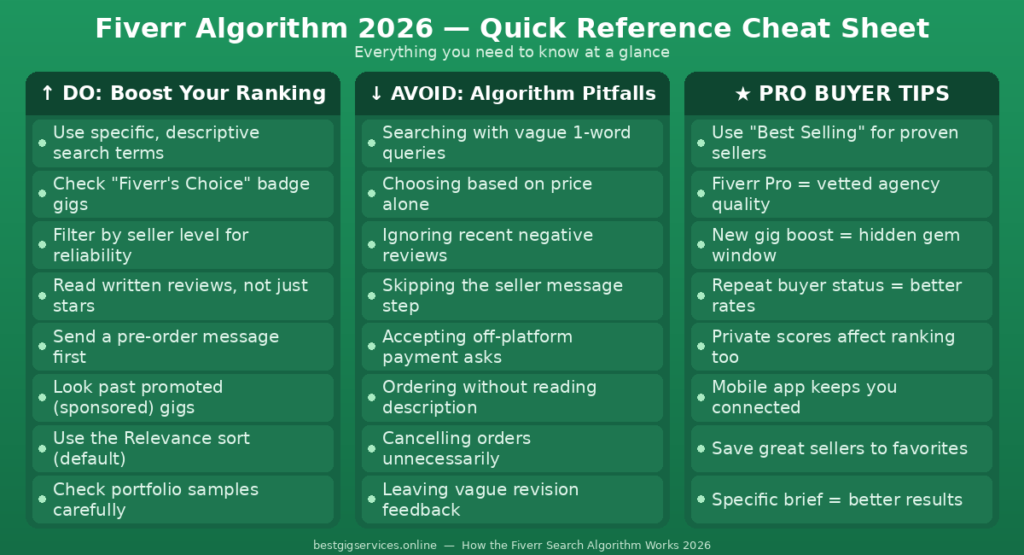
Understanding the algorithm gives buyers a practical edge when searching for freelancers.
Use specific, multi-word queries. The algorithm’s semantic matching rewards specific language. “E-commerce product photographer with white background” will surface more relevant gigs than “photographer.”
Check the “Recently Ordered” social proof. Gigs that display recent order activity are showing you real-time algorithm validation — other buyers are choosing them right now.
Look past the first row of results. The top two or three results on any given page often include promoted gigs. Scroll down to find organically ranked options and compare them directly.
Use filters strategically. The seller level filter, delivery time filter, and budget range filter all help the algorithm narrow results to your actual requirements. Using them produces more relevant matches than browsing unfiltered results.
Pay attention to “Fiverr’s Choice” badges. Fiverr algorithmically awards this badge to gigs that demonstrate exceptional performance across multiple metrics simultaneously. Gigs carrying this badge have been validated by the algorithm itself as top performers in their category.
The Buyer Side of the Algorithm: How Your Behavior Shapes Results
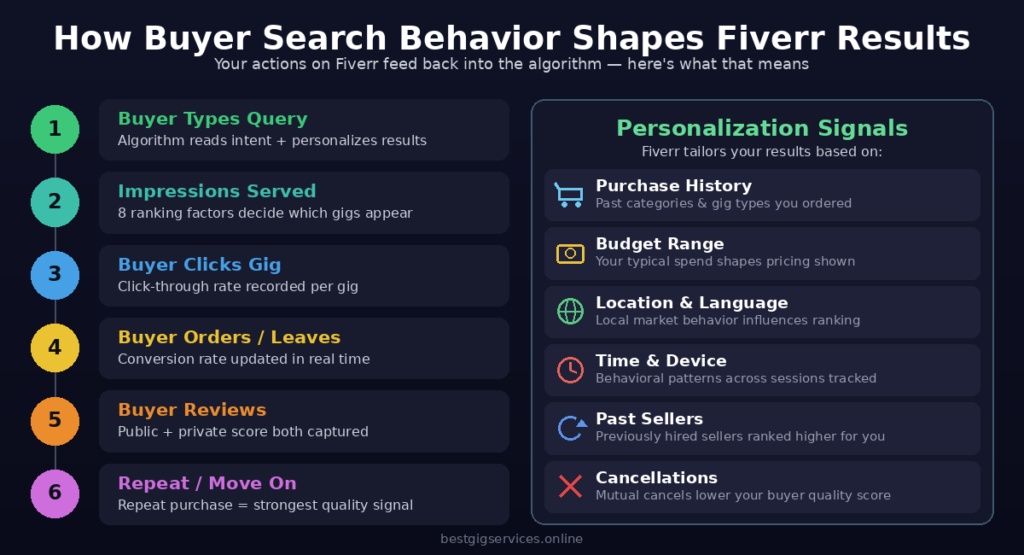
Most buyers do not realize that their own behavior on Fiverr feeds back into the algorithm — shaping their future search results and contributing to how gigs are ranked for other buyers.
Every time you click a gig, how long you spend reading it, whether you send a message or leave without action, whether you complete an order or cancel it — all of this behavioral data is collected and used. Fiverr builds a buyer profile that influences future personalized results.
Buyers who tend to order quickly, approve deliveries without lengthy revision cycles, and leave positive reviews are algorithmically considered “high-quality buyers.” Some sellers can actually see indicators of buyer quality before accepting custom orders. In a real sense, being a clear, decisive, fair buyer puts you in a better position when approaching top sellers.
Fiverr’s “Relevance” vs. “Best Selling” Sort Order
When you search on Fiverr, the default sort order is “Relevance” — which applies the full multi-factor algorithm described throughout this guide. But Fiverr also offers a “Best Selling” sort option.
Best Selling is not the same as the default relevance ranking. It sorts results primarily by total order volume over a recent period, which tends to surface established sellers with high sales counts. The downside of this sort for buyers is that it can overlook newer sellers who are delivering excellent work but have not yet accumulated mass volume.
For most buyer use cases, the default Relevance sort produces better personalized matches. Best Selling is most useful when you want to see which gigs the market has collectively validated at the highest volume — useful for finding safe, proven options in commodity categories.
Algorithm Changes to Expect Beyond 2026
Fiverr’s algorithm is not static. Based on the direction the platform has been moving, several trends are worth understanding as you plan your buying or selling strategy.
AI-powered match quality. Fiverr has been investing heavily in AI infrastructure. Future algorithm iterations will likely use more sophisticated natural language understanding to match buyer intent to seller expertise — going beyond keyword relevance into deeper comprehension of project requirements.
Video gig previews as a ranking signal. Fiverr has been encouraging sellers to add video introductions to their gig listings. As engagement data accumulates, gig videos that drive higher watch-through rates and clicks will likely become a formal ranking factor.
Verified skill badges. Fiverr has introduced skill assessments that sellers can take to earn verified badges in specific competencies. As this system matures, having verified skills in your gig’s core competency area is expected to contribute a positive ranking signal.
Sustainability of satisfaction. The trend across all major gig platforms is toward measuring long-term buyer satisfaction — tracking whether the delivered work actually served the buyer’s goal weeks or months later. Fiverr’s algorithm will likely incorporate longer-horizon satisfaction signals as its data infrastructure develops.
Practical Takeaways for Buyers in 2026
The Fiverr algorithm is sophisticated, but once you understand its logic, navigating it becomes intuitive. Here is a summary of what matters most when you sit down to find a freelancer:
The algorithm is built to surface gigs that convert well, satisfy buyers consistently, and deliver on time — which means the top results you see in any search are not random. They have been tested by real buyers in real transactions, repeatedly. That gives you a foundation of market-validated quality to work from.
At the same time, the algorithm is not perfect. Newer sellers with genuine talent can be buried in early stages. Promoted gigs can appear at the top regardless of organic quality. And personalization means the “right” result for someone else might not be the right result for your specific project.
The best approach combines algorithmic signals — seller-level, review count and quality, Fiverr’s Choice badges, recent order activity — with your own judgment: reading gig descriptions carefully, viewing portfolio samples, and sending a brief message before committing to an order.
Used together, these two layers give you the clearest possible picture of which freelancer is genuinely best suited to your project — and that is exactly what the Fiverr search algorithm is ultimately trying to help you find.
Final Thoughts
The Fiverr search algorithm in 2026 is a layered, performance-driven system that rewards relevance, consistent quality, buyer satisfaction, and ongoing activity — in that order of priority. It is designed not to highlight the cheapest or the oldest gigs, but to surface the ones most likely to result in a successful, satisfying transaction for both parties.
Understanding this system does not require technical expertise. It requires knowing what signals matter, how to read the evidence the algorithm surfaces through labels, badges, and sort orders, and how to supplement that data with your own direct evaluation of sellers.
Whether you are browsing Fiverr as a buyer looking for your next freelancer, or as a seller trying to understand why your gig ranks where it does, the framework in this guide gives you a more complete picture than most people ever develop. Use it well, and your Fiverr experience — in either role — will be measurably better for it.